BALLAST is live on @RobinhoodCrypto .
A launchpad where a project can hold a treasury of tokenized real-world assets, and anyone can read exactly how much, per token, live.
Every token is worth whatever the next buyer pays. That’s the whole model everywhere else — bonding curves exist because there’s nothing underneath to price against. It works until attention leaves. In July the largest launchpad on this chain collected around $12 million in fees, stopped launching tokens, and went quiet two days later. Nobody saw it coming because there was nothing to see.
Robinhood Chain is the only chain where that doesn’t have to be true. Tokenized equities and Chainlink feeds are native here, so one number becomes possible:
backing per token = treasury assets × live price ÷ total supply
Ten assets are available as treasury collateral — T-bills, and nine equities and ETFs including NVDA, TSLA, GOOGL and SPY.
Some things that follow from taking this seriously:
Creators receive zero allocation. 100% of supply seeds the pool. No presale, no team bag. You earn from the swap fee or you earn nothing.
Withdrawals are announced before they happen. A creator can take back only what they deposited, only after announcing it publicly, and only after a delay fixed at deploy time that cannot be changed afterwards. Assets deposited by anyone else are locked permanently.
Ballast is not a claim. Holding a token gives you no right to those assets. No redemption. Not a price floor — a token can and will trade below its backing. Not our opinion of the project. We report the number. We do not vouch for anyone.
Projects without a treasury can launch too, with an empty one and a label saying so. That’s not a warning, it’s a fact stated the same way a full treasury is.
This is unaudited code holding real value. Four assumptions that would have broken it were each verified by execution rather than assumed — whether a contract can custody a stock token, how the price feeds actually behave, how this chain’s modified router encodes a swap, and whether the fee lands where it should. That is not the same as an audit. Treat it accordingly.
https://t.co/iMpz84RTQQ
Every token is worth whatever the next buyer pays.
That isn't cynicism, it's the mechanism. Bonding curves exist because there is
nothing underneath to price against, so the market invents a price out of
attention alone. It works, and it works well, right up until the attention
leaves.
In July 2026 the largest launchpad on @RobinhoodCrypto collected roughly $12 million in fees, stopped launching tokens, and went quiet two days later. The memecoin driving most of its activity fell by a third inside a day. Nobody saw
it coming, because there was nothing to see.
You cannot audit a vibe.
- Why this chain is different
Robinhood Chain launched in July 2026 as an @arbitrum Orbit L2. What makes it
unusual isn't the rollup — it's that around ninety-five tokenized equities and
ETFs are native to it, each with a @chainlink price feed.
That combination doesn't exist anywhere else. @base doesn't have it. @solana
doesn't have it. And it makes one number possible that no other launchpad can
produce:
backing per token = treasury assets × live price ÷ total supply
A project deposits real tokenized assets — treasury bills, equities — into a
contract. BALLAST reads that contract, prices it against @chainlink, and shows
the result on every card, every chart, every portfolio row. Live, timestamped,
and verifiable by anyone without asking us.
This is not curation. It is not a rating. It is arithmetic on public data.
Ten assets are currently available as treasury collateral: $SGOV for T-bills,
and $NVDA, $TSLA, $GOOGL, $AAPL, $MSFT, $AMZN, $META, $SPY and $QQQ.
- What it is not
This section matters more than the pitch, and it belongs near the top rather
than buried in a footer.
Ballast is not a claim on anything. Holding a token gives you no right to
the assets in its treasury. There is no redemption. There is no mechanism to
exchange a token for what sits behind it, and there never will be.
Ballast is not a price floor. A token can and will trade below its backing.
Ballast is not a promise of return. Projects fail. Assets fall. Treasuries
shrink.
And ballast is not our opinion of the project. We report the number. We do
not vouch for anyone.
There is one more, specific to how launches work here. At launch, a project's
liquidity is seeded starting at its backing price and extending upward, with
nothing below. So in the first trades the token cannot print below its backing
in that pool — not because the price is supported, but because nobody has
placed a bid there yet. The protocol spends nothing to hold the price and never
will. Anyone can add liquidity below at any time, and once they do, the token
can and will trade below its backing. Do not read the launch state as a floor.
- What follows from taking that seriously
Creators receive zero token allocation. One hundred percent of supply seeds
the pool. No presale, no team bag, no founder allocation. A creator earns from
the swap fee or earns nothing.
This is the part founders arriving from other launchpads find strangest.
Elsewhere a 25% team allocation with vesting is standard, and some platforms
let a creator pre-buy half the supply before anyone else. Here there is no
founder bag to dump, because there is no founder bag.
Withdrawals are announced before they happen. A creator can take back only what they themselves deposited, only after announcing it publicly, and only
once a delay fixed at deploy time has passed. That delay — seven, thirty or
ninety days — is chosen by the creator at launch and cannot be changed
afterwards. The choice is public, which makes it a costly signal: a creator who
picks ninety days has genuinely tied up their own liquidity.
Assets deposited by anyone other than the creator are locked permanently and
cannot be withdrawn by anyone, including us.
BALLAST v2 — what’s being built
Buyback and burn. The platform’s share of swap fees will buy $BALLAST on the open market and destroy it. There’ll be a public page listing every burn with its transaction, plus the burn address so you can check the total on Blockscout without asking us. Creators get the same option for their own token.
Five more treasury assets, including $HOOD. Robinhood’s own equity, as collateral for a token on Robinhood Chain. Each feed gets verified individually before it goes in — canonical address, Standard proxy, decimals read rather than assumed. One wrong feed would corrupt every backing figure on the platform, so this part goes slowly.
Everything live. On-chain reads every 12 seconds, volume and holders and trades every 30. Each figure will carry its source and how old it is. Where a source is down it says unavailable rather than showing you a zero.
The interface, rebuilt. This is the most common thing people tell me, and they’re right. Every screen redone, with a designed state for loading, empty and error instead of a blank.
None of it is shipped. This is what’s being built, not what exists — and it’s the honest version of a roadmap post, which usually reads the other way round.
Happy holiday ballasted 🐳
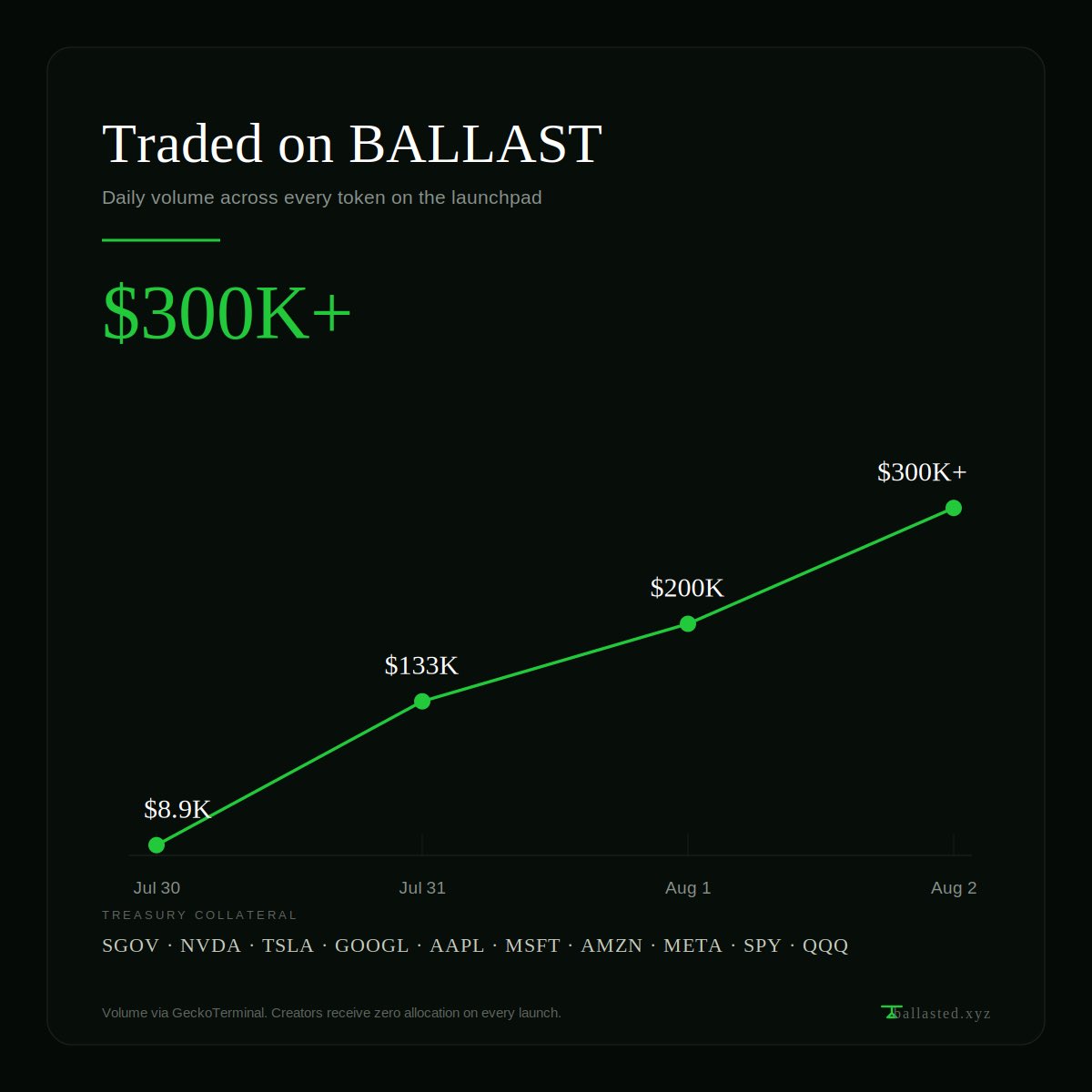
$300,000+ traded across @ballastedapp.
Four days ago it was $8.9K, and every token on the platform was mine.
The thing that hasn’t changed as the number moved: no creator on this launchpad holds a token. 100% of supply seeds the pool at launch, LP locks permanently, and there is no allocation mechanism in the contracts to opt into. Not one of those trades bought a founder’s bag.
Ten tokenized assets can back a launch — $SGOV, $NVDA, $TSLA, $GOOGL, $AAPL, $MSFT, $AMZN, $META, $SPY, $QQQ. Deposit any of them and your backing per token shows on your page, priced live by Chainlink.
Still true: unaudited, and total ballast is $0 because nobody has funded a treasury yet. Volume grew. That number didn’t.
https://t.co/dEiWKhsYwE
Honestly, for a lot of devs you shouldn’t.
If you want a team allocation, a presale, or to pre-buy your own supply, other pads do that and there’s nothing wrong with wanting it. We can’t offer it — the contracts have no allocation mechanism at all.
Three reasons to pick us anyway:
You can’t rug, so nobody can accuse you of planning to. 100% of supply seeds the pool, LP locks permanently at launch, and you hold none of it. That’s an argument your community can verify in a block explorer instead of taking your word for it.
If you hold real assets, you can prove it. Deposit tokenized T-bills or equities into your treasury and backing-per-token appears on your page, priced live by Chainlink. Most pads give you no way to show you have anything behind you, so you end up sounding like the project that raised nothing.
Our incentives point the same way as yours. We take no launch fee. We earn 35% of a 1% swap fee, so a thousand dead launches earn us nothing. We only make money if people actually want what you built.
Every token is worth whatever the next buyer pays.
That is the whole model. Bonding curves exist because there is nothing underneath to price against — so the market invents a price out of attention alone.
It works until attention leaves. In July, the largest launchpad on Robinhood Chain collected roughly $12 million in fees, stopped launching tokens, and went quiet two days later. Nobody could see it coming, because there was nothing to see.
You cannot audit a vibe.
There are now more launchpads on @RobinhoodCrypto than the chain has weeks of existence, and the reaction to that is fair. I build one of them, so read this accordingly.
The complaint I keep seeing is that platforms arrive, take a share of a community that isn’t theirs, and leave the chain more fragmented than they found it. @Noxa_Fi already cost this chain its trust once. Watching several new pads appear in a fortnight, one of them from a partner that positioned itself as something else entirely, is not paranoia. It’s pattern recognition.
So let me say where @ballastedapp sits, without pretending we’re outside the crowd.
We’re new here too. Four launches. Two of them ours. Total ballast $0 — the mechanism this whole thing exists for has not been used by anyone yet. Unaudited code holding real value. @ponsdotfamily does more volume in an hour than we’ve done in total, and that’s not modesty, it’s the number.
What we’re not doing is competing for the same thing. A memecoin pad and this are different products that happen to share a category name. @ponsdotfamily is the leader in launching tokens fast and it deserves that position. We’re trying to answer a narrower question: can a token be measured against something other than attention?
On this chain it can, because tokenized equities and @chainlink feeds are native. A project deposits real assets — T-bills, $NVDA, $SPY — into a treasury contract, and we read it, price it live, and put backing-per-token on the card beside the market price. Not a rating. Not curation. Arithmetic on public data.
The structural parts, since those are what the complaints are actually about:
Creators receive zero allocation. 100% of supply seeds the pool. No presale, no team bag, no pre-buy — there’s no mechanism in the contracts to opt into. Nobody can dump a founder bag because nobody has one.
LP is locked permanently at launch, before anyone can trade.
Treasury withdrawals must be announced publicly and then wait out a delay the creator fixed at launch and can never change. Seven, thirty, or ninety days. Anything deposited by anyone other than the creator is locked permanently — including from us.
No treasury empties overnight. Not because we promise it. Because the contract won’t execute it.
Coming next week: platform fees routed into buying back and burning $BALLAST, with the burn address published so anyone can verify the total. The same option for creators — route your fee share into buying back your own token instead of claiming it, your choice per launch, shown on your page either way. Website and X verification via public post rather than OAuth, because OAuth proves control to us and you’d have to take our word for it. Multi-asset treasuries. More of the roughly 56 @chainlink feeds on this chain, added one at a time after each is checked individually.
What I think this chain actually needs, beyond us:
A shared token list, so every interface shows the same names and logos and impostor tokens have nowhere to hide. That costs nothing and no single pad should own it.
Independent measurement. @ponsdotfamily publishes analytics through @Dune, which is more credible than any of us reporting our own numbers. More of that.
And launchpads publishing their failures. I shipped a broken price-freshness gate and had to redeploy the factory. Our own token page once claimed a change happened before any trading when trading had already occurred, and we corrected it with a date. A chain that has been burned once learns more from those posts than from another launch announcement.
The chain being taken seriously helps everyone on it, including the pads we’re supposedly fighting. Rivalry between projects nobody has heard of yet helps nobody.
https://t.co/iMpz84RTQQ
BALLAST is live on @RobinhoodCrypto .
A launchpad where a project can hold a treasury of tokenized real-world assets, and anyone can read exactly how much, per token, live.
Every token is worth whatever the next buyer pays. That’s the whole model everywhere else — bonding curves exist because there’s nothing underneath to price against. It works until attention leaves. In July the largest launchpad on this chain collected around $12 million in fees, stopped launching tokens, and went quiet two days later. Nobody saw it coming because there was nothing to see.
Robinhood Chain is the only chain where that doesn’t have to be true. Tokenized equities and Chainlink feeds are native here, so one number becomes possible:
backing per token = treasury assets × live price ÷ total supply
Ten assets are available as treasury collateral — T-bills, and nine equities and ETFs including NVDA, TSLA, GOOGL and SPY.
Some things that follow from taking this seriously:
Creators receive zero allocation. 100% of supply seeds the pool. No presale, no team bag. You earn from the swap fee or you earn nothing.
Withdrawals are announced before they happen. A creator can take back only what they deposited, only after announcing it publicly, and only after a delay fixed at deploy time that cannot be changed afterwards. Assets deposited by anyone else are locked permanently.
Ballast is not a claim. Holding a token gives you no right to those assets. No redemption. Not a price floor — a token can and will trade below its backing. Not our opinion of the project. We report the number. We do not vouch for anyone.
Projects without a treasury can launch too, with an empty one and a label saying so. That’s not a warning, it’s a fact stated the same way a full treasury is.
This is unaudited code holding real value. Four assumptions that would have broken it were each verified by execution rather than assumed — whether a contract can custody a stock token, how the price feeds actually behave, how this chain’s modified router encodes a swap, and whether the fee lands where it should. That is not the same as an audit. Treat it accordingly.
https://t.co/iMpz84RTQQ