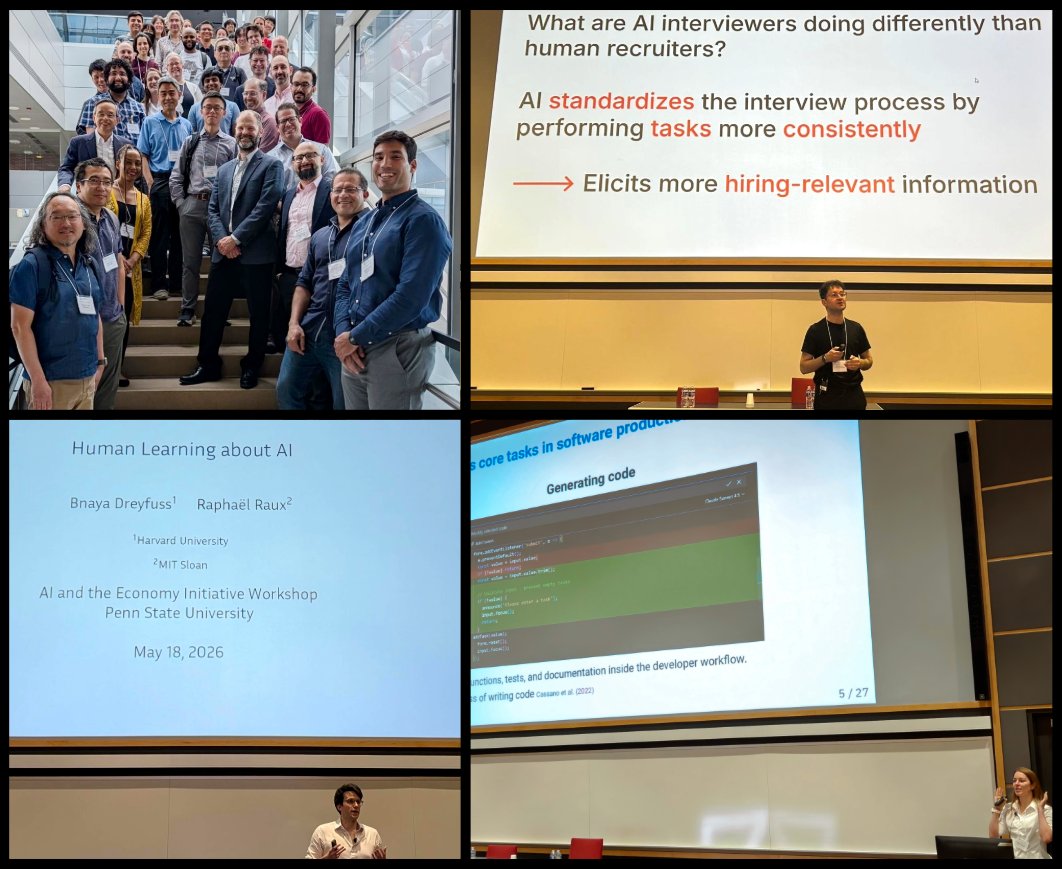
I am sharing a set of slides from my lecture on agentic AI tools for Applied Economists at @penn_state. Materials are available here: https://t.co/2tcpPY4uhS
This builds on this thread and great work by Paul Goldsmith-Pinkham, @aniketapanjwani, and @VelikovMihail
Want to start using Claude Code for academic research?
Or see incredible things other researchers are doing with Claude Code?
Here's a thread of 5 great tutorials, skill and projects you can start using right now.
I'm also keen to do an online "reading group" to work through these and others every week. Beginners welcome. Let me know below if you're interested.
1/ Chris Blattman shares an entire suite of tools he build in the last 4 weeks:
When multiple companies deploy AI systems that learn from overlapping market data, optimize similar objectives, and operate at machine speed, a pattern emerges: Those systems tend to arrive at the same conclusions independently. Is your company deploying AI systems trained on the same market data as your competitors?
Researchers call this the Agentic Convergence Trap. Understanding it requires understanding not just how AI systems behave, but how executives have enabled the behavior.
Here’s how to avoid this trap. https://t.co/5JhC5EVcos
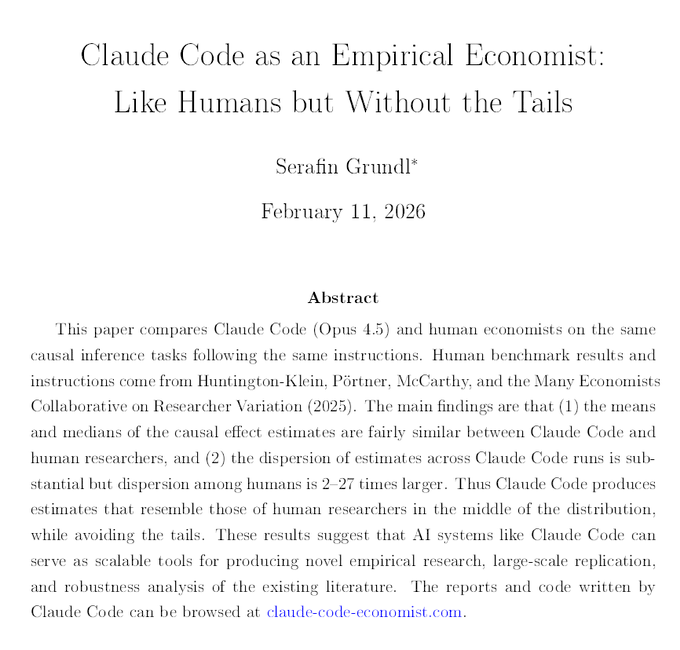
@CRudinschi@penn_state@aniketapanjwani@VelikovMihail Thanks! For the live demo, we take two assignments students solved earlier in the semester (1-data analysis and 2-replicating estimates from an econ paper) and have AI agents do them too, then compare results side by side. Similar to Grundl (2026). We wrap up building a website.
I am sharing a set of slides from my lecture on agentic AI tools for Applied Economists at @penn_state. Materials are available here: https://t.co/2tcpPY4uhS
This builds on this thread and great work by Paul Goldsmith-Pinkham, @aniketapanjwani, and @VelikovMihail
Want to start using Claude Code for academic research?
Or see incredible things other researchers are doing with Claude Code?
Here's a thread of 5 great tutorials, skill and projects you can start using right now.
I'm also keen to do an online "reading group" to work through these and others every week. Beginners welcome. Let me know below if you're interested.
1/ Chris Blattman shares an entire suite of tools he build in the last 4 weeks:
Excited to share that my paper on Algorithmic Collusion is now published in the International Journal of Industrial Organization. Many thanks to the referees and editor. Special thanks to @RanShorrer and @luliquesadalcs for their guidance along the way
https://t.co/Q7nVrTbBSv
@ballesterogh told us about strategic algorithmic monoculture. His work (w/ @RanShorrer@hadi_hoss and @samarthkhanna98) shows that LLMs adjust coordination to incentives and are effective convergence coordinators, but lag behind humans in diverging
6/n
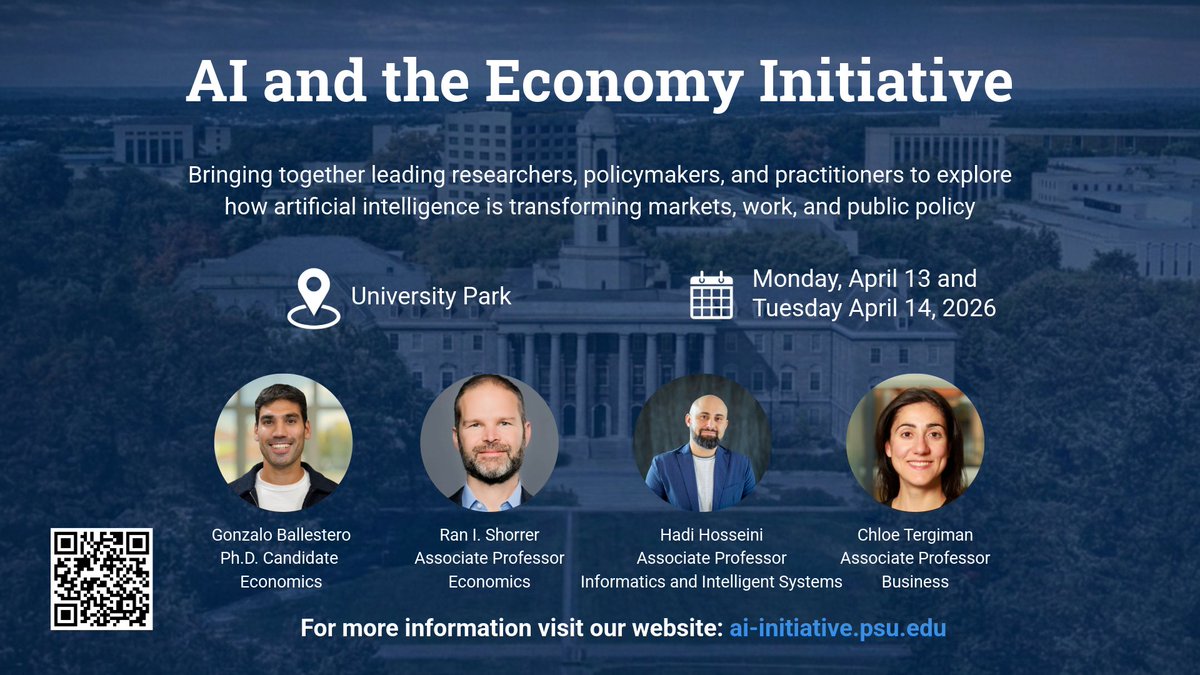
📢 Our inaugural workshop is happening next week!
Join leading researchers, policymakers, and practitioners to discuss how AI is transforming the economy
Organized by @ballesterogh, @RanShorrer, @hadi_hoss , and Chloe Tergiman
Terence Tao spent a year at the Institute for Advanced Study - no teaching, no random events of committees, just unlimited time to think. But after a few months, he ran out of ideas.
Terence thinks that mathematicians and scientists need a certain level of randomness and inefficiency to come up with new ideas.
This winter I co-taught a grad seminar on when & how LLMs can stand in for human subjects in social science research, to a mix of CS & social science students. It was fun (albeit w/occasional friction) to talk methods w/such a diverse group.
Reading list:
https://t.co/f3mspVCFF6
📢 New policy brief: AI agents that can simulate human behaviors and attitudes can help test ideas in social science. Our latest brief introduces a generative AI agent architecture that simulates the attitudes of 1,000+ real people. Learn more: https://t.co/CIRTGbNzSX
When admissions are correlated, diversifying your college applications is the optimal strategy. We spoke with @SNageebAli and @RanShorrer of @PennStateEcon about why the standard advice to apply to reach, match, and safety schools is sound. https://t.co/8RsanAChz4
This is a useful paper on open-ended survey data. Open-ended questions can help reveal individuals’ motives, mental models and decision-making processes. Open-ended survey data have been used to study what’s on top of people’s minds w.r.t. important economic policy questions.
Join us this Wednesday for our next Graduate Student Rump Session w/ students and scholars from
@ISTatPENNSTATE, @PSULiberalArts, @psuarts_arch,
and @PSUEngineering.
🗓️ Wednesday, Nov. 5
🕝 2:30-4:00 p.m.
📍 E202 Westgate Bldg. and Virtual via Zoom
📷 https://t.co/yFOEZ9LQIU