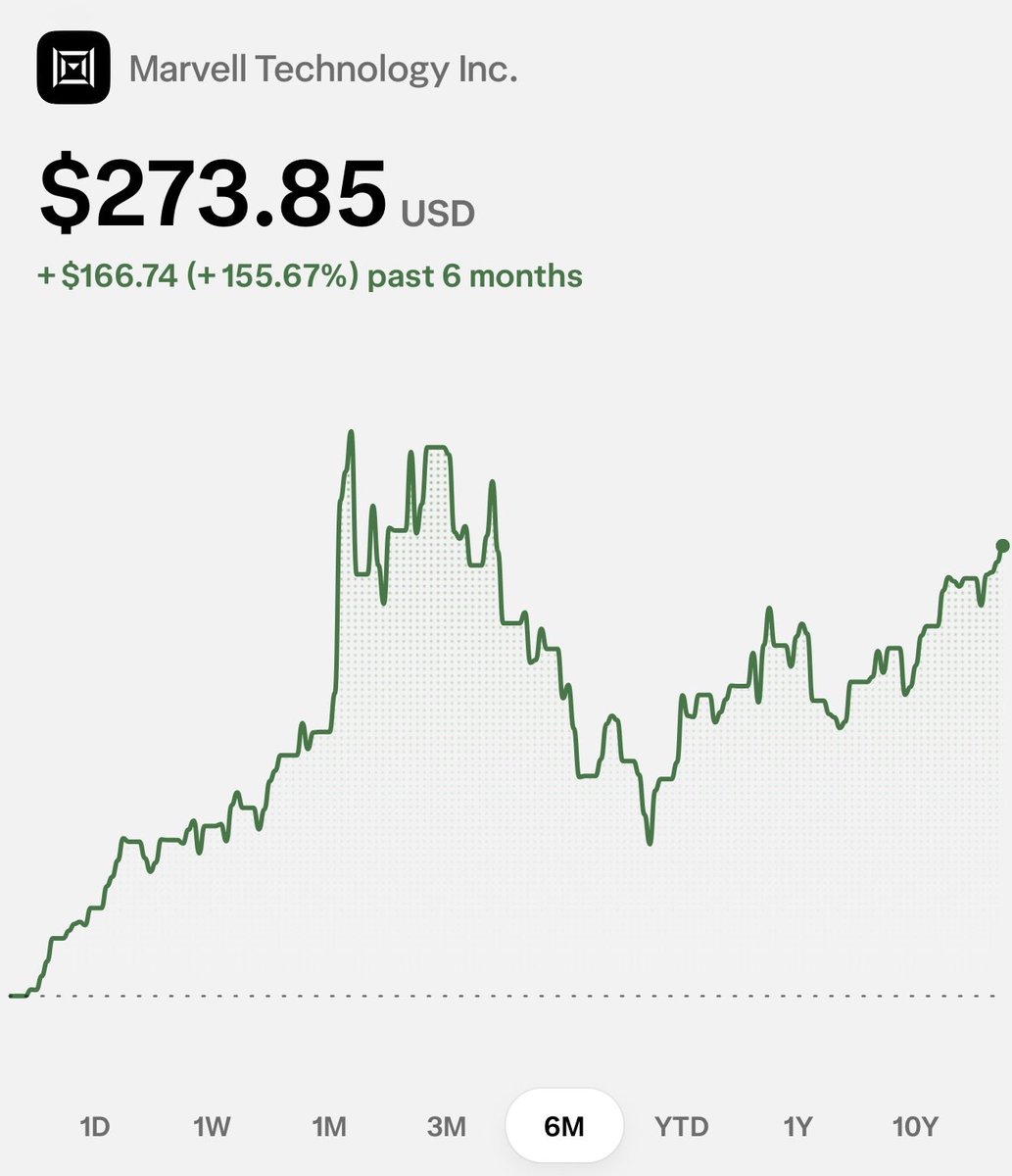
$MRVL is 15% away from making all time highs before its investor day on Oct 6. Marvell has started shipping custom AI-chips to $GOOG, while its next-gen 2nm optical technology advances.
Jensen Huang called this the next trillion dollar company
"TMT MOMENTUM" having its worst Sept since we starting capturing it ... as MUTUALS FUNDS finish up their fiscal year... odd stuff always happens end of this month...
$SIVE, despite having potential, had very bad Q2 numbers and only presented a vague “opportunity pipeline” to us. A very risky story.
$AAOI on the other hand has already received multiple orders from hyperscalers like $AMZN. The company is actively ramping production of next-gen 800G and 1.6T optical transceivers to meet surging demand from hyperscalers and AI data centers.
The management has clear revenue guidances, namely $1.1 billion for 2026 and $471 million monthly revenue by mid-2027.
Yes, $AAOI has a larger market cap, but still has a lower expected 2027 P/S multiple than $SIVE, while $AAOI has orders, QoQ revenue ramp and a management committing to guidances.
$PSX Phillips 66 Strategic Overview: Integrated Downstream Resilience and Growth Analysis. Investment Thesis. New: 7/25/26.
Phillips 66 has assembled a more complex business structure than its refining peers — five distinct earnings engines spanning refining, midstream, chemicals through CPChem, marketing, and renewables — and that complexity is simultaneously the source of its diversification advantage and the conglomerate discount the market applies to the sum of its parts. Each segment carries different margin drivers, cycle timing, and capital requirements, which creates a portfolio that is more resilient than pure-play refining but harder to value and manage coherently than a more focused operator.
The refinery reliability and cost reduction improvements are genuine operational achievements that reflect sustained management focus over multiple years. Closing the gap to best-in-class utilization rates translates directly into margin capture during favorable crack spread environments, and the cost reduction program has structural rather than purely cyclical benefits — the cost base doesn't fully re-inflate when volumes recover, which improves the earnings floor through the cycle.
The derivative-related losses and collateral-driven debt spike are the balance sheet concerns that require direct examination rather than narrative minimization. Commodity businesses use derivatives legitimately for hedging and risk management, but losses at this scale raise questions about whether the hedging program is structured to reduce earnings volatility or inadvertently introducing financial risk that the operating business doesn't require. The debt elevation from collateral requirements is a liquidity management issue that resolves as commodity prices move, but it signals a risk management framework that warrants more transparency than has been provided.
Deleveraging focus alongside continued shareholder returns through dividends and buybacks creates a capital allocation tension that needs to be resolved rather than managed simultaneously. Meaningful deleveraging requires free cash flow directed at debt reduction; aggressive buybacks redirect that same cash flow to shareholders. The credibility of the deleveraging commitment depends on which priority actually wins when the two compete for capital in a normalizing earnings environment.
Succession planning is the governance gap that sits quietly behind the operational improvement narrative. Deep technical expertise in the current leadership team is valuable and acknowledged, but a company managing a five-segment conglomerate through an energy transition period requires visible leadership depth beyond the current executives. The absence of clear succession planning introduces institutional risk that is easy to overlook during periods of strong performance and becomes apparent only when transition becomes necessary.
The conglomerate discount is the valuation challenge that operational excellence alone doesn't resolve. Sum-of-the-parts analysis consistently suggests the combined entity trades below the standalone value of its components, and the path to closing that discount requires either a strategic portfolio simplification that the company has been reluctant to pursue or a demonstration that the integrated model generates synergies substantial enough to justify the complexity premium. Neither has been established convincingly enough to eliminate the discount, and the high current valuation makes the risk-reward less compelling than it appeared before the significant stock appreciation.
SK Hynix removed their price cap for memory long term agreements.
"SK Hynix’s new structure allows spot market price increases to be fully reflected in contract pricing when supply shortages push market prices higher. The shift, according to the report, effectively reworks its long-term contract framework to better capture profitability during upcycle conditions."
Eventually, the other two will follow and I absolutely hate this idea...wtf? You are the largest memory maker in the world at near 90% gross margin, what is the real rational behind this besides greed? Bernstein has them doing 90.9% gross margin in DRAM for Q2'26.
Evercore ISI: Semiconductors
> The rise of Agentic AI in 2026 requires heavy orchestration, memory management, and tool scheduling. Al engineers project future CPU-to-GPU ratios will expand to 2:1 or even up to 10:1.
> The firm models the broader server CPU total addressable market expanding to an annual run-rate of 75 million to 110 million unit shipments.
> Evercore models a massive $275 billion Server CPU TAM by 2030. Top beneficiaries of this structural shift include Arm $ARM, AMD $AMD, and Intel $INTC.
> This quarter, 16 chip and component companies raised prices (including TXN $TXN up to +85% on legacy products, NXP $NXPI, IFX, and STM $STM).
> Lead times for certain analog/MCU components are stretching significantly to 30–99 weeks, with backlog building rapidly.
> The enterprise storage market is forecast to grow ~9% year-over-year in 2026, more than doubling the 4% growth rate seen in 2025.
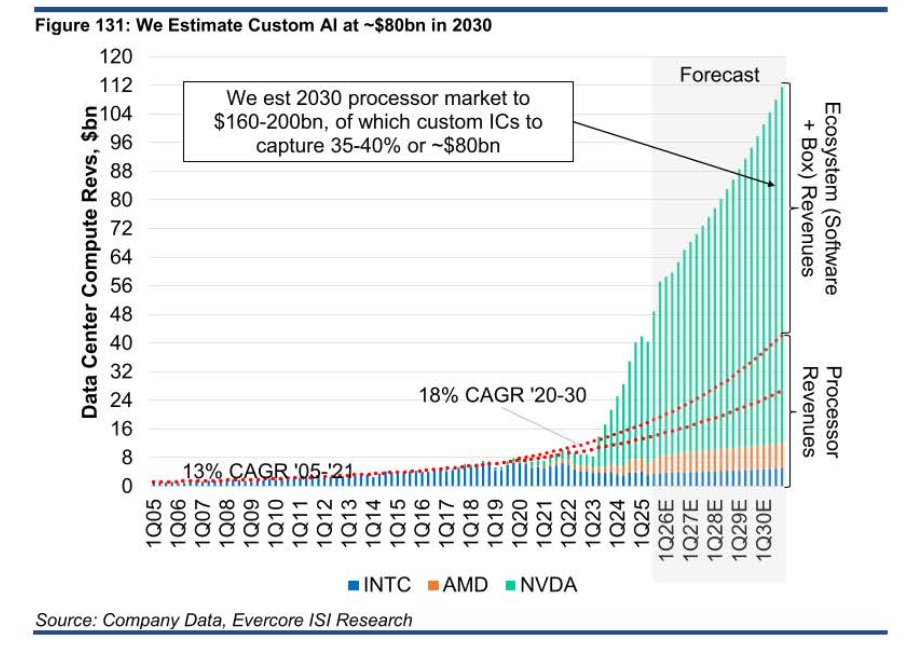
> The total data center processor market is forecasted to reach $160–$200 billion by 2030.
> Custom ICs (ASICs) are expected to capture 35–40% of that total processor market, representing a ~$80 billion market opportunity by 2030.
> Driven by this AI buildout, data center compute revenue is tracking an 18% CAGR from 2020 to 2030, a notable acceleration from the historical 13% CAGR seen between 2005 and 2021.
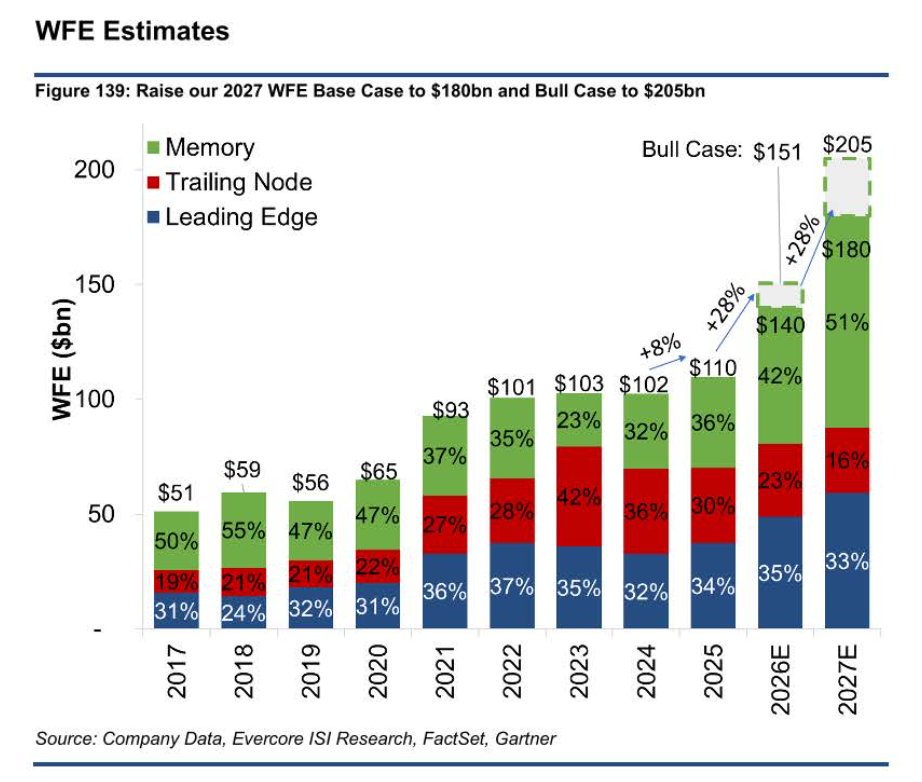
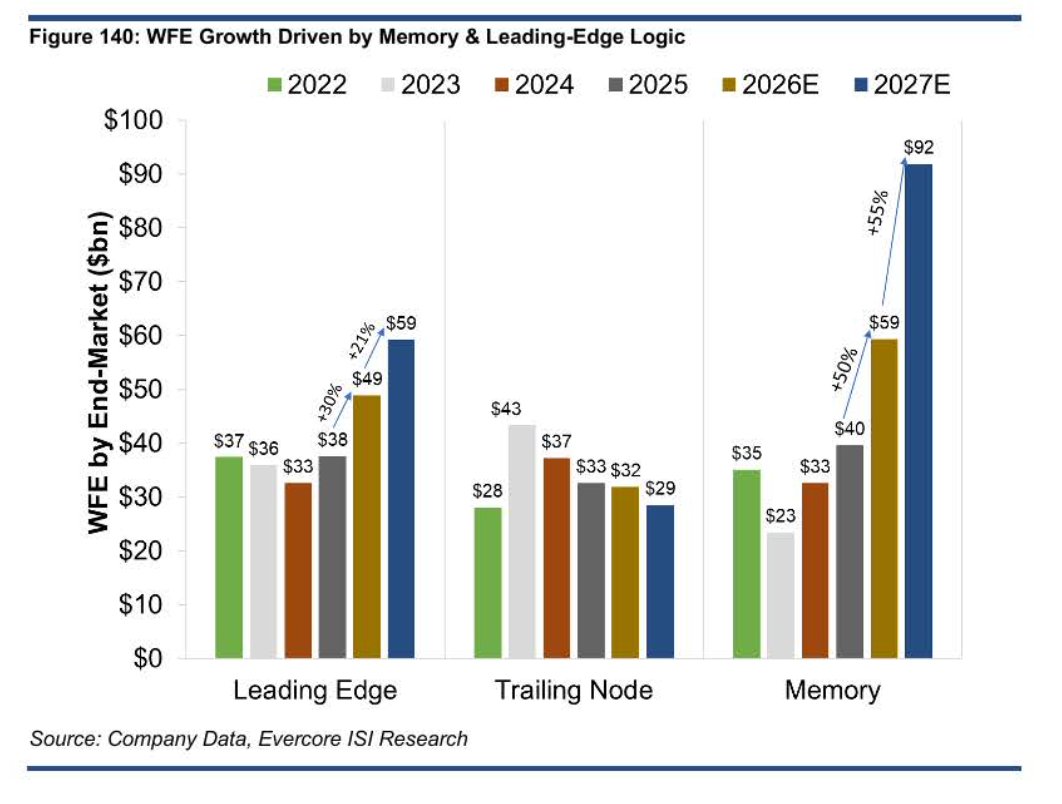
WFE Forecast:
2026E: Base case is set at $140 billion (+28% YoY growth), with a bull case reaching $151 billion.
2027E: The base case is raised to $180 billion (another +28% growth step), with a bull case reaching $205 billion.
Memory: The absolute fastest-growing segment. Spending jumps from $40 billion in 2025 to $59 billion in 2026E (+50%), and skyrockets to $92 billion in 2027E (+55%), making up 51% of all WFE spend.
Leading Edge Logic: Grows from $38 billion in 2025 to $49 billion in 2026E (+30%) and $59 billion in 2027E (+21%).
Trailing Node: Consistently declines, falling from $33 billion in 2025 down to $32 billion (2026E) and $29 billion (2027E).
DRAM Exposure:
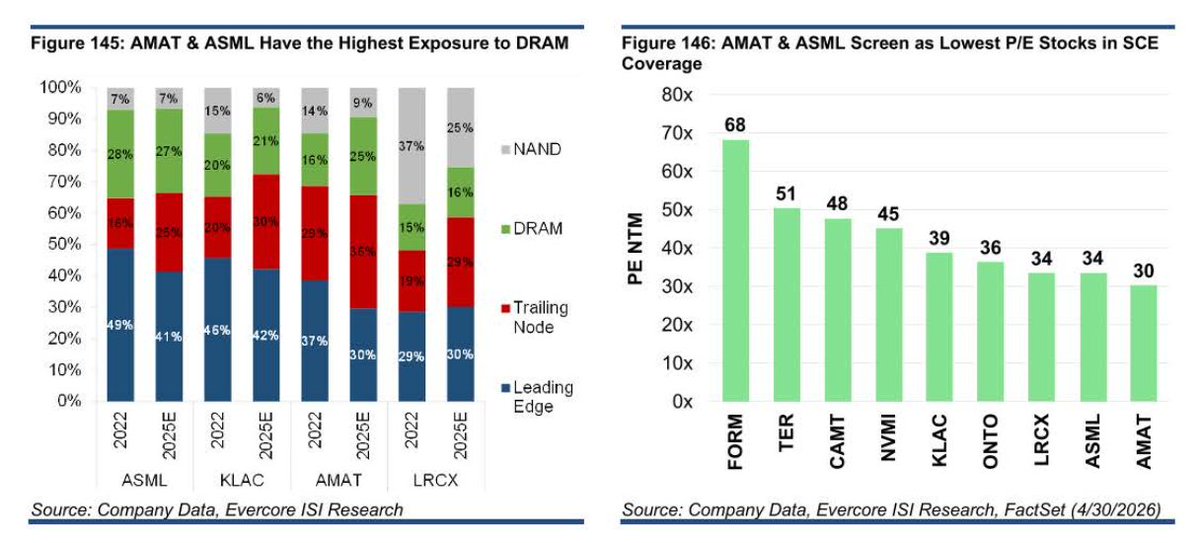
> ASML $ASML & Applied Materials $AMAT lead the coverage group in pure DRAM mix for 2025E, with ASML at 27% and Applied Materials (AMAT) seeing a significant expansion up to 25% (compared to just 16% in 2022).
> KLA $KLAC and Lam Research $LRCX trail slightly with 21% and 16% estimated 2025 DRAM exposure respectively.
Credo Technology $CRDO:
> Evercore models a massive 100% growth in AEC solutions for 2026, followed by an additional 60% expansion in 2027. Credo’s stickiness relies on selling complete system-level AEC assemblies rather than bare silicon.
> The firm expects Credo's optical DSP, silicon photonics, and ZFOptics modules to accelerate sharply, accounting for ~25% of total revenue by 2027 and scaling its absolute addressable TAM by 10x to 20x.
BofA: Storage Shortages Also Hit Apple; Premium iPhones May Bear Greater Price Hike Pressure
> To protect its bottom line and revenue streams, the bank predicts Apple will hike prices on iPads, Macs, and premium iPhone models (Pro and Pro Max).
> The price bumps for Apple's high-end, luxury tier devices are expected to be the most significant.
> After Tim Cook signaled that price hikes would be used to counter rising costs, Bank of America added an extra $100 price increase to its forecasts for the iPhone Pro and Pro Max lines. This is on top of a baseline $100 increase already baked into their models, which still applies to the iPhone Air; meanwhile, pricing for the standard iPhone remains unchanged.
> Anticipating that higher prices will slightly dampen consumer appetite, the bank marginally lowered its projected sales numbers for Macs, iPads, and iPhones. It notes that Mac and iPad price increases are specifically intended to counter more expensive device components.
> Bank of America remains bullish on Apple's long-term financial trajectory, raising its revenue targets over the coming years: predicting $469.8 billion for FY2026 (+12.9%), $534.99 billion for FY2027 (+13.9%), and reaching $574.0 billion by FY2028 (+7.3%).
> Looking at specific business divisions, the bank projects iPhone revenue to jump to $243.75 billion in FY2026 (up from $209.59 billion in FY2025). Meanwhile, Services revenue is expected to grow steadily from $109.16 billion in FY2025 to $124.74 billion in FY2026, $140.01 billion in FY2027, and $158.53 billion by FY2028.
> While pricier hardware helps offset expensive memory components, it could hurt sales volumes and hardware profitability, potentially dropping Apple's product gross margin by around 100 basis points. However, a steady or growing profit margin in the Services division should help cushion this blow.
> Overall profitability is expected to fluctuate due to memory component costs, consumer sensitivity to higher prices, and product sales mix. Bank of America models Apple's operating margin rising to 36.3% in FY2026, dipping to 34.9% in FY2027, and recovering to 35.5% in FY2028.
> Beyond customer-facing price hikes, Apple is expected to mitigate costs via supply chain optimizations, cheaper or recycled materials, and leaner operational spending. Thanks to its strong ecosystem, brand prestige, and AI-driven upgrade cycles, Apple's shipments are expected to outpace competitors. Consequently, the bank holds a "Buy" rating with a $380 price target (calculated at 37x its estimated FY2027 EPS of $10.27)—a premium valuation compared to Apple's historical 5-year P/E median of 27x.
$AAPL
The Oracle flipped GREEN at 9:50 AM.
The first GREEN signal in 7 days.
And it did so before the major news was released.
Before the headlines.
Before the explanations.
Before the experts rushed to tell you why the market was moving.
The Oracle had already made its assessment. And members acted accordingly.
The market simply caught up.
#TheOracle
Taiwanese media reports that Foxconn has begun early shipments of all-optical CPO switch racks to NVIDIA, with shipment forecasts revised upward from the prior 10,000+ units in 2026 to 50,000+ units across 2026–2027.
According to industry sources, Hon Hai Group is producing the all-optical CPO switch racks at its Vietnam plant and has already begun early shipments to NVIDIA. Supply is reportedly extremely tight — even the units originally allocated for demo purposes have been diverted to NVIDIA, leaving "not a single rack to spare."