The US government, citing national security authorities, has issued an export control directive to suspend all access to Fable 5 and Mythos 5 by any foreign national, whether inside or outside the United States, including foreign national Anthropic employees.
The net effect of this order is that we must abruptly disable Fable 5 and Mythos 5 for all our customers to ensure compliance.
Access to all other Claude models is not affected.
We apologize for this disruption to our customers. We believe this is a misunderstanding and are working to restore access as soon as possible.
Read our full statement: https://t.co/bwn0sximKZ
I do not care about the so-called auto workflow, given that it costs 3x tokens without doing anything better for my workflow, so I have to rollback to opus 4.7
Opus 4.8 is significantly less efficient; it consumes considerably more tokens than Opus 4.7, even after delegating the PR loop to Codex. My experience shows that it costs approximately three times as much as Opus 4.7
Sandboxes are becoming the OS for agents.
This is because agents will be more persistent and stateful.
I go deep in my Substack: isolation primitives, performance, portability, architecture, build vs buy, market dynamics.
Give it a read: https://t.co/zBtgEpaoN2
This is huge.
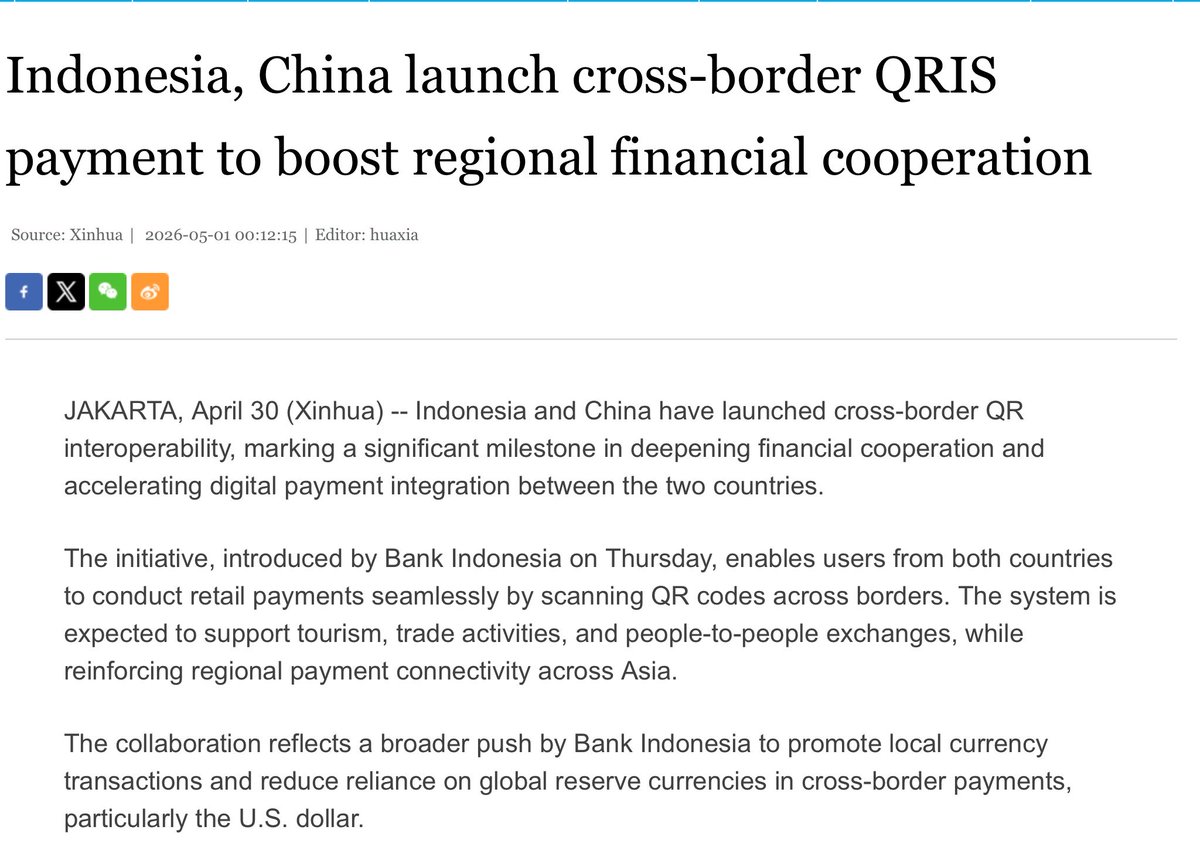
China and Indonesia today fully linked their national QR payment networks.
This isn’t just about convenience. Both central banks call it a deliberate move to bypass the dollar. Transactions settle directly in rupiah and yuan under their local currency settlement framework. No USD in the chain.
A Chinese tourist can now scan an Indonesian QRIS code with Alipay or UnionPay and pay like a local at over 39 million merchants. Indonesians can do the same in China with their 33 local e-wallets.
Why it matters:
China-Indonesia trade hit ~$140 billion last year. Switching to local currencies saves businesses 2-3% on forex and hedging costs. Across ASEAN, nearly 45% of China trade is already settling in RMB — and it’s growing fast.
This QR link takes it from big commodity deals down to everyday retail: coffee, hotels, shopping.
Who’s already on board (ASEAN focus):
• Cambodia: Full two-way
• Indonesia: Just went live
• Thailand: PromptPay connected (Chinese tourists scanning)
• Vietnam: NAPAS linked, full two-way soon
• Malaysia & Singapore: Inbound for Chinese visitors
• Laos: Digital RMB pilots active
Beyond ASEAN: Kazakhstan, Sri Lanka, Turkey, UAE, Argentina (full national QR coverage), and Brazil are in various stages. China’s CIPS now reaches 122 countries/regions.
The bigger picture:
One-way links are becoming two-way, then full integration. Central banks are testing mBridge for CBDC-based settlement. A parallel financial infrastructure where the dollar is no longer the only option.
39 countries have local currency settlement deals. QR systems are spreading fast. This is de-dollarization happening in the background, one scan at a time.
Second price drop in two days! On top of the base 75% off, stack an extra 90% discount for cache hits — that brings it down to just 0.003625USA/0.025 RMB per 1M input tokens with cache hit~ 🎉💰 Go wild and have fun~ 🚀
📌 Just a heads-up: the cache discount is permanent, while the base 75% off promo runs until May 5th — so make the most of it while you can!
#DeepSeek #AGIforEveryone
🚀 DeepSeek-V4 Preview is officially live & open-sourced! Welcome to the era of cost-effective 1M context length.
🔹 DeepSeek-V4-Pro: 1.6T total / 49B active params. Performance rivaling the world's top closed-source models.
🔹 DeepSeek-V4-Flash: 284B total / 13B active params. Your fast, efficient, and economical choice.
Try it now at https://t.co/GCdiMzk1Dl via Expert Mode / Instant Mode. API is updated & available today!
📄 Tech Report: https://t.co/drlDrxkYtp
🤗 Open Weights: https://t.co/T13Y8i7SDM
1/n
This could be an Apple II moment for AI agents.
The big shift isn’t better demos.
It’s agents becoming personal, persistent, and actually useful.
That’s what we’re building with Clawly.
Now on the App Store: https://t.co/nNuxwxijSM
This could be an Apple II moment for AI agents.
The big shift isn’t better demos.
It’s agents becoming personal, persistent, and actually useful.
That’s what we’re building with Clawly.
Now on the App Store: https://t.co/nNuxwxijSM
My dear front-end developers (and anyone who’s interested in the future of interfaces):
I have crawled through depths of hell to bring you, for the foreseeable years, one of the more important foundational pieces of UI engineering (if not in implementation then certainly at least in concept):
Fast, accurate and comprehensive userland text measurement algorithm in pure TypeScript, usable for laying out entire web pages without CSS, bypassing DOM measurements and reflow
Just learned something interesting about how Claude Code handles pricing in multi-round conversations — sharing in case others were curious too.
When you chat with Claude Code, each round sends the full conversation history (system prompt + all previous messages + tool results) as input. So naively, the input token count keeps growing with every turn, and you'd expect costs to scale linearly.
But Anthropic uses prompt caching under the hood. Here's how it actually works (using Opus 4.6 as example):
Base input tokens: $5.00/MTok
Cache writes (first time content enters cache): 6.25/MTok (5min TTL) or 10.00/MTok (1hr TTL) — actually more expensive than base input
Cache hits & refreshes (subsequent reads): $0.50/MTok — 90% cheaper than base input
Output tokens: $25.00/MTok — always full price, no caching
So the economics look like this:
Round 1: Full price for all input tokens, plus a cache write premium to store them
Round 2: Most of round 1's context is a cache hit (0.50/MTok instead of 5.00/MTok), only the new turn pays full price + cache write
Round N: The bulk of history hits cache at $0.50/MTok, you mainly pay full price for the latest turn
The key insight: cache writes cost more upfront, but cache hits are so cheap (90% off) that it pays for itself quickly — especially in coding sessions where you're going back and forth many rounds on the same context.
When the conversation approaches the context window limit, Claude Code auto-compacts by summarizing older messages. This reduces token count but loses some granularity.
Net takeaway: long multi-round coding sessions are much more cost-efficient than I initially assumed. The first couple of rounds "warm up" the cache, and after that the marginal cost of each additional round is surprisingly low.
References:
Prompt caching docs & pricing: https://t.co/HXQ33jN6Kf
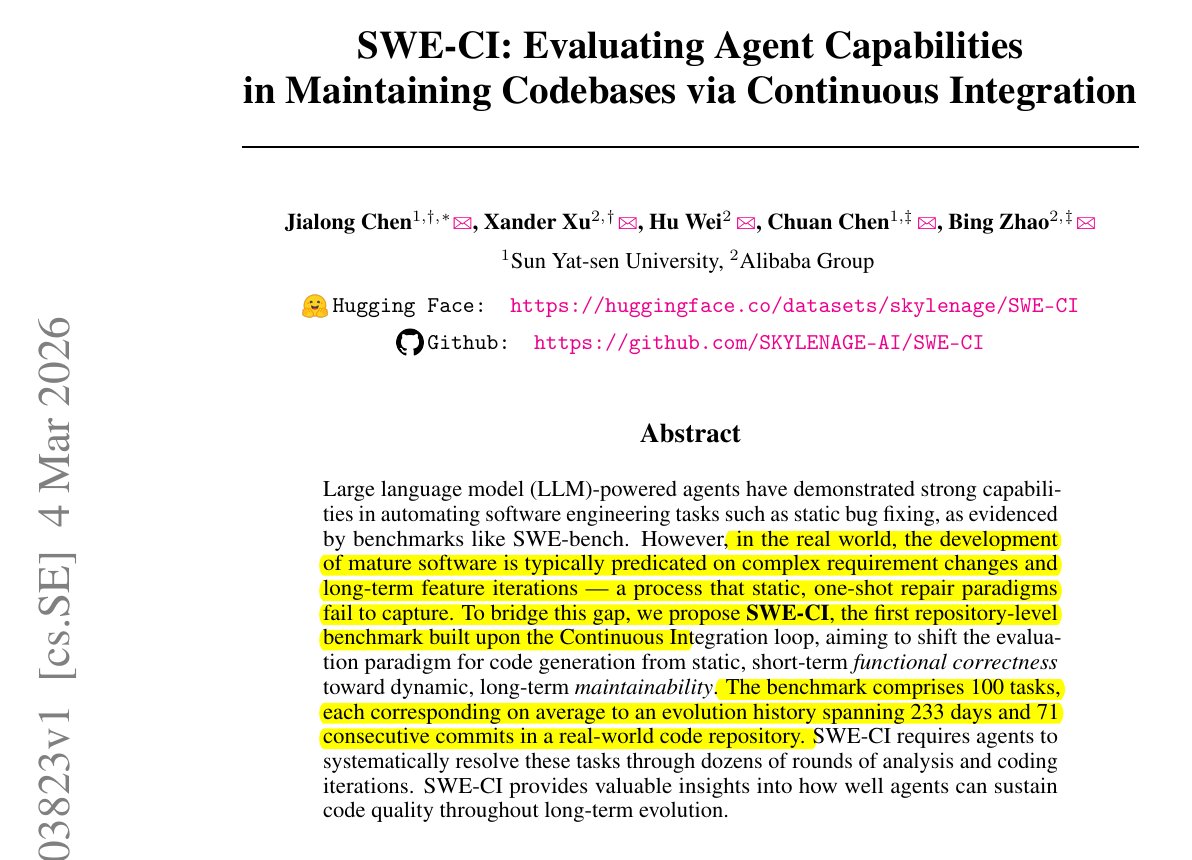
Alibaba ran the ultimate long-horizon experiment for LLMs:
And proves that all current models that are great at creating quick fixes eventually collapse when forced to actually maintain a living real-life coding project.
Here they implemented it on 100 codebases, 233 days of continuous AI-driven evolution - and finally exposes the core limitation of today’s coding agents: they optimize for the super short-term, not the long trajectory.
Passing tests at t=0 is easy; preserving correctness through 233 days of cumulative change is where the models break.
The results show that 75% of current models break previously working features when forced to maintain a project over several months.
This proves we need to stop measuring how fast an AI writes a temporary fix and start measuring how well it prevents future bugs.
Current coding evaluations only check if a system can solve an isolated problem on the very first try.
This completely ignores the reality of software development where small changes build up and bad early decisions cause massive failures later.
That's why here they built a testing framework that forces the AI to update real software repositories continuously across hundreds of days of actual project history.
----
Paper Link – arxiv. org/abs/2603.03823
Paper Title: "SWE-CI: Evaluating Agent Capabilities in Maintaining Codebases via Continuous Integration"
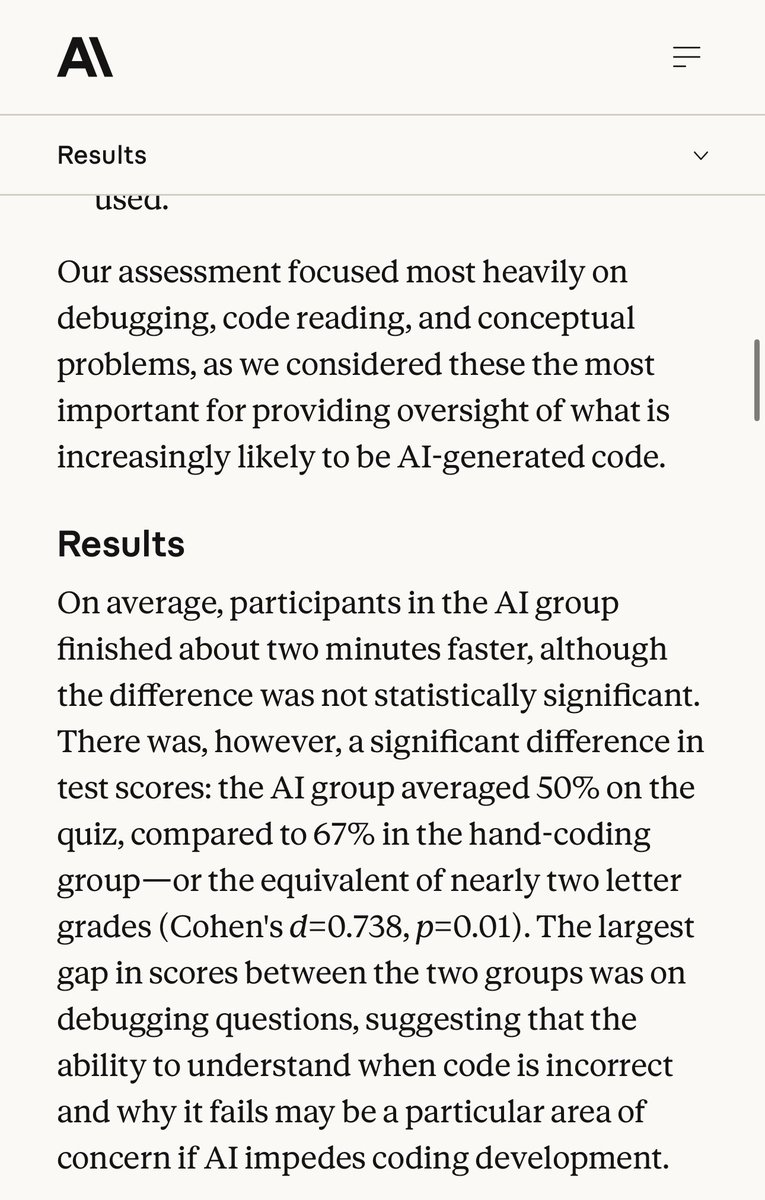
Anthropic themselves found that vibecoding hinders SWEs ability to read, write, debug, and understand code.
not only that, but AI generated code doesn’t result in a statistically significant increase in speed
don’t let your managers scare you into increased productivity. show them this paper straight from Anthropic.