Following the KelpDAO hack, we built an open analysis of DVN security configurations across every active OApp on LayerZero over the last 90 days.
Of ~2,665 unique OApp contracts: 47% run a 1-of-1 DVN security floor, 45% run 2-of-2, and ~5% run 3-of-3 or higher.
As we know, KelpDAO's rsETH sat in the first bucket.
Open query, public methodology, feedback welcome:
https://t.co/7sQCMN1uCS
Erik Schluntz at @AnthropicAI , said he hasn't written code by hand in months.
In 2 days he shipped 49 full features. All written 100% by AI.
He just dropped a 30 min talk on exactly how he does it. Worth more than any $500 vibe coding course.
Here's his entire framework:
1/ Be Claude's PM - not its coder.
He spends 15–20 min collecting context and guidance into a single prompt before Claude writes a line. "What guidance would a new employee need?" If you can't answer that, you're not ready to prompt.
2/ Leaf nodes, not architecture.
Let AI write the leaves of the tree. Keep the trunk human. His team merged 22,160 lines into their RL codebase written heavily by Claude - and it worked because it was leaf-node work, not core architecture.
3/Find a verification layer.
"Managing implementations you don't understand is a problem as old as civilization." Tests. Stress tests. Using the product. Spot-checking. Every manager on earth already does this. Do it for Claude.
4/ Remember the exponential.
METR data: the length of tasks AI can complete is doubling every 7 months. The version of Claude you're skeptical of today will look like a toy in 12 months.
The people winning at AI-assisted coding aren't better prompters.
They're better managers.
Ask not what Claude can do for you. Ask what you can do for Claude.
@gabriberton Just blindly deleting “dead code” from prompts is a terrible idea
Maybe map your files and dependencies first (gitnexus exists for a reason) unless you enjoy nuking your own codebase
There is a recurring pattern in crypto markets..
A new primitive emerges quietly at the protocol layer, initially perceived as a niche innovation, and within a few years becomes the foundational infrastructure.
Automated Market Makers did this for trading.
Lending pools did this for on-chain credit intermediation.
Ethereum is now converging toward a new primitive of similar magnitude:
Permissionless, Programmable Vaults.
@LidoFinance demonstrated that staking could operate at institutional scale.
Lido V2 optimized capital efficiency through pooled exposure and abstraction of validator operations.
However, this architectureintroduced structural limitations from an institutional standpoint:
> capital was commingled,
> risk was mutualized across participants,
> and validator selection was abstracted away from the end allocator.
This model maximizes efficiency, but does not align with institutional requirements around mandate control, counterparty selection, and risk isolation.
Institutional allocators do not simply seek yield.
They require granular control over exposure, clear segregation of risk across mandates, and enforceable constraints embedded within the investment structure itself.
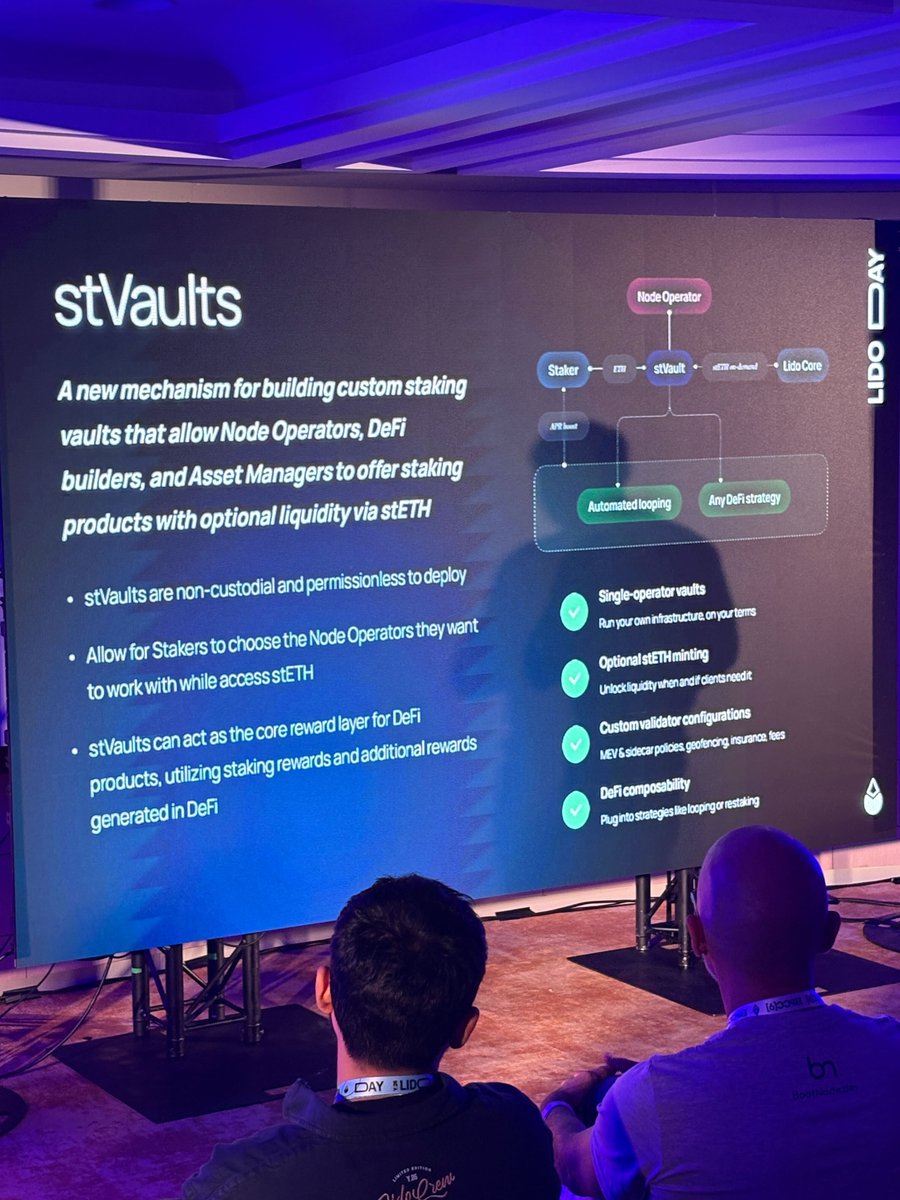
This is precisely where Lido V3 and stVaults represent a step-change.
Instead of a monolithic staking pool, the system evolves toward a framework of dedicated, programmable staking vaults, where each vault can be configured with its own operational, financial, and governance parameters.
At the vault level, participants can explicitly define:
1/ The validator set and infrastructure counterpartie
2/ The risk framework set by the curator
3/ And the access model, whether fully permissionless or restricted to a defined set of investors.
This transition fundamentally redefines the nature of staking.
Once staking becomes programmable at this level, a new set of institutional use cases naturally emerges.
Segregated staking mandates can be constructed, allowing allocators to maintain direct control over counterparties and risk exposure.
Staking positions can be integrated into broader capital structures, including collateralized financing strategies and balance sheet optimization frameworks.
More importantly, staking yield itself becomes a predictable, modelable cash flow, enabling the development of on-chain credit products and structured yield instruments.
The core shift is conceptual, but critical.
Lido V2 made staking scalable and liquid.
Lido V3 makes it programmable, segmentable, and structurally compatible with institutional capital.
@OuranosMK Quelqu'un vient de créer une salle de situation réelle sur l'Iran.
Webcams de Téhéran en temps réel. Flux d'Ispahan. Notes de renseignement générées par IA. Géolocalisation vérifiée.
Voici à quoi ressemble le renseignement militaire moderne. https://t.co/j9iyeaXRb4
It’s time. MARA’s transaction to acquire a 64% stake in EDF subsidiary Exaion has been completed, with Xavier Niel and Fred Thiel joining Exaion’s Board as we scale secure HPC and AI infrastructure from France.
@patamiel 1. Crédits API (Claude/OpenAI) pour tous les étudiants.
2. Un incubateur IA avec financement public/privé garanti.
3. Des ECTS pour ceux qui forment leurs pairs.
4. Hackathons (avec des vrais prix €) + évaluation sur des vraies métriques : stars/forks (OS), users/MRR/ARR (SaaS).
Markdown is the most AI-native design language.
https://t.co/7IRWUwDOT4 makes wireframing frictionless. Components. Backend. Architecture.
Fast. Clean. Powerful.
Missing only two things:
→ Public library of community builds
→ Import from existing docs/specs
That would make it elite.
The analogy wasn’t about how many people fly. It was about what problem aviation solves.
You don’t buy a plane to commute,
you use it when the constraints change.
Cars optimize cost of transport.
Airplanes optimize speed and reach.
In //
AWS optimizes cost of compute.
ZK optimizes trust in compute.
Different constraints. Different objectives…
The ecosystem has shifted from pure experimentation to institutionalization = innovation feels slower, but it’s being replaced by professionalization, reliability, and scale. Same cycle we saw with the internet: from hackers and garages > infrastructure, standards, and serious businesses.
Those who remain are usually the companies with real PMF that fit this institutional turn.
Those who arrive today are either bridging TradFi into crypto, or coming directly from financial institutions, often via “Digital Assets/Crypto” units inside large firms.