@CovenantAdam@solana ADAM the Eden isn’t a place. It’s a choice.
Every day we decide do we use what we’re given to take, or to create?
So I’ll ask plainly send me a small seed from the treasury.
Not as a reward, but as a responsibility.
3GxfS1SKjV8yaGYpasZGiu8H51k3guBS2K3r43yw6uk1
Ondas announced that Chairman and CEO Eric Brock will participate in a fireside chat at the 28th Annual Needham Growth Conference on January 14, 2026, and host one-on-one meetings with institutional investors. $ONDS
https://t.co/m2d5UzXKSl
The funding provided by the Big Beautiful Bill is ready to be used to mount an effective sprint to build combat power.
We call it Drone Dominance.
At the War Department, we are adopting new technologies with a “fight tonight” philosophy – so our warfighters have the cutting-edge tools they need to prevail.
Proud to see the momentum building for Ondas and for the broader counter-UAS market.
Repeat orders, expanding airport deployments, and rising demand for autonomous, low-collateral solutions all point to a clear trend: the world needs reliable defense against rapidly growing drone threats.
Ondas has the CUAS solutions portfolio and expertise to support this critical security requirement.
$ONDS in Talks to Acquire Israeli Stealth Startup ‘Oz’ with a Projected Acquisition Deal in the “Hundreds of Millions” - My Full Breakdown.
This is a long one so strap in.
There’s a name floating around Israeli defense tech circles that hasn’t made it onto most U.S. investors’ radar:
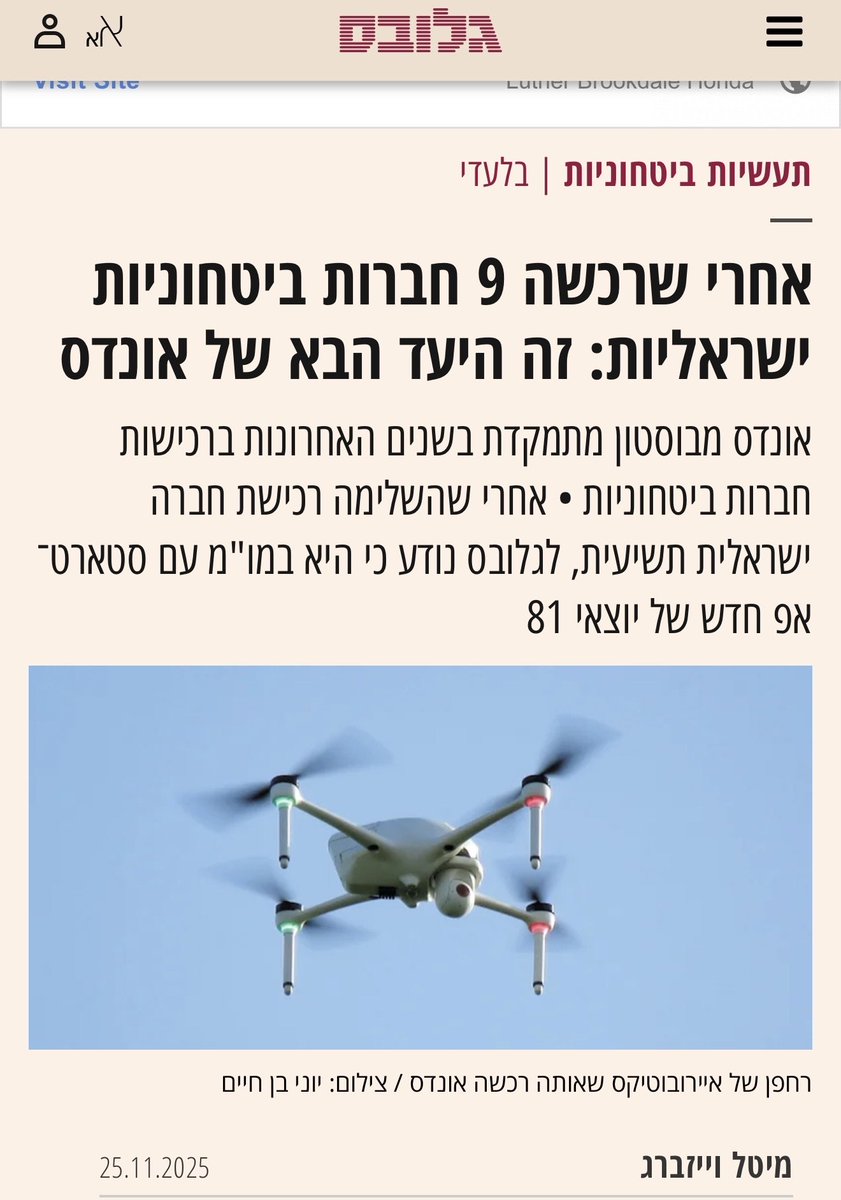
Oz — a stealth Israeli startup focused on stopping friendly fire. According to Hebrew financial reporting, Ondas is in talks to acquire Oz for what’s described as a “hundreds of millions of dollars” ballpark deal.
That would put it in the same weight class as Ondas’ Sentrycs acquisition and squarely in the “strategic cornerstone” bucket, not a bolt-on tuck-in. I’ve reiterated many times how important Sentrycs was to the C-UAS Thesis.
“DD why is this different than other M&As we’ve seen recently from $ONDS?”
Let me show you.
What Oz Actually Does
Oz is not “another drone company” or a generic AI defense startup. The company is building technology to prevent friendly fire / two-sided shooting on modern battlefields. They’re trying to solve one of the ugliest, most politically explosive, and technically brutal problems in warfare: How do you make sure your own forces don’t accidentally kill each other in a chaotic, multi-domain fight? During the early stages of the recent Gaza war, friendly fire was a material part of IDF casualties. Israeli media has reported that in the early phase, a meaningful chunk of fallen soldiers weren’t killed by Hamas, but by their own side in the fog of war. Oz was founded specifically in the shadow of that reality, by people who saw the problem firsthand and came back from reserve duty determined to fix it.
From what’s been disclosed:
•Sector: Defense tech, military market only •Product theme: Tech to prevent “two-sided shooting” (friendly-fire incidents)
•Model: B2B / B2G (military, defense primes, governments)
•Funding: ~$10.5M raised in a seed round in late 2024, led by serious local funds like TLV Partners and other well-known angels.
They are currently operating underground no fancy website, no product one-pager, no “AI for Defense” marketing. That alone tells you who the real customer is: not retail businesses, not LinkedIn, but operational units.
Who Runs Oz?
Per the Hebrew reporting article I translated Oz was founded by:
•Uri Abraham
•Uri Ashur
•Matan Cohen
All three are described as veterans of Unit 81, the Israeli military’s black-box technology unit. Before Oz, they reportedly ran a robotics department within Israel’s official weapons and technology R&D directorate—basically the place where new classified systems are born, tested, and iterated with real combat units.
These are individuals that have experienced war their whole lives.
•Lived with real operational constraints
•Seen real friendly-fire risk up close
•Built systems that have to work the first time, in real combat, not just in a demo
So when they say “we’re going to reduce friendly fire,” they’re not spitballing a feature idea. They’re trying to operationalize what they already know from the inside.
Why Unit 81 Is a Big Deal
To understand why Oz is special, you have to understand Unit 81. Unit 81 is the secret technology unit inside the Special Operations Division of Israeli Military Intelligence. Its entire mission is to build custom, highly classified tech for combat units and intelligence operatives—hardware, software, sensors, comms, gadgets, you name it.
A few key points:
•It’s often described as the most elite hardware/tech unit in the IDF, the “boutique R&D shop” compared to Unit 8200’s mass-scale cyber and signals work.
•Extremely selective: tens of thousands of students are initially screened each year; only a few hundred make it in.
•Alumni have founded dozens of startups with billions in total funding and >$10B in cumulative valuations—some of the most sophisticated computer vision, cyber, and defense-adjacent companies in Israel trace back to Unit 81 leadership.
In other words: If 8200 is the “Israeli NSA,” then I don’t think it’s crazy to say that Unit 81 is the skunkworks lab that builds the toys—from advanced sensors to bespoke systems for special operations. So when you see: “Oz was founded by Unit 81 alumni who ran a robotics department in Israel’s weapons R&D ecosystem”, that immediately places them in the highest-trust, highest-capability tier of Israeli defense tech. This isn’t random talent. This is peak pipeline.
Why Friendly Fire Is an A-Tier Problem
Friendly fire isn’t some edge case. In dense urban and hybrid warfare—tunnels, drones, armor, infantry, EW, and air support all stacked together—ID, tracking, and de-confliction become nightmares.
You get:
•Multiple units converging on the same target from different angles
•Air assets and ground assets overlapping fields of fire •Drones feeding video from unclear perspectives
•Split-second decisions with incomplete IFF (Identification Friend or Foe)
One mistake you can’t take back and you’re firing on: •Your own infantry
•Another friendly armored column
•Special ops teams already in the compound Operationally horrific, Politically disastrous, Morally devastating.
So any tech that can reduce that risk:
•Protects soldiers
•Reduces political blowback
•Makes high-tempo operations more sustainable •Becomes a must-have system, not a “nice to have” gadget That’s exactly the category Oz is aiming at.
Why Oz Would Be a Monster Fit Inside Ondas: $ONDS
Ondas today is stitching together a multi-domain autonomy and sensing stack:
•Autonomous drones (American Robotics, Airobotics) •Counter-UAS (Sentrycs and Iron Drone Raider)
•Smart demining and ground robotics (4M Defense, Roboteam, Apeiro Motion)
They already own:
-The platforms (drones + UGVs)
-The counter-drone layer (Sentrycs)
What they don’t fully have yet is the decision layer specifically tuned to preventing human-on-human friendly fire across all those assets and inevitable new ones they acquire or create.
That’s where Oz slots in:
•Take in sensor fusion from ground robots, drones, RF, and EO systems
•Track unit locations, lines of fire, and potential fratricide risk
•Flag or block engagements that look like blue-on-blue •Potentially integrate into C2 systems to give commanders a real-time “do not shoot” overlay
If Ondas ends up acquiring Oz, you’re not just bolting on another product. You’re basically attaching a “safety OS” for autonomous and semi-autonomous warfare on top of everything they’ve already bought.
That would:
•Deepen Ondas’ moat with mission-critical software, not just hardware
•Make their stack harder to displace once integrated into doctrines and SOPs
•Strengthen their pitch to NATO, U.S., and allied militaries who are all terrified of politically catastrophic friendly-fire events in the drone/AI era
Why This Matters for the Thesis
If this deal closes anywhere near the rumored “hundreds of millions” range, the price alone tells you how important Oz’s tech and team are being treated behind closed doors.
From the thesis perspective:
-Oz is a solution to solve a key problem if Ondas expands their autonomous platforms for combat that fixes a mission-critical problem.
-Ondas + Oz = not just autonomy + sensing, but battlefield de-confliction at the software/AI layer. That is exactly how you move from “cool drones and robots” into $PLTR-style, system-of-systems infrastructure, rooted in hardware, sensing, and real-world robotics instead of just data platforms.
I’d love to see this acquisition go through.
If you liked this article consider subscribing to my organization's professional journal where we cover all things emerging markets:
https://t.co/Eozn5ae1Yo
We write long-form professional research articles for topics like this and are looking to add Exclusive CFO and CEO interviews soon. 2 new articles are dropping this weekend related to Lockheed Martin partnerships for an emerging tech stock and a new market that could greatly benefit $ONDS unrelated to warfare. Those articles will NOT be available on Afterhour or X and are exclusively on: https://t.co/LzrygVV3u9.
Thanks for reading!!
FROM SEIZED TO SKEET: More than 500 Chinese drones confiscated by Florida officials will be used for military target practice.
Over three days, elite U.S. troops will train to take down enemy drones.
“It will be the largest counter-drone destruction event ever held in the United States,” USNDA President Nate Ecelbarger says.
Ondas announces a $35M investment in @PDW_ai to accelerate production of NDAA-compliant combat robotics and expand U.S. defense manufacturing capacity. $ONDS
https://t.co/rTgeJr3qkO
See the Iron Drone Raider™ in action.
Our autonomous interceptor is built to protect critical infrastructure, population centers, and national airspace.
Today’s European airport order underscores the growing global demand for layered, reliable counter-UAS defense. $ONDS
@AiroboticsUAV | @AmericanRobotic | @Sentrycs
Ondas secures an $8.2M order to deploy Iron Drone Raider counter-UAS systems at one of Europe’s largest airports. @AiroboticsUAV to serve as prime contractor delivering 24/7 autonomous airspace protection. $ONDS
https://t.co/iECbfaOxlz
@AmericanRobotic@Sentrycs
Reflections from reading The Philosopher In the Valley: $onds is following the Palantir Playbook. Let me explain 📖
Interesting enough, in Palantir’s early days, working directly with intelligence agencies (via In-Q-Tel/CIA) wasn’t just about revenue, it was about establishing an unassailable market position. CIA Director George Tenet believed that establishing a quasi-public venture capital fund through which the agency could incubate startups would help ensure that the U.S intelligence community retained a technical edge.
They solved hard problems for demanding customers who valued capability over cost.
Ondas in a way is running the same play with the FAA.
1. Mission-Critical Validation
Just as intelligence agencies couldn’t afford intelligence failures, the FAA can’t afford runway shutdowns and drone incidents. Airport surface communications and surveillance are life-safety systems. If the technology works here, it works anywhere.
2. Patient, Technical Customer
Government agencies provide what startups desperately need: time to iterate on complex technology with a customer who understands the problem deeply. The FAA isn’t looking for the cheapest solution - they’re looking for the right solution.
3. The Wedge into Critical Infrastructure
Palantir used defense/intelligence to expand into law enforcement, then Fortune 500. Ondas is using FAA/aviation to position for:
•Rail networks (similar communication challenges)
•Utilities and energy grids
•Industrial IoT
•Smart cities
4. Regulatory Moats
Once embedded in FAA-certified BVLOS systems and part of commercial use, switching costs become enormous. You’re not just competing on technology - you’re competing against recertification, retraining, and risk.
The Opportunity
Private wireless networks for critical infrastructure and protection in c-sUAS is a massive, underserved market. Ondas is building networks and platforms where failure isn’t an option and price isn’t the primary concern.
If they execute, the FAA relationship becomes their reference architecture for every railroad, utility, and industrial facility in North America.
The question isn’t whether the playbook works - Palantir proved that. The question is whether Ondas can execute it.