What is a Voucher in @EuclidProtocol
Let me explain it simply!
Imagine a huge bank with many branches (Ethereum, Cosmos, Solana, and more). When you deposit your money in one branch, the bank gives you a receipt (Voucher). Your real money stays safe inside the vault. 👇👇
Our founder @chouchani9 spoke to @CryptoSlate about what really happens when a bridged token loses its backing.
One point worth sitting with.
$1M of liquidity on each of 10 chains adds up to $10M.
A trader on any one chain can only reach $1M of it.
That gap is what we’re building Euclid to close.
Set it. Sleep on it.
Place a limit order on Euclid Prime at the price you want.
If the market gets there, it fills.
Wake up to a filled order, not a missed move.
Myth: Big TVL means easy trading.
Reality: TVL is money deposited. Liquidity is money available at the price you want.
A protocol can hold $500M and still be thin in your pair. Most of it sits in other pools or outside the current price range. Once price leaves a range, that liquidity stops working for your trade.
Takeaway: Ask where the depth is, not how big the vault is.
Most trading screens tell you the price.
Euclid Prime's Terminal also helps you see why it's moving: token news and deeper market stats, right next to the chart.
Fewer tabs open. Faster calls.
Fed minutes show support for a hike went well beyond the two who voted for one.
@EuclidProtocol CEO Georges Chouchani told @CryptoSlate : markets start pricing more hikes after December, and crypto is already short of cash.
Stablecoin supply is down $16B in a month.
Bitcoin is near $62K.
Read more from @CryptoSlate, link in comments
Myth: a tight spread means a deep market.
Reality: spread only shows the top of the book.
Tight at the top. Thin underneath.
Your first $200 might trade cheap.
The rest won’t.
Look one level down before you trust the top.
Market order vs limit order.
One fills now at whatever price is available.
One fills only at your price or better.
Both will be on Euclid Prime.
Which one do you use most?
Banks are putting tokenized money on more and more networks.
Each launch makes sense on its own. Together, they split one dollar into many prices.
Our founder @chouchani9 on why price parity across networks matters, in @traders_tweets ⬇️
Sunday chore: count your open tabs.
→ 3 charts
→ 2 bridges, still loading
→ 1 explorer, tracking a transaction from Thursday
→ 14 threads you'll read later
How many have you got open?
Not every trade needs a chart.
Sometimes you just want to turn USDC into something else and get on with your day.
Convert on Euclid Prime.
Pick what you spend and receive, check the rate and minimum received, confirm. Done.
Euclid Prime 🔜
Myth: A dollar stablecoin is a dollar stablecoin.
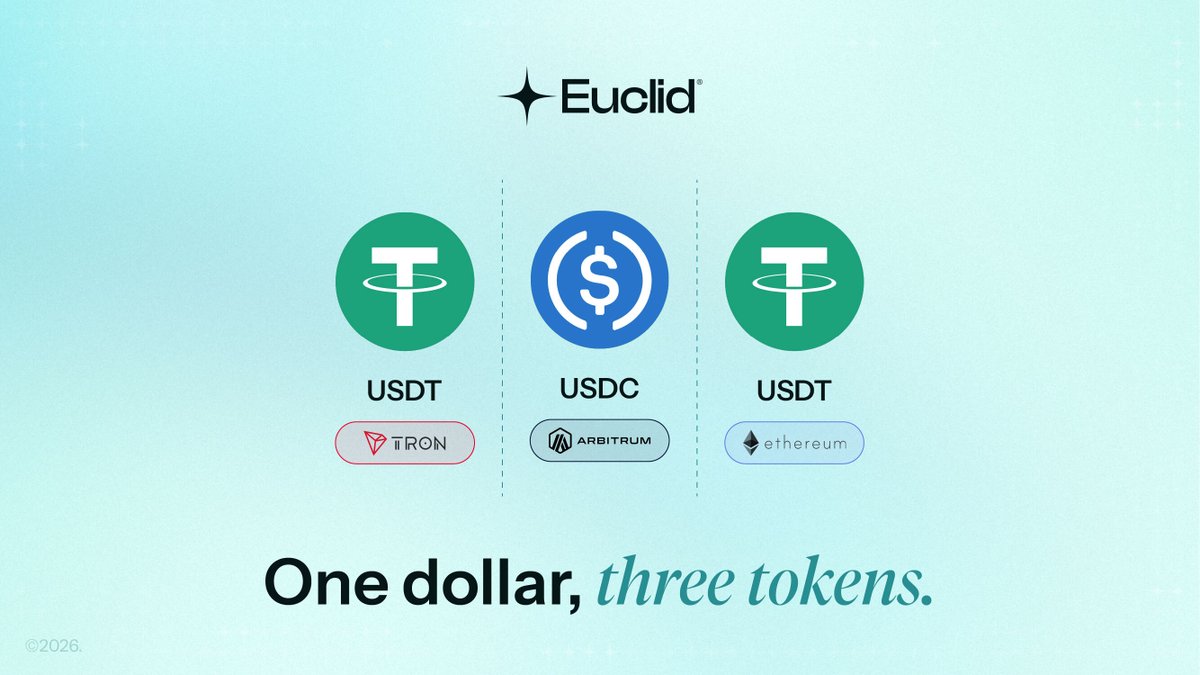
Reality: USDT on Tron. USDC on Arbitrum. USDT on Ethereum.
Three different tokens on three different chains.
Hold one, get paid in another, and someone has to convert or move it first.
Takeaway: One dollar, three tokens. Same dollar on paper. Different money in practice.