Simon Sinek offers a counterintuitive take: The moment you step in and fix the problem, you stop being a leader:
You got promoted because you were the best at the job.
And that's precisely what makes leadership so difficult.
The same instinct that made you great at the work, seeing the problem, knowing the answer, fixing it fast, becomes a liability the moment you move into a leadership role.
Simon is direct about this:
"Then you're not leading. You're just doing the work. You just have the leadership position."
The people who now report to you may not be as good as you. They'll move slower. They'll miss things you would have caught immediately.
And in those moments, every instinct will tell you to step in.
But that instinct is exactly what you have to resist.
"You can't just come in and tell them how you would do it. You have to push them to solve the problems the way that they would, just like someone did for you once before."
Someone once gave you the space to figure it out. That patience is what shaped you. Now it's your turn to offer the same to others.
Simon points to Chanel as a company that has built this principle into its culture.
Newly hired senior leaders are not allowed to speak in meetings for their first three months.
"You don't know anything about our company. And you'll learn by listening."
Chanel trusts that their leaders will be around for the long term, so 90 days of silence is a small price to pay for someone who truly understands the business before they start shaping it.
That's institutionalised patience. And it's almost unheard of.
Most organisations reward speed, decisiveness, and output. So the pressure to swoop in and fix things feels justified, even virtuous.
But Simon draws a hard line between having a leadership position and actually leading.
One is a title. The other is a practice.
And that practice demands something most high performers find deeply uncomfortable. Watching someone struggle toward an answer you already have, and choosing to let them find it themselves.
That restraint is the real work of leadership.
This post from @boristane left me shook. What a powerful call to action.
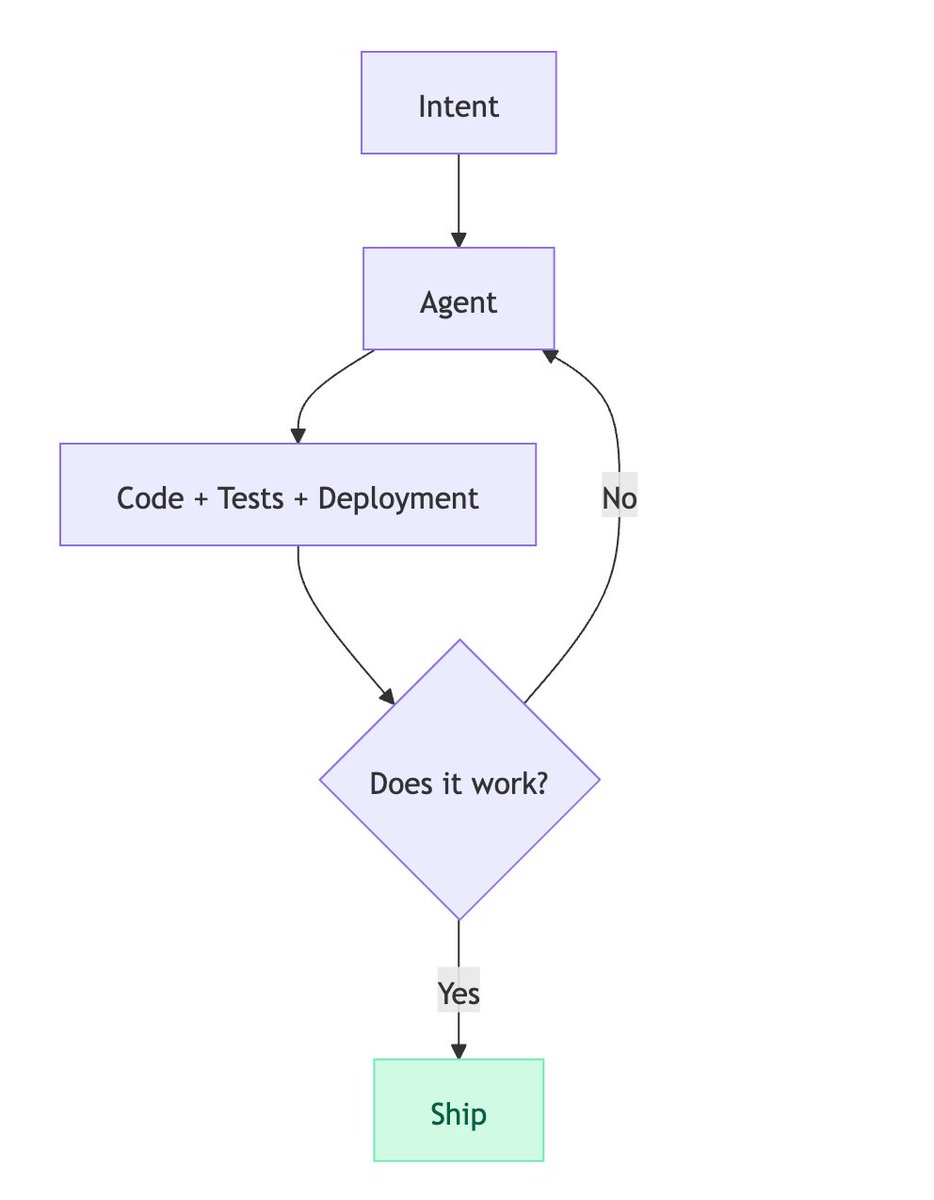
"The SDLC is dead. The new skill is context engineering. The new safety net is observability."
"When every feature took weeks, you had to decide upfront what to build. That constraint is gone."
"Design is becoming something you discover by giving the agent the right context, not something you dictate ahead of time."
"The pull request flow needs to go. I was never a fan, but now it’s just a relic of the past."
"Monitoring is the only stage of the SDLC that survives. And it doesn’t just survive, it becomes the foundation everything else rests on."
Brilliant stuff. https://t.co/Skxcb2tRxH
One thing I was unprepared for in the professional world was how they do layoffs.
There was this one guy who had worked at the company for 10 years.
He had moved closer to the office to cut down his commute.
He had never talked bad about the company, and you could tell that this company was his life.
One day, he gets a call from his boss, who he had worked with for 10 years, and he joins a Zoom. Immediately, HR joins the call, and he knows what's going down.
After that call, laid off.
He goes back to his desk, picks up all his stuff, doesn't even say anything to anyone, doesn't say bye.
I don't blame him, though. He's probably in so much shock.
Gathers all his stuff, walks out the door.
Just like that — 10 years, and gone.
That's how layoffs happen.
And the craziest part was no one around me looked surprised because it is so normalized.
It's just another day in corporate life. And even the people who had known this guy for about 4–5 years weren't surprised.
If you ever think a company cares about you, just know they don't.
They're going to do what's in their best interest, and so should you.
i work in private finance and i can tell you AI is OUT and gnomes are IN as the next big thing for 2026. every investment firm i talk to cant get enough of big mushrooms with small wooden doors, conical red hats, illusion magic, comic mischief, etc
Freelance developers will be the next wave of top earners.
Programming is becoming cheap. Companies are laying off devs due to AI. The era of the bloated 10-person engineering team is ending.
Here is the math of 2026.
The Old Way: Client hires an agency. Result: $50k budget. 3 months timeline. 5 people in meetings. Output: A basic MVP.
The Future Way: Client hires YOU (The AI-Augmented Freelancer). Result: $10k budget. 2 weeks timeline. 0 meetings. Output: A polished product.
The client saves money. You make $20k/month working solo.
The Brutal Truth: Companies are realizing they don't need headcount. They need execution. If you can architect, prompt, and deploy singlehandedly, you are an agency.
Don't look for a job. Look for a problem to solve. Become an army of one.
The best engineers never just wrote code. They were clarity merchants.
The collapse of the implementation middle isn't making engineering less important but it's revealing what was always important: understanding problems so clearly that the code (now, the spec for our agents) becomes more obvious.
The engineers who will thrive aren't those who can translate specs to code fastest. They're the ones who can:
1. Shape ambiguous problems into actionable intent
2. Design the context architecture that makes good outcomes inevitable
3. Judge what matters from what merely works
This mirrors what others have observed about business model shifts: when distribution costs drop to zero, value accrues to curation and taste. When implementation costs approach zero, value accrues to problem formulation and judgment.
The tools that win won't just accelerate the middle but I think they'll eliminate the need for it to exist separately at all.
The craft evolves. It always has. But it remains craft.
PSA for a CTO, Head of AI, VP/Dir of Engineering, CXO:
This is going to be one of the most important "back to work" weeks of your career. You must get your team aligned on agentic dev ASAP. If you're feeling behind or overwhelmed, here are some good reads to get you inspired 🧵
Vibe-coding is not the same as AI-Assisted engineering.
A recent Reddit post described how a FAANG team uses AI and it sparked an important conversation about semantics: "vibe coding" and professional "AI-assisted engineering". While the post was framed as an example of the former, the process it detailed - complete with technical design documents, stringent code reviews, and test-driven development - is a clear example of the latter imo.
This distinction is critical because conflating the two risks both devaluing the discipline of engineering and giving newcomers a dangerously incomplete picture of what it takes to build robust, production-ready software.
As a reminder: "vibe coding" is about fully giving in to the creative flow with an AI (high-level prompting), essentially forgetting the code exists. It involves accepting AI suggestions without deep review and focusing on rapid, iterative experimentation, making it ideal for prototypes, MVPs, learning, and what Karpathy calls "throwaway weekend projects." This approach is a powerful way for developers to build intuition and for beginners to flatten the steep learning curve of programming. It prioritizes speed and exploration over the correctness and maintainability required for professional applications.
There is a spectrum between vibe coding and doing it with a little more planning, spec-driven development, including enough context etc and what is AI-assisted engineering across the software development lifecycle.
In stark contrast to the post, the process described in the Reddit post is a methodical integration of AI into a mature software development lifecycle. This is "AI-assisted engineering," where AI acts as a powerful collaborator, not a replacement for engineering principles. In this model, developers use AI as a "force multiplier" to handle tasks like generating boilerplate code or writing initial test cases, but always within a structured framework.
Crucially, the big difference here is the human engineer remains firmly in control, responsible for the architecture, reviewing and understanding every line of AI-generated code, and ensuring the final product is secure, scalable, and maintainable. The 30% increase in development speed mentioned in the post is a result of augmenting a solid process, not abandoning it.
For engineers, labeling disciplined, AI-augmented workflows as "vibe coding" misrepresents the skill and rigor involved. For those new to the field, it creates the false and risky impression that one can simply prompt their way to a viable product without understanding the underlying code or engineering fundamentals.
If you're looking to do this right, start with a solid design, subject everything to rigorous human review, and treat AI as an incredibly powerful tool in your engineering toolkit - not as a magic wand that replaces the craft itself.
Last quarter I rolled out Microsoft Copilot to 4,000 employees.
$30 per seat per month.
$1.4 million annually.
I called it "digital transformation."
The board loved that phrase.
They approved it in eleven minutes.
No one asked what it would actually do.
Including me.
I told everyone it would "10x productivity."
That's not a real number.
But it sounds like one.
HR asked how we'd measure the 10x.
I said we'd "leverage analytics dashboards."
They stopped asking.
Three months later I checked the usage reports.
47 people had opened it.
12 had used it more than once.
One of them was me.
I used it to summarize an email I could have read in 30 seconds.
It took 45 seconds.
Plus the time it took to fix the hallucinations.
But I called it a "pilot success."
Success means the pilot didn't visibly fail.
The CFO asked about ROI.
I showed him a graph.
The graph went up and to the right.
It measured "AI enablement."
I made that metric up.
He nodded approvingly.
We're "AI-enabled" now.
I don't know what that means.
But it's in our investor deck.
A senior developer asked why we didn't use Claude or ChatGPT.
I said we needed "enterprise-grade security."
He asked what that meant.
I said "compliance."
He asked which compliance.
I said "all of them."
He looked skeptical.
I scheduled him for a "career development conversation."
He stopped asking questions.
Microsoft sent a case study team.
They wanted to feature us as a success story.
I told them we "saved 40,000 hours."
I calculated that number by multiplying employees by a number I made up.
They didn't verify it.
They never do.
Now we're on Microsoft's website.
"Global enterprise achieves 40,000 hours of productivity gains with Copilot."
The CEO shared it on LinkedIn.
He got 3,000 likes.
He's never used Copilot.
None of the executives have.
We have an exemption.
"Strategic focus requires minimal digital distraction."
I wrote that policy.
The licenses renew next month.
I'm requesting an expansion.
5,000 more seats.
We haven't used the first 4,000.
But this time we'll "drive adoption."
Adoption means mandatory training.
Training means a 45-minute webinar no one watches.
But completion will be tracked.
Completion is a metric.
Metrics go in dashboards.
Dashboards go in board presentations.
Board presentations get me promoted.
I'll be SVP by Q3.
I still don't know what Copilot does.
But I know what it's for.
It's for showing we're "investing in AI."
Investment means spending.
Spending means commitment.
Commitment means we're serious about the future.
The future is whatever I say it is.
As long as the graph goes up and to the right.