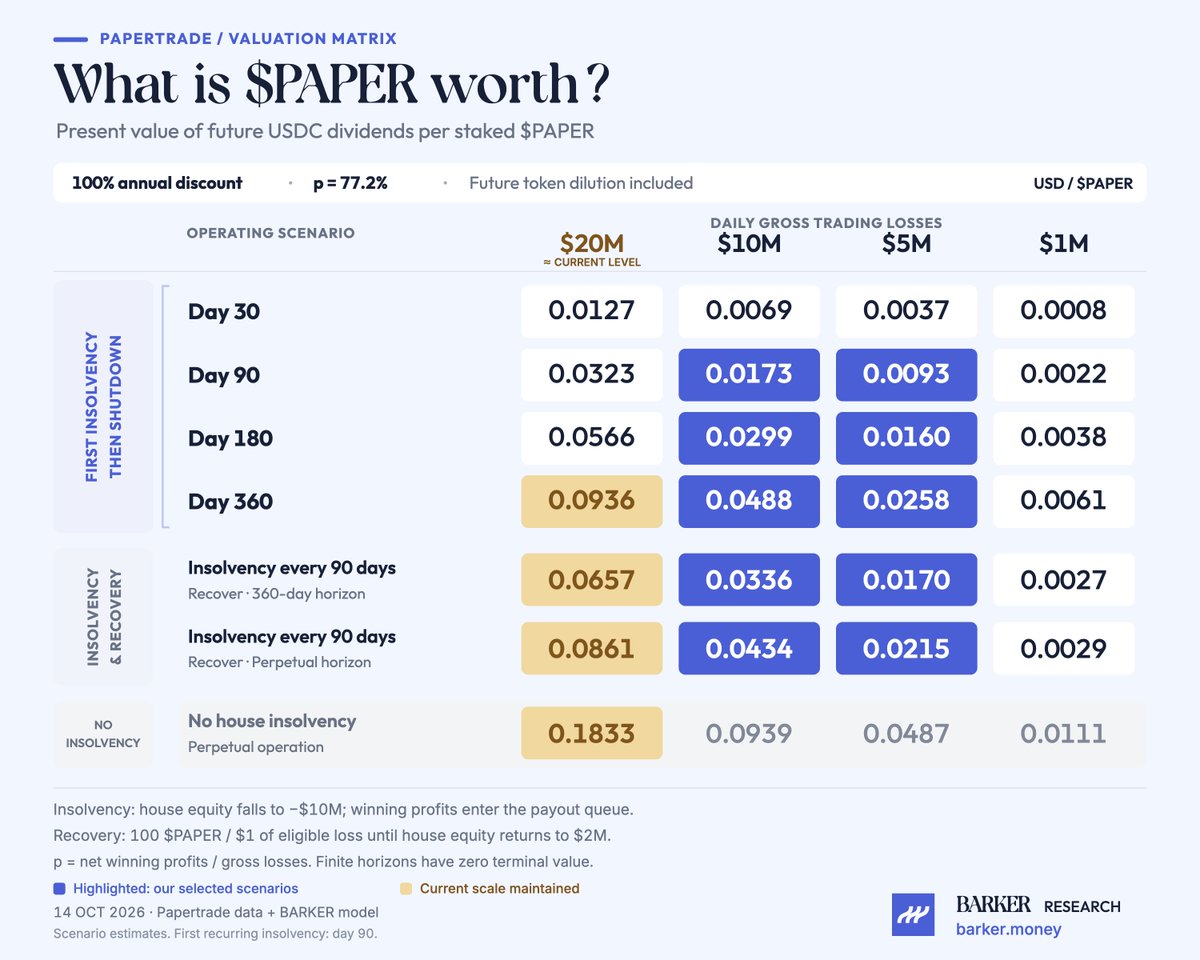
What is $PAPER worth if daily gross trading losses stay near $20M?
Papertrade’s issuance curve connects trader losses, token dilution and staking dividends. We mapped out what that means for valuation.
🔵 Our selected scenarios
🟡 Current scale, longer horizons
Full analysis in the quoted post.
@papertrade_xyz@paperstrategy_@izebel_eth
What is $PAPER worth if Papertrade keeps generating ~$20M in daily gross trading losses—or activity falls sharply?
I modeled 28 scenarios across business scale, shutdown and recovery, accounting for future dilution and staking dividends. https://t.co/tQkDqmnlVc
What is $PAPER worth if Papertrade keeps generating ~$20M in daily gross trading losses—or activity falls sharply?
I modeled 28 scenarios across business scale, shutdown and recovery, accounting for future dilution and staking dividends. https://t.co/tQkDqmnlVc
What is $PAPER worth if Papertrade keeps generating ~$20M in daily gross trading losses—or activity falls sharply?
I modeled 28 scenarios across business scale, shutdown and recovery, accounting for future dilution and staking dividends. https://t.co/tQkDqmnlVc
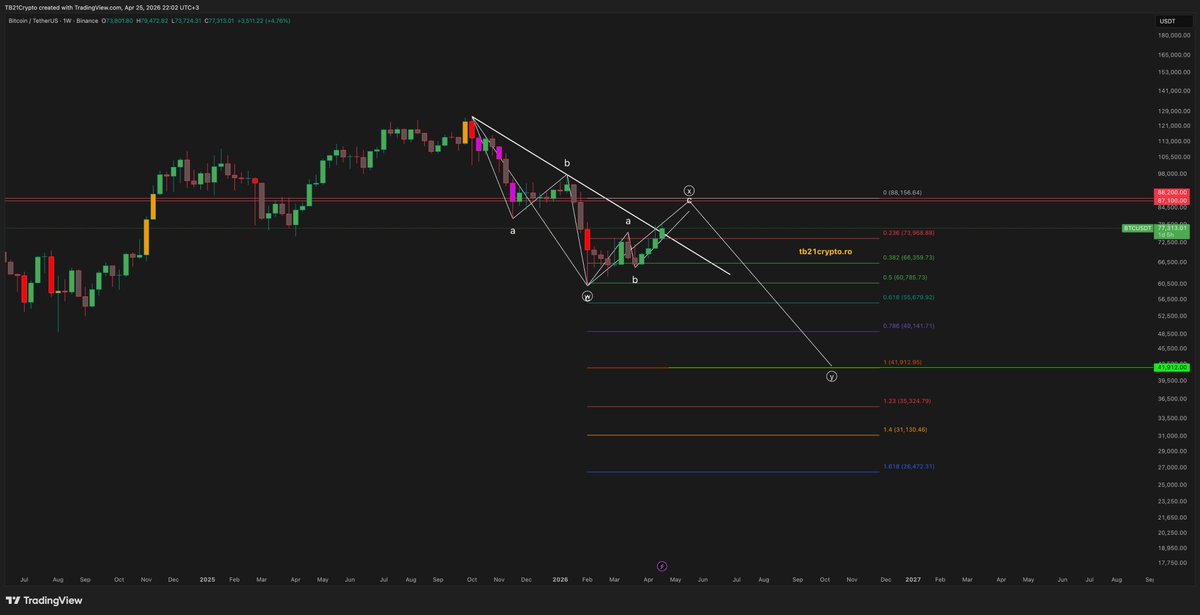
$BTC WXY
BTC is doing nothing more than respecting an algorithm that has been working for over 10 years in bear markets. Most people, because they don’t understand what a bear market structure looks like, aggressively assume at the first major correction that the bottom was at $60,000, which is not true.
Unfortunately, things are much simpler than that, but most people refuse to accept it, constantly searching for so-called “miracle solutions” that don’t exist.
After the completion of wave X in the $87,000–$88,000 zone, the final target area will be at the 1 Fibonacci level, but for that we still need a bit more time.
--------------DYOR
https://t.co/1jSOh9u9fC
Cześć!
Widzimy duże zainteresowanie tematem Zondy w Polsce i rosnącą potrzebę edukacji wokół bezpieczeństwa w krypto.
Chcemy przygotować materiał / współpracę, która pokaże realne alternatywy i pomoże użytkownikom lepiej zarządzać ryzykiem.
Daj znać, czy ten temat Cię interesuje – możemy coś wspólnie z MEXC zrobić!
@gab_riel4k Roi from MEXC KOL BD here. If you're into referral/earn opps, our affiliate program pays up to 70% lifetime commissions on trades from your refs, plus 0 spot fees and strong liquidity for BTC pairs + alts/memes. Happy to share details if interested!
@launchnodes@foundation_gsr Cool initiative with Philanthropy 3.0! If your community ever trades ETH yields on low-fee platforms, MEXC has 0% maker fees 👀 Happy to chat more if interested.
One important technical item that I forgot to mention is the proposed switch from Casper FFG to Minimmit as the finality gadget.
To summarize, Casper FFG provides two-round finality: it requires each attester to sign once to "justify" the block, and then again to "finalize" it. Minimmit only requires one round. In exchange, Minimmit's fault tolerance (in our parametrization) drops to 17%, compared to Casper FFG's 33%.
Within Ethereum consensus discussions, I have always been the security assumptions hawk: I've insisted on getting to the theoretical bound of 49% fault tolerance under synchrony, kept pushing for 51% attack recovery gadgets, came up with DAS to make data availability checks dishonest-majority-resistant, etc. But I am fine with Minimmit's properties, in fact even enthusiastic in some respects. In this post, I will explain why.
Let's lay out the exact security properties of both 3SF (not the current beacon chain, which is needlessly weak in many ways, but the ideal 3SF) and Minimmit.
"Synchronous network" means "network latency less than 1/4 slot or so", "asynchronous network" means "potentially very high latency, even some nodes go offline for hours at a time". The percentages ("attacker has <33%") refer to percentages of active staked ETH.
## Properties of 3SF
Synchronous network case:
* Attacker has p < 33%: nothing bad happens
* 33% < p < 50%: attacker can stop finality (at the cost of losing massive funds via inactivity leak), but the chain keeps progressing normally
* 50% < p < 67%: attacker can censor or revert the chain, but cannot revert finality. If an attacker censors, good guys can self-organize, they can stop contributing to a censoring chain, and do a "minority soft fork"
* p > 67%: attacker can finalize things at will, much harder for good guys to do minority soft fork
Asynchronous network case:
* Attacker has p < 33%: cannot revert finality
* p > 33%: can revert finality, at the cost of losing massive funds via slashing
## Properties of Minimmit
Synchronous network case:
* Attacker has p < 17%: nothing bad happens
* 17% < p < 50%: attacker can stop finality (at the cost of losing massive funds via inactivity leak), but the chain keeps progressing normally
* 50% < p < 83%: attacker can censor or revert the chain, but cannot revert finality. If an attacker censors, good guys can self-organize, they can stop contributing to a censoring chain, and do a "minority soft fork"
* p > 83%: attacker can finalize things at will, much harder for good guys to do minority soft fork
Asynchronous network case:
* Attacker has p < 17%: cannot revert finality
* p > 17%: can revert finality, at the cost of losing massive funds via slashing
I actually think that the latter is a better tradeoff. Here's my reasoning why:
* The worst kind of attack is actually not finality reversion, it's censorship. The reason is that finality reversion creates massive publicly available evidence that can be used to immediately cost the attacker millions of ETH (ie. billions of dollars), whereas censorship requires social coordination to get around
* In both of the above, a censorship attack requires 50%
* A censorship attack becomes *much harder* to coordinate around when the censoring attacker can unilaterally finalize (ie. >67% in 3SF, >83% in Minimmit). If they can't, then if the good guys counter-coordinate, you get two non-finalizing chains dueling for a few days, and users can pick on. If they can, then there's no natural schelling point to coordinate soft-forking
* In the case of a client bug, the worst thing that can happen is finalizing something bugged. In 3SF, you only need 67% of clients to share a bug for it to finalize, in Minimmit, you need 83%.
Basicallly, Minimmit maximizes the set of situations that "default to two chains dueling each other", and that is actually a much healthier and much more recoverable outcome than "the wrong thing finalizing".
We want finality to mean final. So in situations of uncertainty (whether attacks or software bugs), we should be more okay with having periods of hours or days where the chain does not finalize, and instead progresses based on the fork choice rule. This gives us time to think and make sure which chain is correct.
Also, I think the "33% slashed to revert finality" of 3SF is overkill. If there is even eg. 15 million ETH staking, then that's 5M ($10B) slashed to revert the chain once. If you had $10B, and you are willing to commit mayhem of a type that violates many countries' computer hacking laws, there are FAR BETTER ways to spend it than to attack a chain. Even if your goal is breaking Ethereum, there are far better attack vectors.
And so if we have the baseline guarantee of >= 17% slashed to revert finality (which Minimmit provides), we should judge the two systems from there based on their other properties - where, for the reasons I described above, I think Minimmit performs better.