We've opened a proposal to simplify how you connect the PowerSync SDKs to your backend. It would let you choose upload-only, download-only, or two-way sync.
It also smooths out several paper cuts 😊
https://t.co/IXXAM1WrpF
A PowerSync community member built a multi-threaded in-memory SQLite connection pool for PowerSync Web.
It was waaaay faster than our persistent OPFS options for his read-heavy workload. He published a benchmark: a three-connection pool delivered 49% lower median concurrent-read latency than our single-connection InMemoryVFS. Sequential-query latency was pretty much unchanged i.e. the benefit came from parallelism.
Inspired by that work, we built something _even faster_ into the PowerSync Web SDK.
InMemoryWriteAheadLogPool runs one designated writer and a configurable number of reader workers over shared database and write-ahead-log buffers. Multiple reads can execute in parallel, including while a write is in progress.
This is intended for highly concurrent, online-only workloads with relatively small synced datasets. It is per-tab and non-persistent, requires cross-origin isolation, and trades additional worker startup and memory usage for query concurrency.
One of the better offline-first case studies I have seen: a 2M-row sync design failed its target, so the team changed the data shape and cut wire volume by three orders of magnitude. Includes self-hosted Kubernetes, Postgres, scaling, and failure recovery.
https://t.co/4Iu66qa6qP
I regularly see teams that are getting tired of REST polling.
Today a customer told us they’re actively trying to route as much as possible through sync specifically to avoid building more REST APIs.
I’m still bullish that sync engines are a meaningfully better architecture than traditional request/response for a lot of collaborative and offline-capable apps.
Still plenty of hard problems to solve though...
We often speak to customers that are syncing massive (1GB+) volumes into SQLite
This is something we'll have better support for over time, but a good workaround for now is to use the PowerSync SQLite Seeder community project
Meet the winners of the PowerSync AI Hackathon! 🏆
Huge thanks to everyone who participated in the PowerSync AI Hackathon — we were blown away by the submissions
Today we launched the beta of Sync Streams, our new partial sync architecture that is the successor to legacy Sync Rules.
Sync Streams is a flexible format that lets you define exactly which data from your backend can sync to each client using simple SQL-like queries.
Great news! @supabase will be sponsoring additional prizes for the winners of the PowerSync AI hackathon, and also $25 in credits to every participant 🥳 ⚡️
https://t.co/hTNT8MK82Z
I wrote another blog post!
Apparently building apps that work offline sounds scary to people
Turns out it's not that scary, just a matter of making the right tradeoffs at the right time
At @powersync_ we're obsessed with our customers. We are nothing without them.
When it comes to supporting customers, companies typically have a "Customer Success" team that is the primary interface with customers. However, we're a devtool company and our CS Engineers need to be first-class engineers to work with customers effectively.
We've also learnt, from over a decade in the devtool space, that your CS engineers have some of the best product insights.
When we needed to create our CS team for PowerSync, we decided to flip the script: we created a Product Success Engineering team. The idea being that our CS engineers would contribute to the product directly (as in merged PRs).
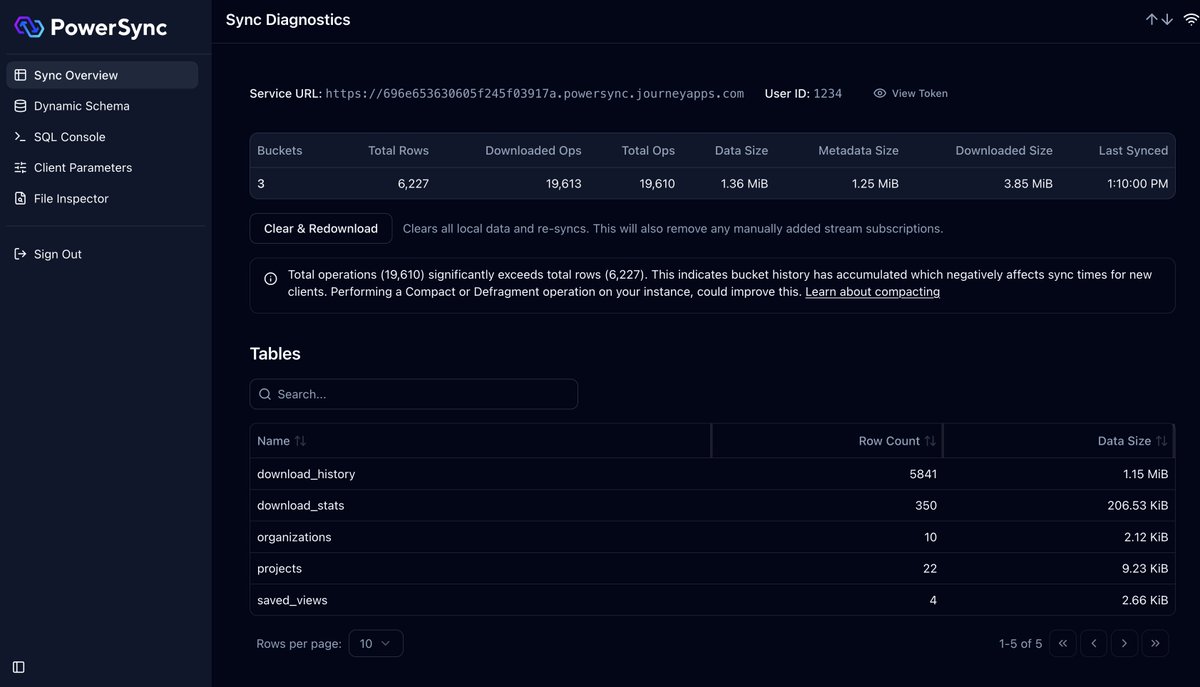
This has been working really well for us - they've been contributing extensively. The recent step change in agentic coding capabilities has just accelerated this flywheel - today we released a new Sync Diagnostics Client in the PowerSync Dashboard built by the PSE team.
What if you could get all the benefits and capabilities of modern sync engines without giving up your existing tech stack?
Learn more about how PowerSync makes building modern and agentic applications simple in our latest blog post “Unleashing the Power of Sync”