👖 He delivers again! 👖
Truett Hanes goes 2:36:56 in jeans to finish fourth overall in the open field at the Austin Marathon 😌
He averaged a 6:00 mile pace in denim.
📸 skylersharpphoto
Brendan Fraser and Rachel Weisz will return for a new ‘THE MUMMY’ movie
Matt Bettinelli-Olpin & Tyler Gillet (‘Scream 5’) are set to direct.
(Source: https://t.co/5aPg1ULy2A)
I’m about 2 seconds away from texting Jolin and telling her to call Sherrone right now and tell him he’s gone if we don’t let the kid throw the football.
Susie from Alabama says if she wins the $2 billion power ball she’s going to use her first $70 million to pay Kalen DeBoer’s buyout. This is so great. God bless SEC football:
MY OPEN LETTER TO PRESIDENT TRUMP
The frustrating part is that I was on board for a reset. Truly. I’ve said it publicly. I’ve written about it in this very feed. I understood the need for a detox. For decades, the U.S. economy played the part of the rich guy at the table -- picking up the check for a global order that no longer worked in our favor. We hollowed out our industrial base. We enabled unfair trade imbalances under the illusion of diplomacy. We subsidized demand for cheap imports while outsourcing the hard questions about how our domestic workforce would adapt.
Eventually, that had to stop. It was unsustainable -- financially, politically, and morally. We couldn’t keep pretending that a consumption-led economy held together by zero-interest rates and global fragility was a long-term solution. I wanted a rebalancing. I welcomed the idea of a harder, smarter America-first policy that pushed for fair treatment, reciprocal agreements, and a real industrial strategy rooted in technological superiority, national security, and capital formation. That would’ve been leadership.
But that’s not what this is.
What you’ve rolled out isn’t detox -- it’s whiplash. This isn’t strategic decoupling. It’s scattershot retaliation dressed up as reform. There’s no roadmap. No operational playbook. No clear articulation of where this ends or what the metrics of success even are. It’s not an attempt to responsibly unwind America’s role as the global shock absorber -- it’s a brute-force attempt to disorder the existing system with no viable alternative in place.
You can’t replace a fragile supply chain with chaos and call it resilience. You can’t build American industry by torching the scaffolding that underpins capital flows, labor mobility, and global coordination -- especially when the U.S. itself no longer has the domestic capacity to meet its own industrial needs. You talk about bringing jobs home, but the U.S. doesn’t have the labor force, permitting structure, or wage flexibility to stand up full-scale manufacturing at speed. And now -- after years of deportation policies and underinvestment in vocational training -- you’ve made the labor gap even wider.
Capital isn’t going to rush to fill that void just because you raised tariffs. It’s going to wait. It’s going to sit on the sidelines and preserve optionality. Because right now, no CEO can confidently model a five-year capex plan. No board can greenlight supply chain onshoring when they don’t know whether a tariff rate will double next quarter based on your Twitter account or some arbitrary trade deficit formula.
That’s the issue. This wasn’t rolled out as part of a comprehensive American renewal strategy. It wasn’t coordinated with the Fed. It wasn’t communicated clearly to Treasury. It wasn’t backed by a labor reskilling program or any form of public-private manufacturing incentive beyond empty slogans. It was dropped like a bomb -- seemingly designed more to shock than to build.
And in the absence of credible structure, capital is retreating -- not realigning.
I was ready to endure the pain of a thoughtful, structured reset. Most long-term investors were. We’ve lived through tightening cycles. We understood that globalization, as it stood, had reached a breaking point. But this isn’t a correction of imbalances. This is a rupture without scaffolding.
What you’ve created isn’t reindustrialization. It’s an intentional sabotage of capital planning. No executive is going to build a factory with four-year political horizon risk, a floating tariff regime, and no labor certainty. No investor is going to fund expansion in a market where the basic cost of imports can change weekly based on what country has a current account surplus that week. The system you’ve launched isn’t designed for certainty. It’s designed for control.
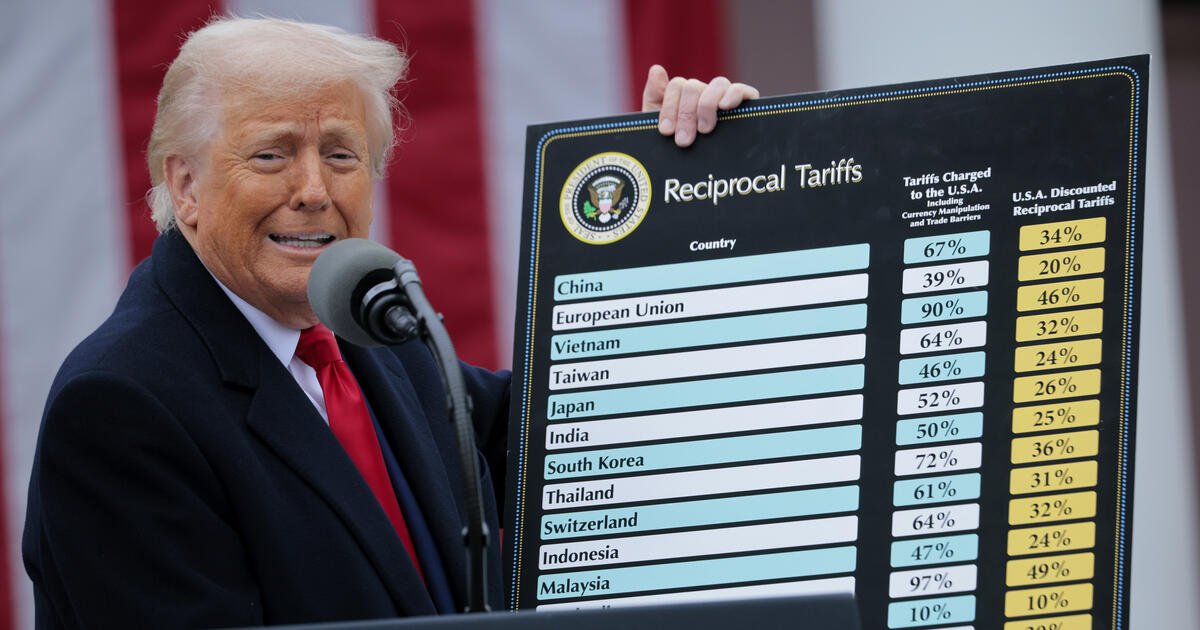
And the irony is -- we’re not even punishing bad actors. We’re punishing everyone. Allies. Poor countries. Longstanding partners. Israel gets slapped with 17% tariffs while dismantling their own to support American imports. Vietnam gets hit with 46% because it’s become too productive. Lesotho, one of the poorest countries on Earth, faces a 50% tariff because it doesn’t buy enough U.S. goods -- as if that were a sign of unfairness rather than poverty. It’s incoherent. It’s cruel. And it undermines any claim to moral high ground.
You say this is about protecting American workers. But no worker is helped by policy so erratic that no employer wants to hire. No consumer is helped when import costs rise and domestic capacity doesn’t exist to replace them. No investor is helped when the cost of capital spikes in the face of weaponized uncertainty.
This is not a plan to make America stronger. It’s a gamble that markets and allies will blink first. It’s brinkmanship with no floor.
And the most maddening part? There was a path. A real one. A version of this policy that could’ve worked -- not in headlines or soundbites, but in practice. A path that applied pressure with purpose, that aligned economic force with long-term national interest, that sent a clear message to adversaries and partners alike without destabilizing global commerce or blindsiding capital allocators.
You could’ve gone after China -- hard -- and had the backing of nearly every serious investor and strategist on the Street. Not just because of trade deficits or currency suppression, but because China has been actively undermining our economy and our people. I would’ve supported a four-year plan to end all dependence on Chinese manufacturing unless they stopped stealing American IP (DeepSeek). No more games. Make it explicit: if they don’t comply, we’ll back Taiwanese independence and bring the entire global semiconductor economy with us. No ambiguity. No half-threats. As I see it, China is at war with us -- and our policy should reflect that.
With the EU, you could’ve played it clean. Match auto tariffs percent-for-percent. That’s fair. And then leave the rest alone -- especially goods and services. We run a huge surplus on services with the EU. It props up some of our biggest competitive advantages -- enterprise software, consulting, cloud, defense tech, streaming, media IP. Tariffing the EU outside of autos would be like shooting your own foot for balance. We’re not in a trade war with Europe. We're in a competition for global enterprise dominance -- and right now, the U.S. is winning.
That’s what real strength would’ve looked like. That’s what an America-first trade doctrine could’ve achieved. You’d be rebuilding the system from the inside out -- not just throwing bricks through the windows and calling it a redesign.
Investors would’ve backed it. CEOs would’ve planned around it. Global partners would’ve respected it -- even if they didn’t like it. And capital would’ve flowed toward American resilience instead of retreating from American unpredictability.
But instead of that, you went with chaos. And now, confidence is shattered. Not because the numbers are bad -- but because no one knows what the numbers mean anymore.
That’s the cost of burning down the rules without building new ones.
So no, this is not the detox we needed. It’s not strategic decoupling. It’s not a path to renewal. It’s a slow, loud dismantling of the very foundation that has allowed American capital, innovation, and enterprise to dominate for decades. And it didn’t have to be this way.
But now we’re here. And the market is reacting accordingly -- not to the fundamentals, but to the sense that the future may no longer be modelable. That’s not a trade. That’s an exit.
I don’t want this post to be hyper-political. This isn’t about red or blue. It’s not about the 2024 election cycle. It’s not about ideology. It’s about strategy. It’s about execution.
It’s about understanding that when you're the United States -- when you sit at the helm of the global economic engine -- every policy you roll out reverberates through capital markets, supply chains, boardrooms, and governments. Words become signals. Signals become pricing. Pricing becomes pain -- or progress.
And I hope -- for the sake of the markets, for the sake of businesses trying to plan, and for the future we’re all investing into -- that it’s not too late to recalibrate.
Because we don’t need more noise.
We need a plan.
To illustrate just how nonsensically these tariffs were calculated, take the example of Lesotho, one of the poorest countries in Africa with just $2.4 billion in annual GDP, which is being struck with a 50% tariff rate under the Trump plan, the highest rate among all countries on the list.
Why? Does Lesotho apply extortionate tariffs on U.S. products and the U.S. is merely being "reciprocal" here? Not at all, despite what Trump is saying, it's NOT the way these tariffs are defined.
As a matter of fact Lesotho, as a member of the Southern African Customs Union (SACU), applies the common external tariff structure established by this regional trade bloc.
Which means it applies the same tariffs on U.S. products as South Africa does, as well as the 3 other members of the bloc: Namibia, Eswatini and Botswana.
So since the tariffs charged by these 5 countries on U.S. products are exactly the same, they must all be struck with a 50% tariff rate by the U.S., right? Not at all: South Africa is getting 30%, Namibia 21%, Botswana 37% and Eswatini just 10%, the lowest rate possible among all countries.
So what gives? Again, the way these tariffs are calculated has absolutely zero relationship with actual tariffs imposed by these countries on U.S. products. Instead, they appear to be simply derived from trade deficit calculations.
Looking at Lesotho specifically, every year the U.S. imports approximately $236 million in goods from Lesotho (primarily diamonds, textiles and apparel) while exporting only about $7 million worth of goods to Lesotho (https://t.co/uHvem6nH2o).
Why do they export so little? Again this is an extremely poor country where 56.2% of the population lives with less than $3.65 a day (https://t.co/GEho8xFjAp), i.e. $1,300 a year. They simply can't afford U.S. products, no-one is going to buy an iPhone or a Tesla on that sort of income...
The way the tariffs are ACTUALLY calculated appears to be based on a simplistic and economically senseless formula: you take the trade deficit the U.S. has with a country, divide it by that country's exports to the U.S and declare this - falsely - "the tariff they charge on the U.S."
And then as Trump did in his speech last night, you magnanimously declare that you'll only "reciprocate" by charging half that "tariff" on them.
As such, for Lesotho, the calculation goes like this: ($236M - $7M)/$235M = 97%. That's the "tariff" Lesotho is deemed to charge this U.S. and half of that, i.e. roughly 50% is what the U.S. "reciprocates" with.
It's extremely easy to see why this makes no sense at all.
First of all, there's nothing Lesotho can do about it: they can't change tariffs they allegedly charge the U.S. to reduce the tariff rate the U.S. "reciprocates" with because, again, it's NOT based on any tariff that they charge.
Similarly they can't do much about reducing the trade deficit they have with the U.S. because, again, they simply don't have enough money to buy U.S. products.
Also the main rational Trump gave for the tariffs is to get production back to the U.S., to "bring manufacturing back". 47.3% of Lesotho's exports are diamonds: how do you bring the "manufacturing" of that "back to the U.S."? Anyone can see it makes just about zero sense.
The Lesotho example exposes the fundamental economic incoherence of these tariffs. Rather than addressing actual trade barriers, they punish countries based on trade deficits that arise from structural economic realities. All the more countries like Lesotho which pose zero competitive threat to American industry.
Worse yet, these tariffs will likely make these structural realities even worse: the U.S. is Lesotho's second most important export destination so it's a fair bet that applying 50% tariffs on their products will make people in Lesotho even poorer, and therefore even LESS able to afford U.S. products.
But perhaps the most unfair and detrimental aspect of all this is that these tariffs represent a complete reversal of longstanding U.S. development policy, and therefore a betrayal of countries - like Lesotho - who chose to follow U.S. advice in the past.
For decades the U.S. has used preferential trade access to encourage economic development in the world's poorest nations, recognizing that trade, not just aid, could get them out of poverty and ultimately put them in a position where they too could afford iPhones or Tesla.
They're now effectively penalizing countries for following previous U.S. policy, a lesson which I bet they won't forget anytime soon.
So all in all the irony is painful: in the name of fighting unfair trade, America has just demonstrated what truly unfair trade looks like.
This isn't something designed to address genuine trade issues, but simply a mechanism based on arbitrary math to punish countries for the affront of selling more to the United States than they buy.