Developer and part time trader. Your research must be done by yourself. --แอคนี้เอาใว้เพื่อบ่นไปเรื่อย-- **im not trades for living** but I’m good imo kek.
One pattern I find useful when watching perps in crypto is over excited traders. A few places its common is at the top/bottom end of ranges also the end of an extended trending move. A few tools for spotting this live is open interest, liquidations and regular candlestick charts. Open interest for direct positioning in correlation with candlestick size which tells intent. Relative liquidation spikes are also a sign of enough people being wiped out in order for a local reversal/snap back. If you see them all together you have good fuel for a reversal with good fuel behind it. The outcome is you are able to spot where there is enough fuel for a larger reversal and are able to bet on that subsequent movement before it has been priced in.
Formation complète Claude Code 6 HEURES.
La formation Claude la plus complète d'internet.
Gardez-la précieusement en Signet 🔖
de A à Z : configuration, création de workflows, déploiement de sites web, création d'équipes d'agents, automatisation du navigateur, recherche de clients et tarification de vos services.
Le tout sans écrire une seule ligne de code.
À la fin : vous utilisez Claude Code comme un pro et vous monétisez vos compétences.
Débutant ou avancé, tout est là en un seul endroit, ce cours couvre tout.
Ça vaut plus que tous les cours à 500$ que t’as failli acheter.
I received $6 in USDT back just by spending with my Tria card.
Spend crypto, earn real rewards, and use your Tria card across 150+ countries.
#MyTriaCashback
Get your Tria card now:
https://t.co/AxUR51Wq8V
I SAW THIS ARTICLE AT 11:27 PM AND DIDN’T SLEEP UNTIL 4:11 AM
Read it three times, then just... started building.
Took the Avellaneda-Stoikov quoting logic.
Wired it to the Hawkes process for order flow.
Added the VPIN circuit breaker exactly like the article says.
Ran 500 simulations tonight:
> Mean P&L: +$312/session
> Sharpe: 1.87
> Win rate: 68%
> VPIN saves: 11 sessions
> Max drawdown: -$890
The VPIN part is insane btw, 11 times it pulled my quotes before informed flow ran me over, without it sharpe goes negative, just like that.
Kyle's lambda estimation is literally 30 lines of python, i had no excuse not to build this.
Side effect, now i can't sleep.
I recorded a 20-min tutorial on how to read the footprint correctly
0:16 - passive/aggressive flow
1:37 - tick sizes
4:02 - clusters vs profiles
6:00 - positioning
11:30 - aggregated data
14:05 - example trade
15:20 - nuances
16:53 - highs/lows
18:52 - context
You’re going to have several setbacks along the way.
I would love to be able to tell you that it’s a straight line path from evaluation to Sim funded to live. But that would be a complete lie.
You’re going to have a stretch, stretches of time or weeks of success. Make you think that you’ve got this all figured out. Let me assure you, you do not.
I’ve been in markets for over 20 years and I still make many of the same mistakes I’ve made in the past and I will continue to make those same mistakes …
Sometimes you do everything right or you’re just aggressive at the wrong time and it cost you money.
This is the business of Risk and there’s no way around it.
Most people will run out of time or run out of money before they run out of lessons to learn. Godspeed.
Your brain thinks gambling is normal because you've gotten it used to constant euphoria. You see pnl swings equivalent to the amounts people see in across their entire lives. You constantly hunt for 10x or 50x trades that make anything below that seem disgusting. Your job should be to make trading boring, make the long/short button not feel like a slot machine. Spend a few weeks developing a system whilst aiming for reasonable 2-5r monthly returns. Give yourself a real chance of turning this into an actual career.
@jlashleygaming @shubham240202@splinter0n@WhaleInsider Actually it went fron 122k to 102k and this is almost 19%. Which some alt went through -99% so that why.
The Psychological Stages of a Trend
STAGE 1: Skepticism
> Early meta shifts are met with extreme skepticism
> The majority would rather bet on the more recent, strongly conditioned meta than adapt to the new information being presented.
> A minority of early meta adopters set out to vocalize the shifting tides to the masses and are met with mixed reception.
STAGE 2: The Momentum Crescendo
> With time, the new meta (trend) will lead to a trickle-in effect of participation as they begin to acknowledge and get comfortable with the new information.
> Many participants increase exposure to the trend as it accelerates and as their confidence in the trend grows. i.e small bets early and bigger bets later
> A new feedback loop begins to form. This is when the conditioning effects of the new meta take place.
> A trend will continue for a while even after the overwhelming majority of participants agree on the direction.
> Contrarian traders begin to appear, i.e. "Everyone is bearish therefor I am bullish"
note: fading confident sentiment works best in slowing momentum and poorly in strong momentum.
STAGE 3: Divergence
> Over time, conditioning effects will breed increasingly overconfident market participants willing to bet bigger and bigger on the current meta.
> The momentum of the trend begins to wane and produce less intense results.
> Late trends are met with a divergence between confidence and momentum.
> Rising confidence; waning momentum
> The decrescendo begins.
Lessons:
In risk markets it's wise to bet heaviest early in trend development when there is most skepticism. Maintain that position as other begin to flow in, then wane risk over time as the meta breeds a plethora of now overconfident betters.
Fading sentiment works well when participants get seemingly get louder the more momentum slows. The divergence is actionable.
The majority will be loudest and bet biggest after they become certain; a lethal game.
"It's what you know that kills you"
Trading is hard because don't know what to do, you have no process. That's 80% of the battle. Once you have extreme clarity on what you want to see & where you want to see it, everything else is quite simple. It then becomes a game of testing and refining.
Something I see traders get wrong time and time again is supply & demand
Too many get caught up with the "X candle that led to a Y move that broke Z structure" stuff
Instead, you should be focussed on the following question:
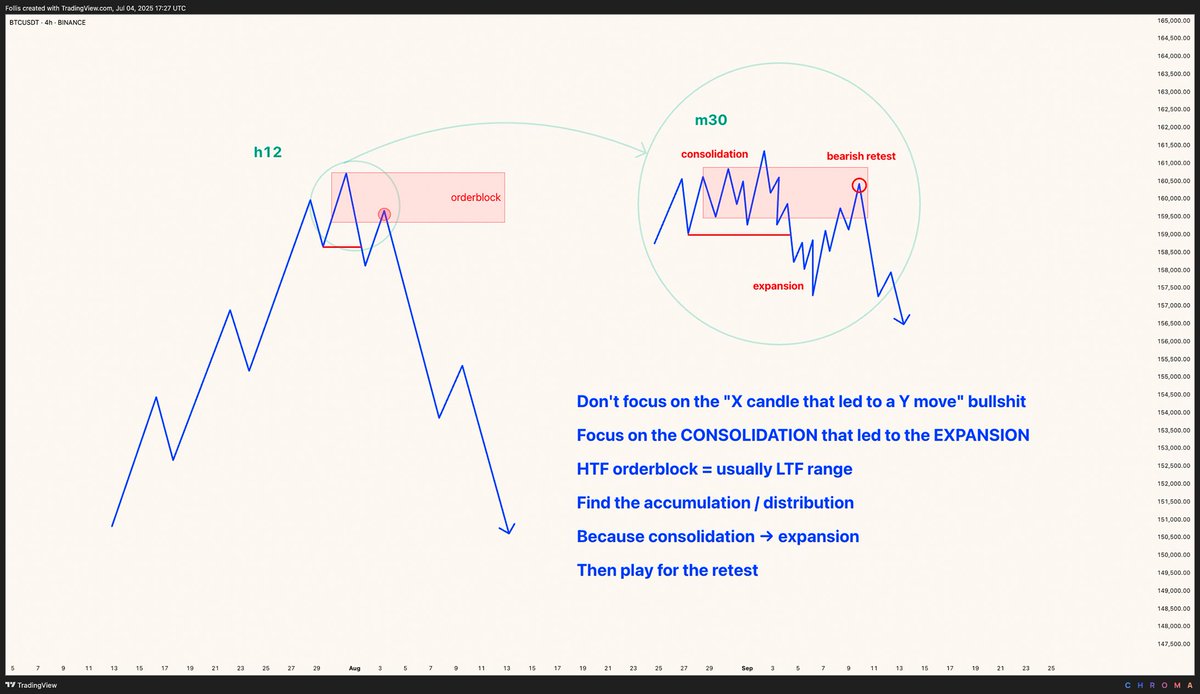
What was the CONSOLIDATION that led to the EXPANSION?
HTF orderblock candles are usually LTF consolidation ranges
This chart illustrates what I mean by this
So when you are looking for an supply/demand zone or orderblock to be retested
What you are actually looking for is a retest of that consolidation range
Which is exactly how we are taught to trade range breakouts — you wait for the retest, then play the confirmation
Consolidation → expansion