There's a physicist at Stanford named Safi Bahcall who modeled this exact principle and the math is wild.
He calls it "phase transitions in human networks." When you're stationary, your probability of a lucky event is limited to your existing surface area: the people you already know, the places you already go, the ideas you've already been exposed to. Your opportunity window is fixed.
When you move, your collision rate with new nodes in a network increases nonlinearly. Double your movement (new conversations, new cities, new projects) and your probability of a serendipitous encounter doesn't double. It roughly quadruples. Because each new node connects you to their entire network, not just to them.
Richard Wiseman ran a 10-year study at the University of Hertfordshire tracking self-described "lucky" and "unlucky" people. The single biggest differentiator wasn't IQ, education, or family money. Lucky people scored significantly higher on one trait: openness to experience. They talked to strangers more, varied their routines more, and said yes to invitations at nearly twice the rate.
The "unlucky" group followed the same routes, ate at the same restaurants, and talked to the same 5 people. Their networks were closed loops. No new inputs, no new collisions.
Luck isn't random. Luck is surface area. And surface area is a function of movement.
The lobster emoji is doing more work than most people realize. Lobsters grow by shedding their shell when it gets too tight. The growth requires a period of total vulnerability. No protection, no armor, soft body exposed to the ocean.
That's the cost of movement nobody posts about. You have to be uncomfortable first. The new shell only hardens after you've already moved.
The Great Replacement isn’t theory; it’s code overwriting human labor, and the pace is brutal. If you’re not alarmed, you’re not looking at the numbers.
The data paints a grim picture. In 2025 alone, companies directly blamed AI for 55,000 job cuts, 12 times more than just two years earlier. Challenger, Gray & Christmas tracked it, and the trend exploded into 2026. In January, U.S. employers announced over 108,000 planned layoffs, with AI cited in about 7% but lurking as a shadow driver across many more. By mid-March 2026, 171 layoffs at tech companies alone had already claimed 55,911 jobs, that’s 736 people per day, outpacing all of 2025’s daily average of 674.
Amazon confirmed 16,000 corporate cuts to start the year, with another 14,000 reportedly on deck for Q2, potentially erasing nearly 30,000 roles in a single year. Block slashed nearly half its workforce, over 4,000 people, explicitly tying it to AI enabling “smaller and flatter teams.” WiseTech Global followed with 2,000 layoffs, calling traditional approaches to writing and maintaining code increasingly obsolete. Atlassian cut 1,600 jobs, 10% of its workforce, pivoting to AI. UPS, Dow Chemical, Pinterest, CrowdStrike, Chegg, Salesforce, and Intel all followed suit.
And then there’s the biggest shoe yet to drop. Meta is planning layoffs that could affect 20% or more of its company to offset costly AI infrastructure bets. With a headcount of 79,000 as of December 2025, that’s roughly 16,000 employees gone, its largest cut since the 2022 “Year of Efficiency.” Zuckerberg said in January he was already seeing “projects that used to require big teams now be accomplished by a single very talented person.” Oracle is eliminating 10% of its staff while raising $50 billion for AI data centers. The pattern is uniform: slash payroll, pour the savings into AI, repeat. Meta’s AI capital expenditure will hit $115 to $135 billion this year, roughly double 2025.
Goldman Sachs economists warn AI could add 5,000 to 10,000 monthly net job losses in exposed sectors. Harvard Business Review analysis of over 1,000 executives shows most layoffs are anticipatory: companies aren’t waiting for AI to fully perform; they’re preemptively cutting based on its promised potential. Nearly 60% admit framing layoffs as AI-driven “plays better with stakeholders” than admitting financial pain. It’s a shiny excuse to gut payrolls while stocks climb on innovation narratives.
Seattle tops the list of cities most impacted, with 16,590 employees affected. San Francisco follows with 9,395, and Menlo Park adds 1,500 and counting. The carnage is going global: Stockholm accounts for 1,900 Ericsson layoffs, and ASML’s Dutch headquarters has seen 1,700 roles cut.
Some argue the doom loop still isn’t here, that adoption is slow, unemployment at 4.3% is manageable, and automation has never caused structural collapse before. But that argument is getting harder to make when announcements come faster than people can track. Development cycles are compressing to near real-time. You no longer need a large team to ship. That’s not theory; that’s Dorsey’s stated rationale for vaporizing 4,000 jobs in a single announcement.
The signals are loud. One stark tally: 35,000 tech workers laid off in the first six weeks of 2026, one every 2.5 minutes. Anthropic’s CEO forecasts 20% white collar unemployment within 12 to 18 months. Economists note AI is now reshaping labor markets, not just tasks. White collar roles, middle managers, analysts, support staff, are vanishing first, with AI agents handling contracts, fraud detection, and complex workflows around the clock.
The IMF has called AI’s labor impact a “tsunami.” Jobs aren’t shifting; they’re disappearing. The death spiral looms: more automation, more firings, tanked consumer spending, defaults, recession. The only open question isn’t whether this is happening. It’s how fast.
🚨 THE BIGGEST DATA HEIST IN HISTORY IS CALLED POKÉMON GO.
For 8 years, 143 million people walked the streets to catch a Charizard.
The reality? They were working for free.
Niantic just admitted that players' cameras scanned parks, storefronts, and sidewalks around the world from every angle.
The loot? A visual database of 30 BILLION real images.
It wasn't a game. It was the secret construction of the world's largest AI dataset.
Today, Niantic uses your Sunday strolls to sell visual navigation systems to delivery robots (without GPS).
No company, not even Google, could have paid a fleet of vehicles to do that.
You thought you were playing a video game; you were the volunteer subcontractor for global robotics.
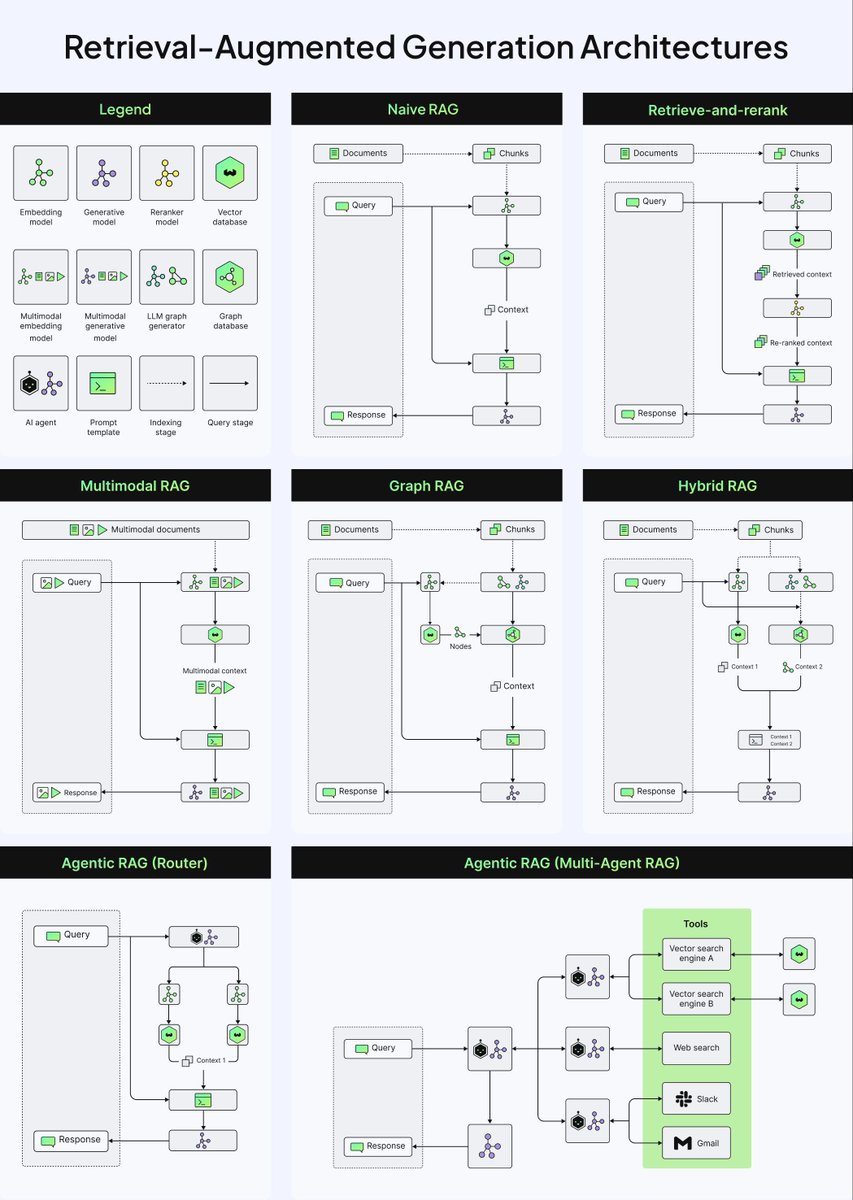
Think RAG is just vector search and retrieval?
It's actually 7+ different architectures (you might be using the wrong one)
1️⃣ 𝗡𝗮𝗶𝘃𝗲 𝗥𝗔𝗚 - The Vanilla approach. Documents get chunked, embedded, and stored in a vector database. When a query comes in, you retrieve the most similar chunks and pass them to the LLM.
2️⃣ 𝗥𝗲𝘁𝗿𝗶𝗲𝘃𝗲-𝗮𝗻𝗱-𝗥𝗲𝗿𝗮𝗻𝗸 - Naive RAG + a crucial step: after initial retrieval, a reranker model re-scores and reorders the results for actual relevance. This catches cases where semantic similarity doesn't perfectly align with what the user actually needs.
3️⃣ 𝗠𝘂𝗹𝘁𝗶𝗺𝗼𝗱𝗮𝗹 𝗥𝗔𝗚 - Handles more than just text. Images, videos, audio - this architecture uses multimodal embedding models to encode different data types into the same vector space, then retrieves and generates responses across modalities.
4️⃣ 𝗚𝗿𝗮𝗽𝗵 𝗥𝗔𝗚 - Instead of treating documents as isolated chunks, this approach builds a knowledge graph that captures relationships between entities and concepts.
5️⃣ 𝗛𝘆𝗯𝗿𝗶𝗱 𝗥𝗔𝗚 - Combines Vector Search with Graph RAG. By combining semantic retrieval with structured relationship mapping, you get a system that understands both the "what" (intent) and the "how" (connectivity) of your data.
6️⃣ 𝗔𝗴𝗲𝗻𝘁𝗶𝗰 𝗥𝗔𝗚 (𝗥𝗼𝘂𝘁𝗲𝗿) - Instead of a single retrieval path, an AI agent decides which search engine or knowledge source to query based on the user's question. It might hit a vector database for one query, a web search for another, or multiple sources and combine them intelligently.
7️⃣ 𝗔𝗴𝗲𝗻𝘁𝗶𝗰 𝗥𝗔𝗚 (𝗠𝘂𝗹𝘁𝗶-𝗔𝗴𝗲𝗻𝘁 𝗥𝗔𝗚) - The most sophisticated. Multiple specialized agents work together, each with access to different tools and databases. One agent might search internal docs, another queries external APIs, a third handles web search - all coordinating to answer complex queries that require information from multiple domains.
The architectures get progressively more powerful but also more complex to implement and maintain. Start simple, then level up as your use case demands it.
This was just a peek into @stackai and @weaviate_io latest ebook about building production-grade agentic RAG systems, get your free copy here: https://t.co/COMsWkoBGG
if you’re an EE, CS, or cryptography student
write your thesis on public key cryptography at the image sensor level
Proof of Physical capture will become a backbone of society soon.