Excited to launch https://t.co/RYdGWhprlS - your personal farm advisor for instant crop and livestock advisory!
Get free, location-specific advice on crops, varieties, planting times, costs, pests & livestock.
No more guessing or wasting money on the wrong crops or livestock bets.
What will you plant today? Visit https://t.co/WEhsZyjQCi to get started!
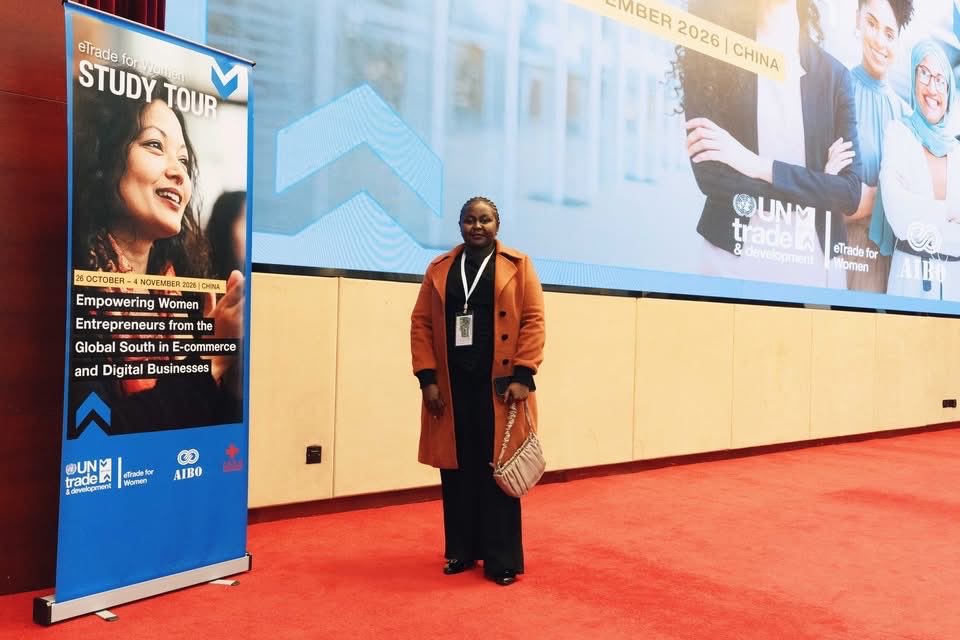
From Beijing’s imperial palaces to Shenzhen’s innovation hubs and Guangzhou’s bustling trade ecosystem. 🇨🇳
An incredible learning experience through the @etradeforwomen - AIBO study tour.
Proud to take Africa’s LegalTech innovation to global stages through @HakiChain . 🌍
From Beijing’s imperial palaces to Shenzhen’s innovation hubs and Guangzhou’s bustling trade ecosystem. 🇨🇳
An incredible learning experience through the @etradeforwomen - AIBO study tour.
Proud to take Africa’s LegalTech innovation to global stages through @HakiChain . 🌍
Why are old stories that were not even covered up all that well become sudden international and geopolitical news?
The timing is suspicious, so worth asking: who benefits and why now?
If Jensen, the premier champion of open models, is taken out then anyone who wants AI closed, centralized, and controlled might benefit.
Why now? The midterms seem relevant. But also perhaps the upcoming IPOs.
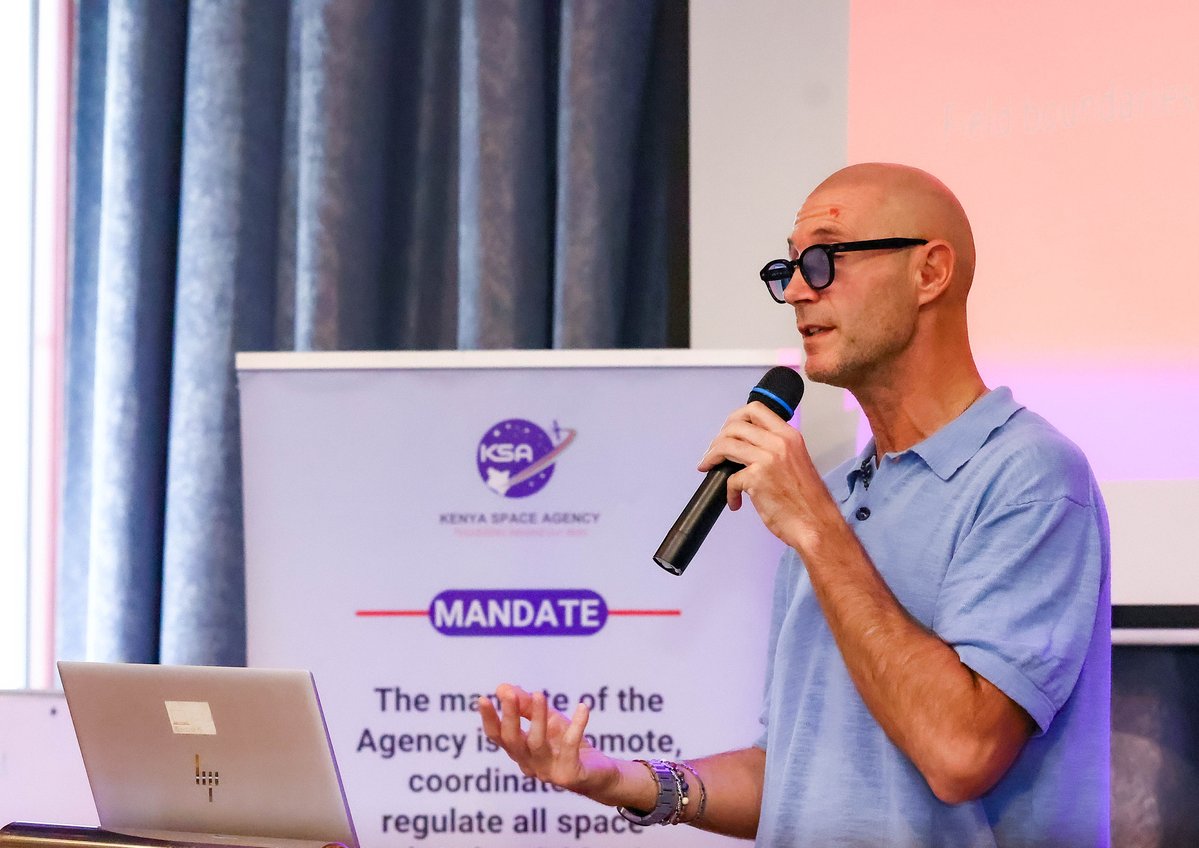
WORLDCEREAL CROP MAPPING TRAINING.
The Kenya Space Agency (KSA) Director General, Maj Gen Hillary Kipkosgey, joined stakeholders in Nairobi for the WorldCereal System Training Workshop, conducted at the Golden Tulip Hotel in Westlands on November 5 to 6 2026.
The workshop convened by KSA and organized in collaboration with the European Space Agency (ESA), the Food and Agriculture Organization (FAO), the United Nations Economic Commission for Africa (UNECA), and the WorldCereal Consortium, focuses on the utilization of the WorldCereal processing architecture for crop mapping.
The WorldCereal system is an open-source, flexible, and scalable platform that enables users to generate customized crop maps that can be tailored to specific geographic regions, growing seasons, and crop types. It leverages public and private reference data, freely available high-resolution Earth Observation (EO) satellite imagery, meteorological time-series data, and advanced machine learning algorithms.
The two-day hands-on training aims to equip participants with the technical skills to integrate the cloud-based platform into their daily toolsets for local and global crop monitoring. It will also build the capacity required to utilize the WorldCereal platform deployed at the newly launched Earth Observation Innovation Laboratory at the Taita Taveta University. In his remarks, the DG noted that Agriculture remains a critical pillar of Kenya's economy, supporting livelihoods, providing employment, and contributing to national food security. However, the sector continues to face challenges associated with climate variability, recurrent droughts and floods, changing land-use patterns, and the growing need for reliable agricultural statistics to inform planning and decision-making.
This workshop presents a strategic opportunity to strengthen local technical and institutional capacity, promote national ownership, and integrate advanced agricultural monitoring capabilities into existing geospatial data infrastructures and operational workflows.
These efforts aim to enhance the use of Earth Observation technologies in creating opportunities and addressing the challenges facing Kenya's agricultural sector.
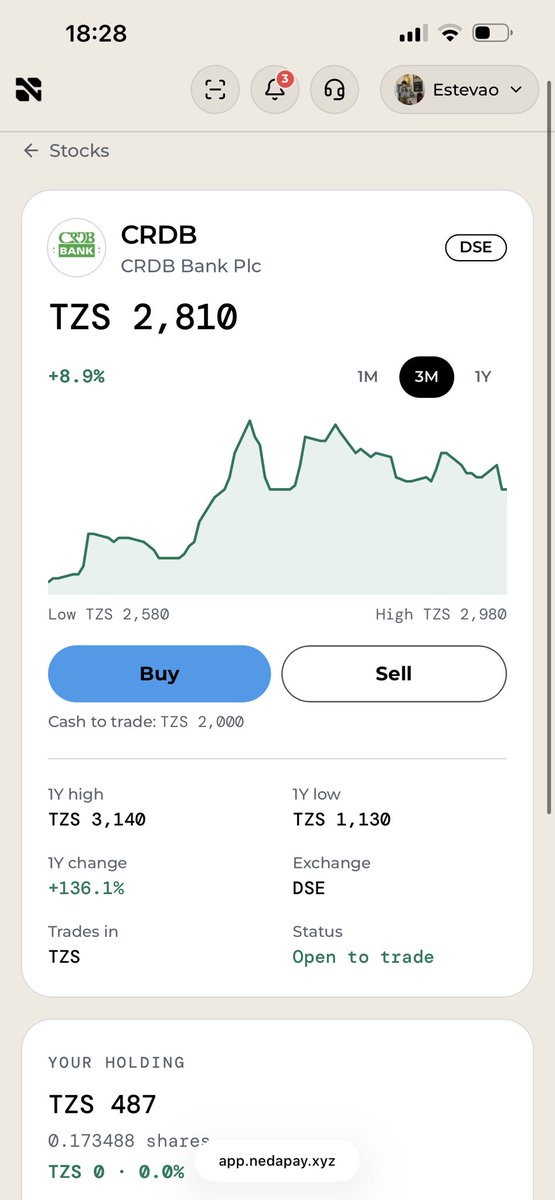
We’ve already tokenized some Tanzanian stocks, gonna tokenize all Tanzanian securities onchain. 😄 Fully backed 1:1 with shares locked. You can also buy US stocks. You can also buy Tanzanian stocks with @USDC That’s all on @nedapay_xyz !
The farmer's problem to solve, or a result of the farmer's failure?
Cooperatives are actually the consistent alternative to large (industrial) farmers. Significant production in Kenya today is through cooperatives and associations.
Government's role ends at creating a sane business environment and getting out of the way. Regardless of the government of the day, farmer subsidies remain significant in supporting food production.
I'd argue that economic incentives have to be appraised where it pains most.
If food is not available in the format and recommended quantities to all humans, whose responsibility is it at individual, family, society, industry, and government that's the unlock to food being consistently available?
Also beyond this, whose responsibility is it for proactive climate management?
I'd apply AI x Blockchain across these distinct segments individually over a one size fits all approach.
@BasedKago The gap between the consumer wastage and the farm harvest is what you need to bring down and by quantifying it is possible to create a circular economy around it where instead of the waste ending up in land fills it gets to farms which need it as compost or animal food.
“The scientific method” might be one of science's most successful myths.
Not because science doesn't work. But because the idea of ONE universal recipe for discovering truth seems rather unscientific.
Dr Iain McGilchristist argues that great discoveries don't come from following the scientific method.
My reaction: Who exactly is he arguing with?
Richard Feynman famously said, “Science is the belief in the ignorance of experts.”
I love this!
Carl Sagan warned that skepticism itself could become dogma. Edmund Husserl questioned how our methods acquire meaning in the first place.
In my own investigations into economics, I've tried representing rotating labor associations in Kenya as protocols. It's wonderfully satisfying to turn human cooperation into diagrams, rules, and equations.
Until someone asks: Whose memory counts? Who gets to refuse? What did we leave out?
I can make the model more elegant. That doesn't necessarily make it more true.
Perhaps scientific humility begins when we're willing to hear: “That's not what we meant.”
A slightly irreverent reflection on science, certainty, four great thinkers, and why I keep making diagrams anyway.
Read More: https://t.co/tocw7EPBnQ