Struggling to write a good story? Rehearse these 6 elements and start.
1. Hook: Grab attention.
2. Setting: Build connection.
3. Trigger: Increase the tension.
4. Outcome: What did the trigger cause?
5. Lesson: Give Value to the reader.
6. Conclude with a call to action!
Once you learn how to shop directly from China, E.g Temù or shien your wardrobe changes completely. Call me cheap I don't care I ain't rich, I don't do fraud.😭
It's knowing what to search for.
Here's my style after making plenty of mistakes.
1. T-shirts:
Skip 100% polyester unless you're buying gym wear.
Instead, search:
• 100% Cotton
• Combed Cotton
• Heavyweight Cotton
• 240-300 GSM Cotton
• Premium Cotton
• Mercerized Cotton
The heavier the GSM, the thicker and more premium the shirt usually feels.
2. Jeans:
Denim Jeans
Temu is surprisingly good for denim if you know what to search.
Search:
• Denim Jeans
• Cotton Denim
• Raw Denim
• Selvedge Denim (if available)
• 98% Cotton + 2% Elastane
• 99% Cotton
Avoid jeans with high polyester content. The more cotton, the better they'll age and feel.
3. Body-hug clothing:
Search:
• Ribbed Knit
• Modal
• Viscose Blend
• Cotton-Spandex Blend
They hold their shape much better than cheap polyester.
4. Hoodies
Search:
• 400 GSM
• French Terry
• Cotton Fleece
• Heavyweight Hoodie
5. Chains
Search:
• 316L Stainless Steel
• Titanium Steel
• PVD Gold Plated
• Vacuum Plated
These are far more resistant to fading than ordinary fashion jewelry.
6. Earrings
Search:
• 925 Sterling Silver
• 316L Stainless Steel
• Hypoallergenic
• Moissanite (if you're buying stones)
7. Scarves
Search:
• Mulberry Silk
• Silk Blend
• Cashmere Blend
• Wool Blend
• Viscose
Avoid the shiny, thin polyester scarves if you're after a premium look.
8. Loafers
Search:
• Genuine Leather
• Cow Leather
• Full Grain Leather (rare but worth looking for)
• Rubber Outsole
9. Sneakers
Search:
• Rubber Outsole
• EVA Midsole
• Breathable Mesh
• Leather Upper
• Stitched Sole
Pictures lie a lot
The description usually tells the truth.
Here's how I shop:
1. Read the material composition before anything else.
2. Sort by Most Orders or Best Selling, not cheapest.
3. Only buy products with lots of reviews or pictures or even better when a Nigerian has purchased it before they always tell the truth.
4. Read the 1-star reviews first. They'll tell you what the seller won't.
5. Look at customer photos, not the product photos.
6. Check the weight of the product. Better quality clothing is often heavier.
7. Read the size chart. Don't assume your Nigerian size matches.
8. If the title has words like "luxury," "premium," or "designer" but the material is 100% polyester, not everything but still move on.
Your best friend isn't the product picture.
It's the material, the reviews, and the customer photos.
That's how you separate the gems from the junk.
I hope this help.
Things are to expensive for a country this poor.
If you’re serious about DATA ANALYSIS, here’s a full course with exercises on Data Analysis, Python, SQL, Panda, Visualization, Data cleaning, etc
https://t.co/gWvRZHDc43
https://t.co/jEe2XxYxDn
https://t.co/zESDg3aG3T
https://t.co/fDhd4aCIOz
https://t.co/DZNT8fYTQZ
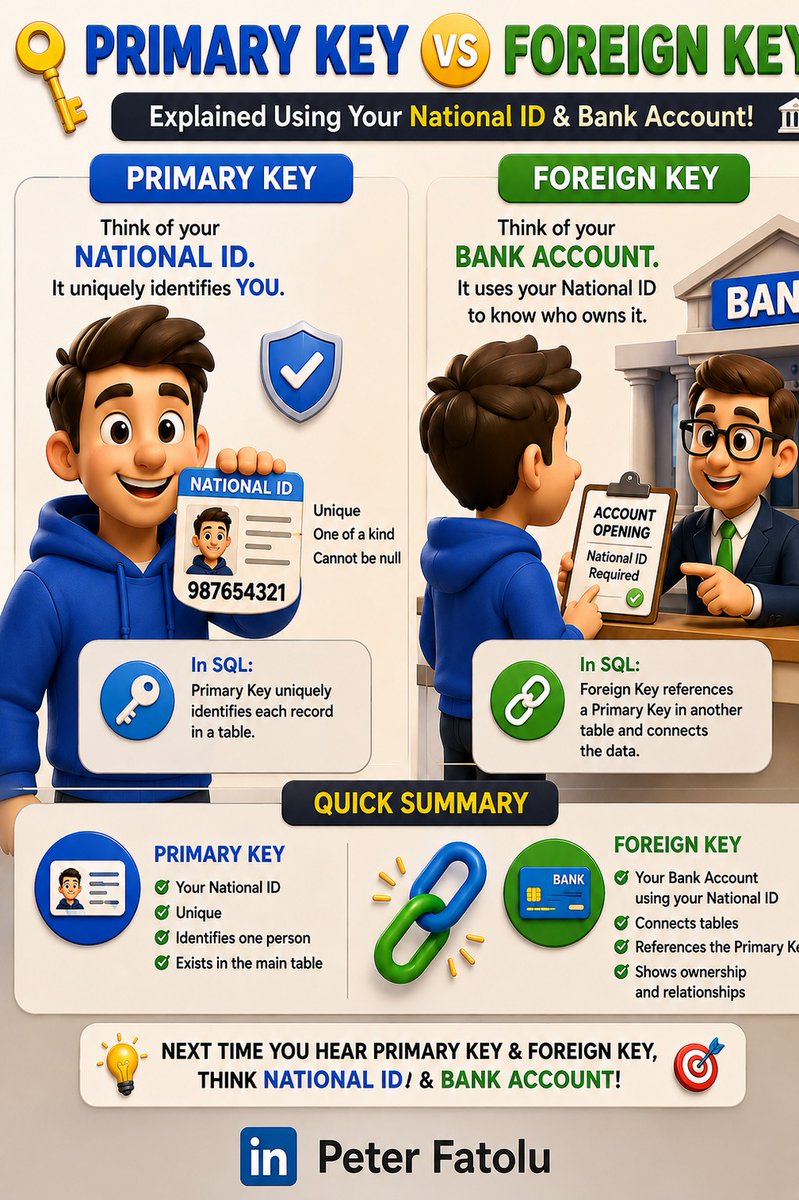
🔑 Primary Key vs Foreign Key – Explained Using Your National ID & Bank Account! 🏦
Ever found yourself mixing up Primary Keys and Foreign Keys in SQL?
Let's forget databases for a minute and think about something we all use...
Your National ID and your Bank Account. 👇
🆔 Primary Key
Imagine every citizen has a National ID Number.
No two people can have the same ID.
Even if two people share the same name, their National IDs are always different.
Your National ID is what uniquely identifies you.
💡 In SQL:
✅ Every record has one unique identifier.
✅ It cannot be duplicated.
✅ It cannot be empty (NULL).
Think of a Primary Key as the identity card of every row in a table.
🏦 Foreign Key
Now imagine you decide to open a bank account.
The bank doesn't create a brand-new identity for you.
Instead, it asks for your National ID.
Why?
Because the bank needs to know who owns the account.
Your account is linked to your identity using your National ID.
💡 In SQL:
🔗 A Foreign Key references a Primary Key in another table.
🔗 It connects related tables.
🔗 It keeps your data accurate and organized.
One person can own multiple bank accounts...
But every account still points back to one National ID.
That's exactly how a Foreign Key works.
📌 Quick Summary
🆔 Primary Key
= Your National ID
✔️ Unique
✔️ Identifies one person
✔️ Exists in the main table
🔗 Foreign Key
= Your Bank Account using your National ID
✔️ Connects tables
✔️ References the Primary Key
✔️ Shows ownership and relationships
The next time someone asks you about Primary Keys and Foreign Keys, don't think about SQL...
Think about your National ID and your Bank Account. 🔑🏦
You'll probably never confuse them again.
💬 What's another SQL concept you'd like me to explain using a real-life analogy?
👇 Drop it in the comments!
#SQL #DataAnalytics #DataAnalyst #Database #LearningSQL #DataEngineering #BusinessIntelligence #SQLTutorial #TechEducation #DataScience
Top 100 Data Analyst Interview Questions*
Data Analyst Role & Basics*
1. What does a data analyst do in a company?
2. What is the difference between a data analyst, data scientist, and BI analyst?
3. What is the typical workflow of a data analyst (from requirement to insight)?
4. What are the main goals of data analysis (descriptive, diagnostic, predictive, prescriptive)?
5. What is KPI and why is it important?
6. What is the difference between metrics and KPIs?
7. What is a dashboard vs a report?
8. What is exploratory data analysis (EDA)?
9. What is the difference between raw data and processed data?
10. How do you prioritize which analysis to work on first?
SQL & Databases*
11. What is SQL and why is it critical for data analysts?
12. How do `SELECT`, `WHERE`, `ORDER BY`, `LIMIT` work?
13. How do you join two tables (`INNER`, `LEFT`, `RIGHT`, `FULL` joins)?
14. How do `GROUP BY` and aggregate functions (`SUM`, `AVG`, `COUNT`, `MAX`, `MIN`) work?
15. How do you write subqueries and CTEs?
16. How do you calculate running totals or rolling averages with window functions?
17. How do you clean and filter data directly in SQL?
18. How do you handle duplicates and NULL values in SQL?
19. How do you optimize a slow query?
20. How do you design a simple schema for a business domain (e.g., orders, users)?
Excel & Spreadsheets*
21. How do you use Excel for quick data cleaning and analysis?
22. How do you use `SUMIF`, `COUNTIF`, `VLOOKUP` / `XLOOKUP` in Excel?
23. How do you remove duplicates and standardize text in Excel?
24. How do you use PivotTables for summarizing data?
25. How do you build simple dashboards in Excel (charts + slicers)?
26. How do you use conditional formatting for insights?
27. How do you export data to CSV or share formatted reports?
28. How do you handle large datasets in Excel vs a database?
29. How do you avoid common Excel pitfalls (e.g., hard‑coded numbers, no labels)?
30. How do you document your Excel analyses?
Data Visualization & BI Tools*
31. What is the purpose of data visualization?
32. When do you use bar charts, line charts, pie charts, histograms?
33. What are best practices for labeling, colors, and readability?
34. How do you design a dashboard for a non‑technical stakeholder?
35. What is the difference between a report and a self‑service dashboard?
36. How do you use Power BI / Tableau / Looker / Google Data Studio for dashboards?
37. How do you filter and slice data in a BI tool?
38. How do you handle measures and dimensions in BI tools?
39. How do you share dashboards and control access?
40. How do you tell a “data story” using charts and annotations?
Descriptive Statistics & EDA
41. What are mean, median, and mode?
42. What is standard deviation and variance?
43. What are quartiles and IQR?
44. How do you detect outliers and what should you do with them?
45. What is a distribution and how do you inspect it (histograms, boxplots)?
46. What is skewness and kurtosis?
47. How do you calculate growth rate, percentage change, CAGR?
48. How do you compute cohort‑style metrics (e.g., retention by signup month)?
49. How do you summarize categorical vs numerical data?
50. How do you structure an EDA notebook or report?
Python (or R) for Data Analysis next??
Comment "PYTHON"
Struggling to write a good story? Rehearse these 6 elements and start.
1. Hook: Grab attention.
2. Setting: Build connection.
3. Trigger: Increase the tension.
4. Outcome: What did the trigger cause?
5. Lesson: Give Value to the reader.
6. Conclude with a call to action!
You may not have a “bad CV” — but if it can’t pass ATS, recruiters may never even see it.
And that’s exactly why many qualified Nigerians keep applying and hearing nothing back.
Before you send out another application, run your CV through the FREE Resume Scan on NoResumeNoJob👇
3. Which month recored peak COVID Cases?
Answer: January
4. Which country has the highest recovery rate? Answer: United States of America
5. What is the relationship between Active Cases and Vaccination Rate?
Answer:A weak positive relationshi
Question and Answers
1. Which country has the highest confirmed cases? Answer: United States of America
2. Which country has the highest deaths? Answer: United States of America
Save the date and time of this career conversation on "Professional CV for Data Analyst"
Sat 13 June 2026
Speakers: @MubarDauda
and Chinaaza
Host: @Niyi_Growth
You can't afford to miss this space, see you there 👍
https://t.co/OxTA01ogIu