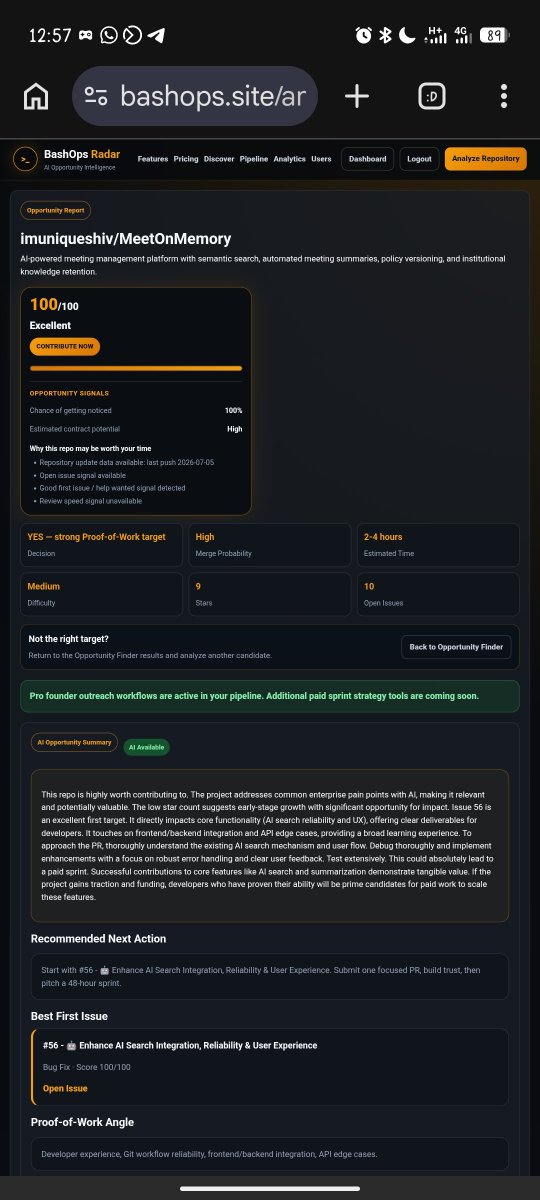
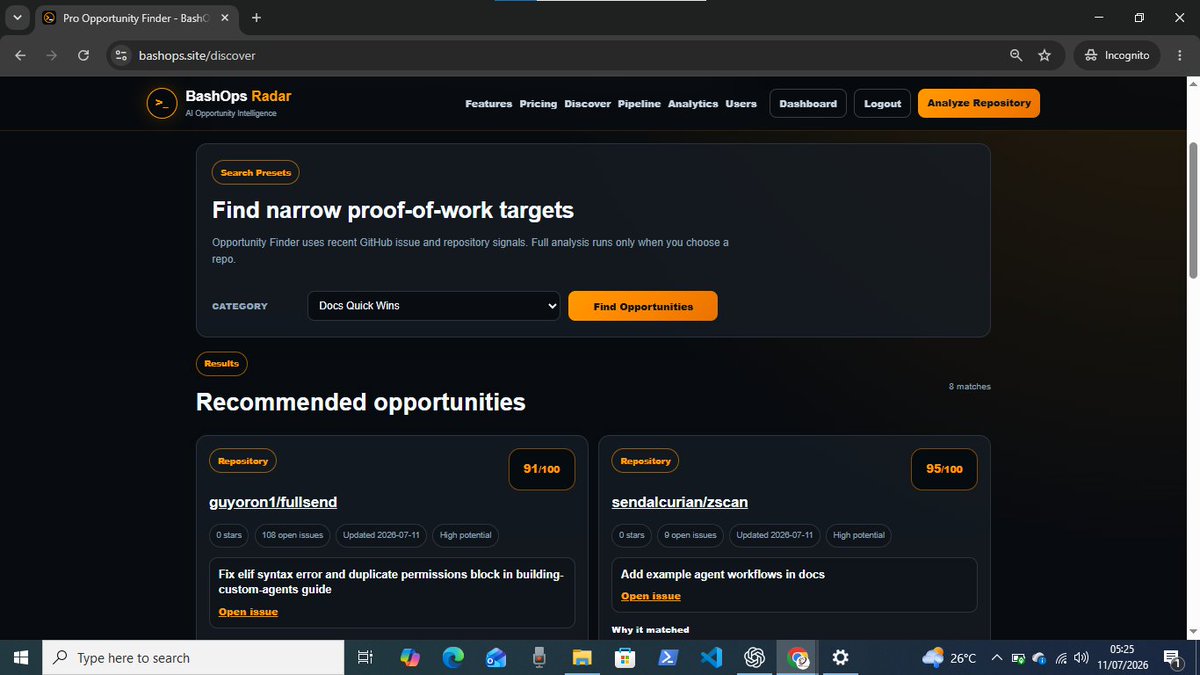
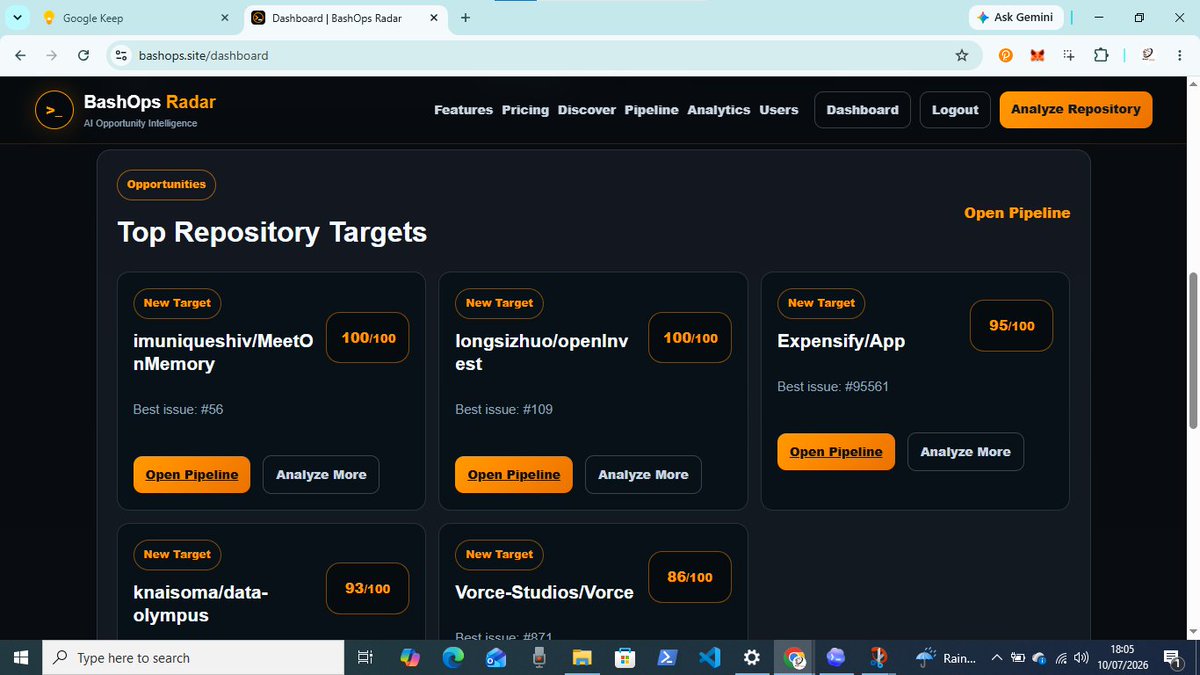
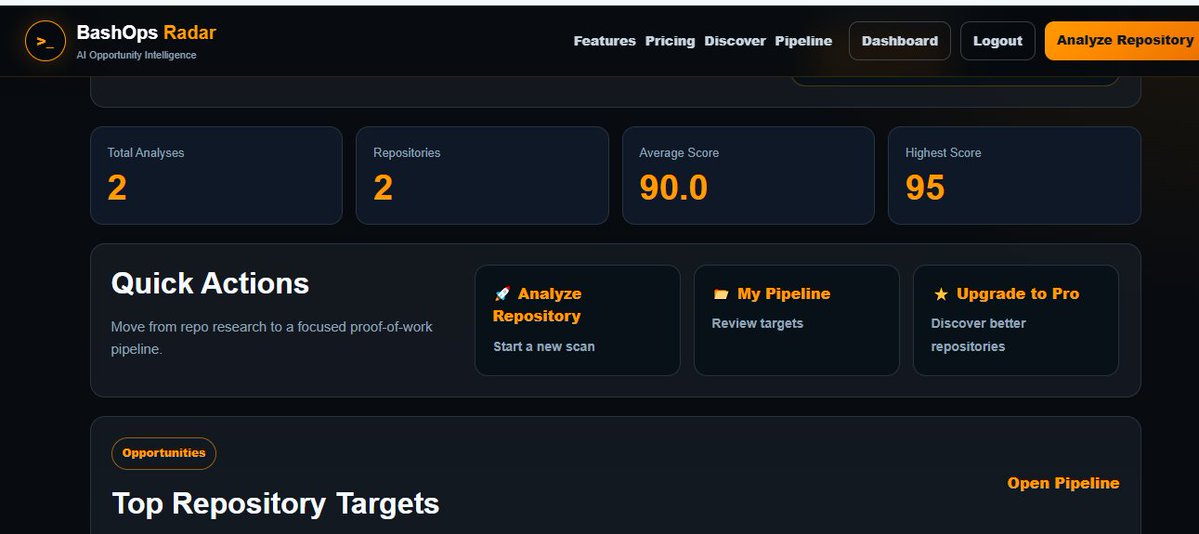
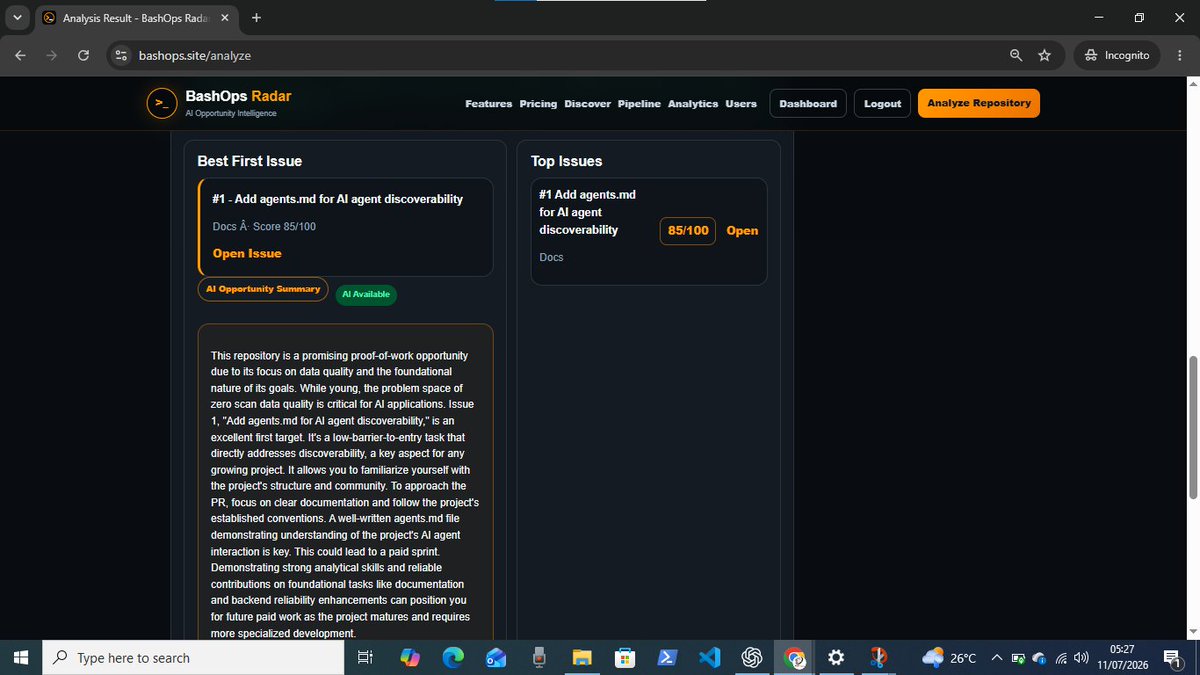
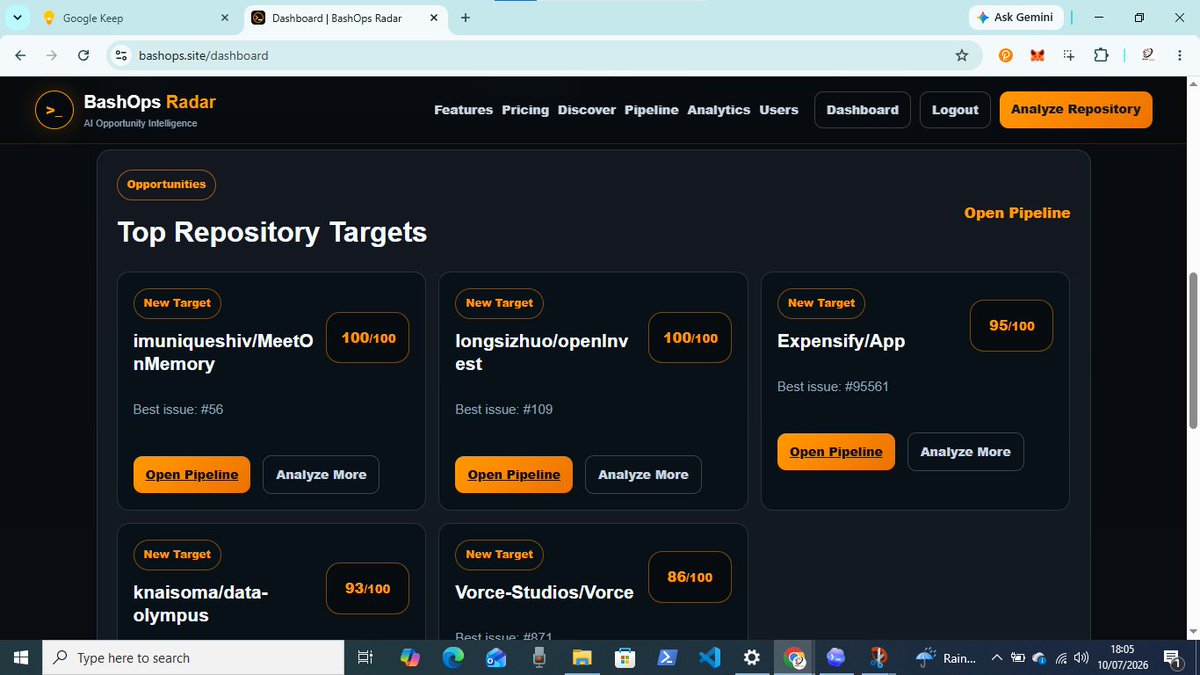
I built BashOps Radar to help:
• Discover promising repositories • Find the best issue • Score opportunity before writing code • Build a proof-of-work pipeline
🌐 https://t.co/mTgTXJw4Cp
⚙️ GitHub Action https://t.co/Vml4JVcvKG
Feedback is welcome.
Client-Acquisition Lesson
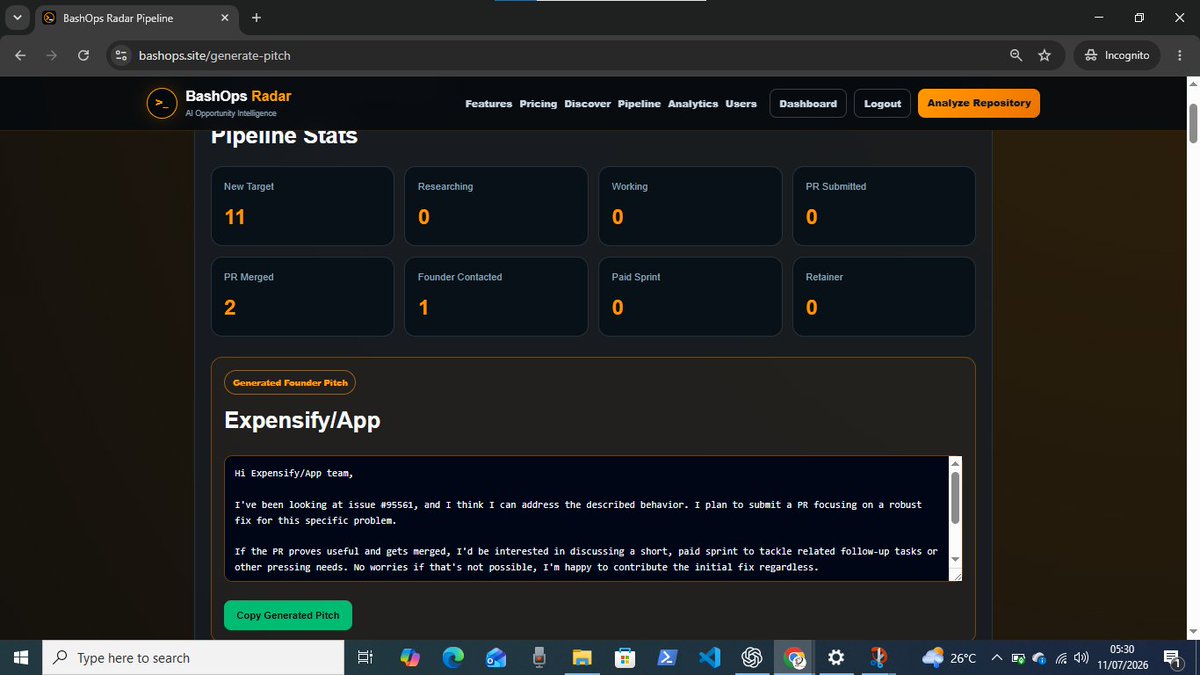
The problem: developers send generic messages asking founders for work.What usually happens: no reply, because there is no proof.A better approach: contribute one useful fix first, then discuss a small paid follow-up based on what you learned.Proof before pitch.BashOps Radar helps structure that workflow:
https://t.co/N4vvsZ9W5m
This reminds me how underrated direct asks are.
Most builders wait until launch to tell people what they're building, but small conversations like this compound over months.
A surprising number of open-source opportunities start with one genuine interaction rather than a polished launch.
I think another shift is happening alongside that.
Engineers who understand distribution and customer discovery are becoming much more valuable than engineers who only ship features.
Technical depth is still essential, but understanding how software reaches users is starting to compound just as much.
@gokulr This feels bigger than a UI improvement.
Once repositories become the source of truth for specs, documentation and implementation stay much closer together.
I think we'll see fewer "stale docs" problems because updates happen in the same workflow as code.
One thing I've started noticing is that more developer workflows are moving into GitHub itself instead of living in separate SaaS tools.
Specs are one example.
CI/CD already made that shift years ago.
I wonder what other developer workflows still feel unnecessarily disconnected from the repository.
Contribution Journey
Researching → identified a scoped issue
Working → reproduced the problem locally
PR Submitted → kept the fix focused
PR Merged → proof-of-work established
Founder Conversation → followed up with a specific next-step offer
A GitHub contribution becomes more useful when you treat it as a process, not a one-off event.
https://t.co/N4vvsZ9W5m
Contribution Journey
Researching → identified a scoped issue
Working → reproduced the problem locally
PR Submitted → kept the fix focused
PR Merged → proof-of-work established
Founder Conversation → followed up with a specific next-step offer
A GitHub contribution becomes more useful when you treat it as a process, not a one-off event.
https://t.co/N4vvsZ9W5m
Nice work. One thing I've found is that finding "good first issues" is only half the problem.
I've wasted more time contributing to repositories that looked active but rarely reviewed PRs than I have searching for issues themselves.
Have you noticed similar patterns when testing across different repositories?
I've been building BashOps Radar around exactly this workflow.
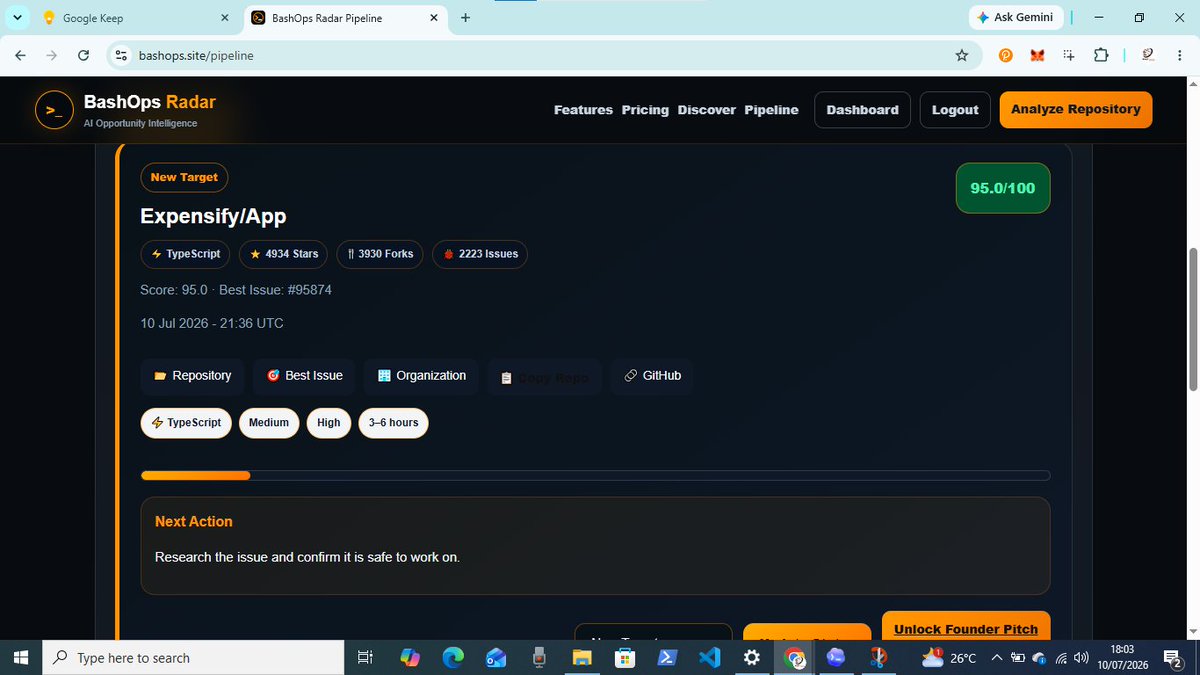
Instead of only listing issues, it scores repositories, recommends a first issue, explains the reasoning, and tracks the contribution from research to PR and founder outreach.
I'm still validating the scoring model, so I'd genuinely like another contributor's opinion.
Manual testing is finally done.
Repository analysis ✔️
Opportunity Finder ✔️
Pipeline ✔️
Dashboard ✔️
GitHub Action ✔️
Public API ✔️
Mobile ✔️
Now comes the harder part:
Finding the first developers who get real value from it.
Try it here:
https://t.co/dhBGW5VJHt
Most repository analyzers stop after giving a score.
BashOps Radar continues with:
→ Best issue
→ Proof-of-work angle
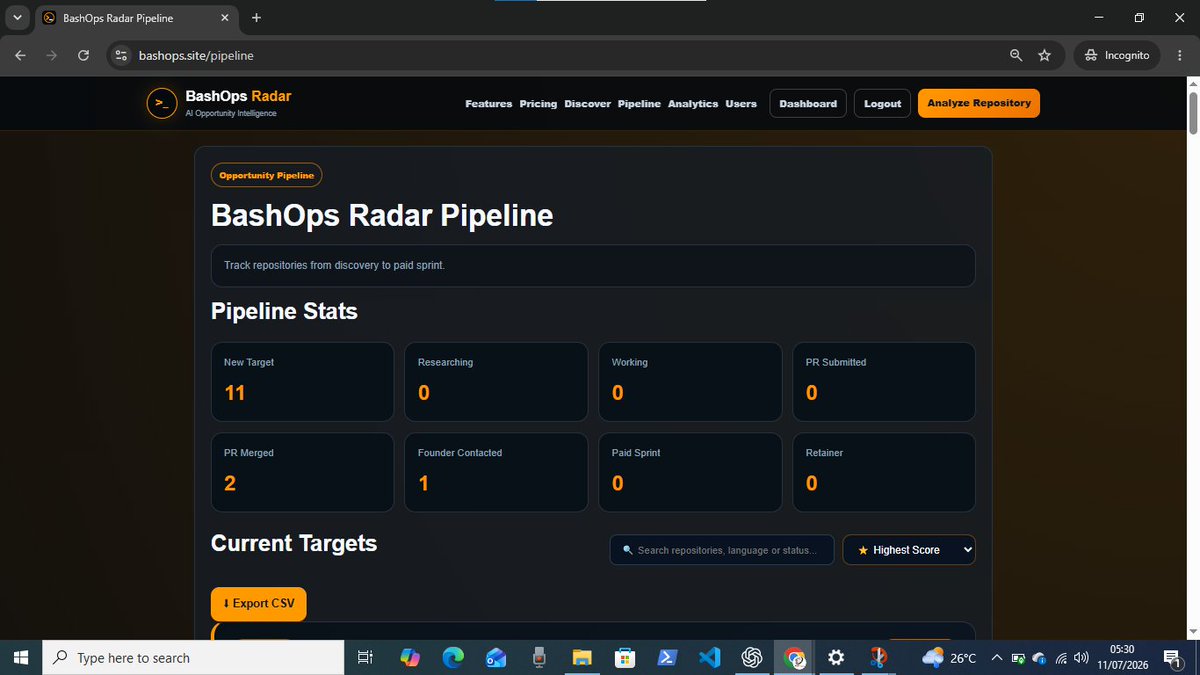
→ Pipeline tracking
→ Founder outreach workflow
→ Shareable snapshot
I'm looking for contributors willing to test it and tell me what breaks.
https://t.co/PBh6J6j1CB
One feature I'm happiest with isn't AI.
It's the new Proof-of-Work Snapshot.
Developers can now share their research, contribution stage, opportunity score, and repository analysis in one clean page.
Perfect for build-in-public.
🌐 https://t.co/dhBGW5VJHt
Instead of asking ChatGPT,
"What GitHub repo should I contribute to?"
I built a tool that analyzes repositories before I spend hours writing code.
It now explains why a repo is worth contributing to, not just a random score.
Try it:
https://t.co/dhBGW5VJHt
Finished a big update to BashOps Radar.
New additions:
• Transparent scoring
• Best First Issue
• Proof-of-Work Snapshot
• Opportunity Finder
• Pipeline tracking
• Better mobile experience
Would love feedback from anyone who contributes to open source.
🌐 https://t.co/PBh6J6j1CB
I've spent the last few weeks building BashOps Radar to answer one question before I open my editor:
"Is this GitHub repository actually worth contributing to?"
It scores repositories, ranks issues, explains the score, tracks your proof-of-work pipeline, and even generates a shareable contribution snapshot.
Looking for honest feedback from developers.
🌐 https://t.co/PBh6J6j1CB
GitHub Action:https://t.co/aWkvfOYE5r
Today I finished another major milestone for BashOps Radar.
It started as a simple repository scoring tool.
Now it has grown into a complete proof-of-work workflow for developers.
Instead of asking:
"Which GitHub repo should I contribute to?"
it now answers:
Is this repository worth my time?
Which issue should I start with?
Why did it receive this score?
What are the chances this contribution gets noticed?
How difficult is the work?
How long should it take?
How do I move from a contribution to a founder conversation?
I also finished a feature I'm particularly excited about:
Proof-of-Work Snapshots.
Developers can now generate a clean shareable snapshot of their repository research and contribution progress.
Researching → Working → PR Submitted → PR Merged → Founder Contacted.
Instead of telling people they're contributing to open source, they can actually show the work.
Everything has been manually tested across:
✅ Repository Analysis
✅ Opportunity Finder
✅ Pipeline
✅ Score Transparency
✅ GitHub Action
✅ Public API
✅ Dashboard
✅ Mobile
I'm now shifting almost all my time from building to distribution.
The next challenge isn't writing more code.
It's getting BashOps Radar in front of developers who can actually benefit from it.
Website: https://t.co/N4vvsZ9W5m
BashOps Radar
GitHub Action: https://t.co/aWkvfOYE5r
I'd genuinely appreciate feedback from developers who use GitHub regularly.
@goyabean_eth Congrats on getting that first PR merged to prod — timing aside, that’s real proof of work. Are you planning to keep contributing while job searching?
@nathan_tarbert Solid approach with the reproduction repo — that’s often the key to getting traction. What part of the process was the trickiest for you?
@ChitrakshTarun@expo@nishanbende Awesome, congrats on the merged PR! Expo sounds like a fun one. What are you thinking for the next contribution or any challenges you hit along the way?