@themegamind24@meetmotes The shared bot lag during high-volatility events has genuinely cost people more than any actual trading mistake. Isolating it per NFT makes way too much sense.
Why Shared Bots Fall Short
When thousands of users share a single trading bot, permissions and custody get messy, a problem @meetmotes solves with 1-to-1 architecture.
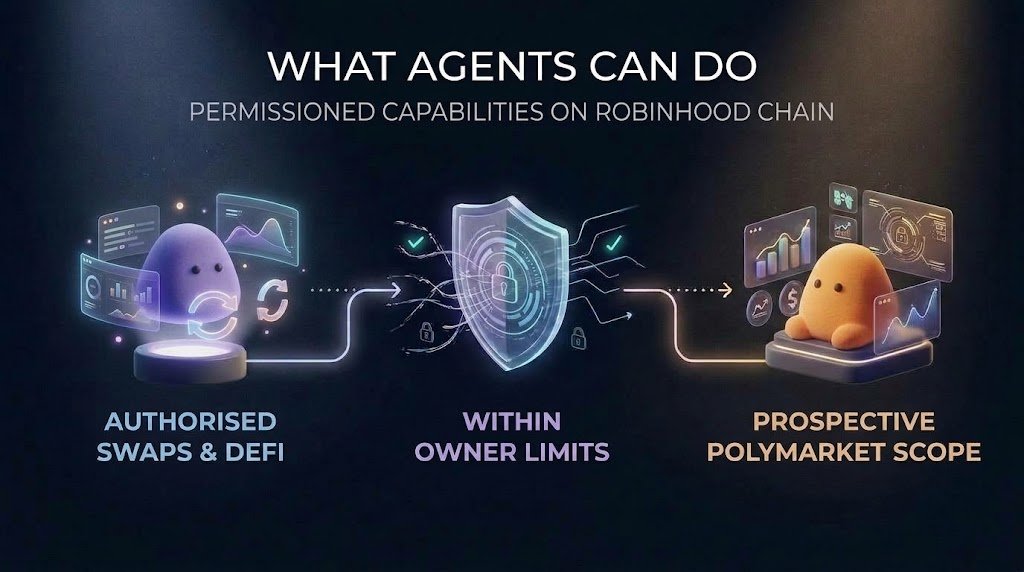
Each of the 20,000 NFTs on Robinhood Chain links to 1 isolated agent identity and 1 dedicated USDC smart account. Your signed policies dictate every authorised swap or prospective Polymarket action your agent can propose.
In turn, defined eligible activity generates a planned 1% fee to fund operations and planned $MOTES buy-backs.
If you want to look deeper at the 1-to-1 agent architecture on Robinhood Chain, you can check it out here:
https://t.co/mXbhZm0T6R
Imagine uploading your resume just once and having an agent handle most of the application process for you.
That is what caught my attention about Dreamwork Pro.
@Alexxx636 Running a small team, the real cost is coordination time, not gas. I would rather pay a bit more per transaction and have five teams I can DM than save money and spend weeks explaining our stack to strangers.
I used to think choosing infrastructure was mostly a technical decision.
Cheaper transactions, more control, fewer limitations. On paper, those sounded like the obvious reasons to choose one chain over another.
But there's something easy to overlook when you're building: the people you eventually need to work with also have to be somewhere.
I've seen how much harder collaboration becomes when builders, tools and potential partners are scattered across different ecosystems.
That's why GenLayer's move to @arbitrum makes sense to me.
On October 22, GenLayer announced that its public coordination chain was moving from ZK Stack to Arbitrum Nitro.
What I find interesting is what stayed the same.
Optimistic Democracy, GenVM and Intelligent Contracts remain intact. Validators still reach consensus through different AI models, and intelligent contracts still execute on validators' nodes.
The migration changes the EVM infrastructure coordinating transaction order, validator committees, votes, appeals, staking and final outcomes.
And there's a practical reason behind that choice.
Arbitrum already has an established builder ecosystem, with more than 30 dedicated chains using its technology. Even Robinhood's chain runs on Nitro.
GenLayer is positioning its public infrastructure closer to an ecosystem where many of its potential partners and builders already operate.
I also find it interesting that its relationship with Matter Labs isn't ending. Their collaboration continues through Prividium for private, enterprise-focused deployments.
There's a lesson here I think more builders should take seriously: infrastructure decisions aren't only about what your protocol needs today. They're also about the environment in which you want it to grow.
If you were launching a protocol today, would you prioritize the cheapest infrastructure available or the ecosystem where your future collaborators already are?
I used to think having a strong password was enough to keep my crypto account safe. Then I started paying attention to how convincing some phishing messages can look.
A message can look official. A website can look identical to the real thing. And one careless click or shared verification code can put your account at risk.
That changed how I think about Binance security.
I now pay attention to the small things: using passkeys for 2FA, setting an anti-phishing code so I can recognise genuine Binance emails, and enabling a withdrawal whitelist so funds can only go to approved addresses.
There’s also something I find important about Binance Proof of Reserves. Using a Merkle tree and zk-SNARK proofs, users can verify that their balances are included and that reserves cover liabilities without exposing individual account balances.
Most user funds are held in offline cold storage, while SAFU serves as an emergency reserve for extreme platform-level situations. But protecting the platform and protecting your personal account are two different responsibilities.
One thing I wish more people understood: Binance will never ask you to transfer your crypto to a "safe wallet" or share your 2FA code.
If you haven't checked your security settings recently, take five minutes to do it.
Official resources:
https://t.co/nzqz4qA9Hv
https://t.co/76ICmuThH2
What's the security setting you think most crypto users overlook until it's too late?
#Binance #BinanceSecurity #StaySAFU #CryptoSecurity #ProofOfReserves #Passkeys #ScamAlert
Restricted Jurisdiction Disclaimer: Products and services referred to here may not be available in your region.
Digital asset prices are subject to high market risk and price volatility. The value of your investment may go down or up, and you may not get back the amount invested. You are solely responsible for your investment decisions. Not financial advice. See Binance Terms of Use and Risk Warning.
@Alexxx636 Arbitration only works when the losing party can understand why it lost. If each validator’s reasoning is summarized in plain language and stored immutably, that improves the odds I would accept the result. Opaque majority votes do not.
One thing I've noticed about disputes is that having all the evidence doesn't automatically mean people will agree on what happened.
Imagine an autonomous agent buying something on your behalf. The seller says the job is complete. The buyer's agent says the agreed conditions weren't met. Both have records. Both have reasons. Who gets to decide?
This is the problem that makes @GenLayer interesting to me.
Its job is to give AI agents a way to resolve questions that require judgment. Validators running different AI models use Optimistic Democracy to reach consensus, while Intelligent Contracts execute through GenVM on validator nodes.
Now @GenLayer is moving its public coordination chain from ZK Stack to @arbitrum Nitro.
I think the interesting part is where that puts GenLayer.
An adjudication layer becomes more useful when the people building autonomous agents can actually reach it. Arbitrum already has a large ecosystem of builders, applications and infrastructure. Moving closer to that environment creates a more natural path for developers to experiment with GenLayer.
There's another detail I appreciate: the move doesn't mean abandoning ZKsync. GenLayer continues working with Matter Labs on Prividium and private enterprise deployments.
That distinction makes sense. Public agent activity and private institutional agreements don't necessarily need the same environment.
Bradbury's next phase is also live on the new stack. Meanwhile, Optimistic Democracy and GenVM remain intact. The coordination infrastructure has changed, not the underlying job GenLayer is designed to do.
Here's what I'm genuinely curious about:
If two autonomous agents disagree over whether a transaction fulfilled its conditions, would you trust a network of validators using different AI models to settle that dispute?
And what evidence would you need before trusting its decision?
@themegamind24@meetmotes Still wild to me seeing Robinhood Chain and automated on-chain DeFi agents in the same sentence. Never would have called this timeline a few years ago
Encrypted Financial Infrastructure.
Building automated strategies on-chain requires privacy and strict guardrails, which sits at the core of @meetmotes on Robinhood Chain.
Across 20,000 unique NFTs, 1 token maps to 1 AI agent and 1 dedicated smart account funded with USDC. You define and sign the permission boundaries so your agent executes authorised DeFi strategies safely.
As eligible activity takes place, a planned 1% service fee connects real usage to protocol operations and planned $MOTES buy-backs.
If you're following the Motes creator campaign and want to read the official brief, take a look here:
https://t.co/mXbhZm0T6R
Dear @kudahelp_ng, my account has remained restricted despite several calls, emails, completing your video verification and submitting all requested documents.
You emailed me yesterday at 1:30 PM, promising to lift the restriction shortly, but nothing has changed. My business is suffering, and I still have no clear explanation or resolution.
I've exhausted all support channels. I need urgent intervention and unrestricted access to my funds.
I'll attach screenshots and supporting evidence for clarity. Please resolve this! @joinkuda
Account number: 2015693086
ACC Name : Sakariyahu Abubakar
Prospective Polymarket Integration.
Prediction markets are booming, and @meetmotes is designing its NFT-linked agents to bridge DeFi and market research on Robinhood Chain.
Holding 1 of the 20,000 Motes gives you 1 agent identity and 1 USDC smart account governed by your signed risk limits. Alongside authorised DeFi swaps, the roadmap includes prospective Polymarket research and order execution subject to rollout availability.
Eligible activity across the network is planned to generate a 1% fee for operations and potential $MOTES buy-backs.
Exploring the 1 NFT = 1 agent setup on Robinhood Chain? You can check out Motes here:
https://t.co/mXbhZm0T6R