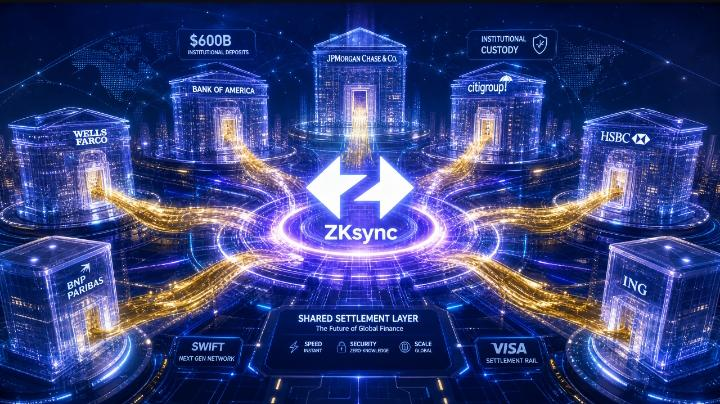
Institutional adoption on @zksync isn't some distant roadmap goal, it's already operational today. We are watching the legacy financial system re-architect itself onchain and you can understand exactly why and how through three distinct lenses:
1️⃣. The Proof Points Lens.
Historically, banks couldn't use public blockchains because they strictly require privacy, compliance, and absolute control over their environments. ZKsync's Prividium architecture finally solves this by enabling private, offchain execution that is cryptographically verified on Ethereum.
Look at the systemic weight of who is actually building on this right now:
• Cari Network: 5 major U.S. regional banks (including Huntington and M&T) with over $600B in combined deposits are utilizing it for multi-bank tokenized deposits. Because these deposits remain as liabilities on the banks' balance sheets, they are subject to existing regulatory oversight and FDIC insurance. Notably, it was founded by the 27th U.S. Comptroller of the Currency.
• Deutsche Bank: Partnered to deploy the Memento ZK Chain for the DAMA 2 project. Driven by the projected $84 trillion global wealth shift to digital-native generations, they are bringing fund management fully onchain. This shrinks traditional fund deployment from months down to just 2-3 weeks and replaces multi-day settlement with instant redemptions.
• First Abu Dhabi Bank: Backing a sovereign UAE Dirham stablecoin on the ADI Chain, developed alongside major sovereign wealth entities like ADQ and IHC. Crucially, this infrastructure is set to be regulated by the UAE Central Bank.
2️⃣. The Network Effects Lens.
Think about how legacy systems like SWIFT or Visa grew. When a new institution joins a shared network, it doesn't just add isolated volume, it exponentially multiplies the number of possible settlement connections. 10 institutions create 45 connections, 100 create nearly 5,000.
Every new bank spinning up a Prividium zone compounds the utility of the entire ecosystem. They get completely private execution internally, but through the shared Elastic Network, they gain trustless, mathematically proven interoperability with every other institution on the network without relying on risky third-party bridges.
3️⃣. The $ZK Role Lens.
So, how is this massive network coordinated?
$ZK is the only native asset of the ZKsync ecosystem. It has a hard-capped supply of exactly 21 billion tokens with zero inflation and functions as the ultimate governance token. Holders control the network's most critical decisions: protocol upgrades, fee structures, and economic parameters.
Historically, banks couldn't use public blockchains because they strictly require privacy, compliance, and absolute control over their environments. ZKsync's Prividium architecture finally solves this by enabling private, off chain execution that is cryptographically verified on Ethereum.ndependent chains and Prividium zones before efficiently posting them to Ethereum L1, which drastically cuts verification costs. Active governance proposals, such as the ZKnomics framework, are currently outlining how future protocol revenues could be systematically routed back into the ecosystem.
Bottom line: The infrastructure institutions have been waiting for is here. One unified network. One native asset.
@masterford33@RallyOnChain the structure here is so good, you'd expect a thank you for this honor first but you buried it and led with doubt instead. feels like how people actually process good news
Mañana comenzará el Mundial, y muchos estarán atentos a los partidos. El fútbol nos recuerda algo que no debemos olvidar: la vida no es una carrera para lucirse en solitario, sino un camino que aprendemos a recorrer juntos. Quien no sabe pasar el balón, aunque tenga talento, todavía no ha entendido el juego. Y quien no sabe vivir con los demás y para los demás, todavía no ha entendido la vida. #ViajeApostólico