While I agree it is very rare, it apparently may have happened last year.
Web search results:
NTSB Investigation: DCA26LA012 (United Airlines Flight 1093 / Weather Balloon Collision)
The National Transportation Safety Board (NTSB) is investigating this as a Class 3 aviation accident. A preliminary report was released around November 20–21, 2025 (about one month after the October 16, 2025 incident). As of May 2026, no final report has been issued; investigations of this type typically take 12–18+ months.
Key Details from the Preliminary Report
Date/Time/Location: October 16, 2025, at 06:43 MDT, near Moab, Utah (approx. lat/long 38.595486, -109.25594), while in cruise at FL360 (36,000 ft pressure altitude).
Aircraft: Boeing 737-8 MAX, registration N17327, operating as United Flight 1093 (DEN to LAX) under Part 121. Total occupants: 112 (per report). Aircraft damage: Substantial (to the first officer’s forward windshield).
Injuries: Captain — 1 minor (multiple superficial lacerations to right arm from glass shards). First officer and all 106 passengers — uninjured. No other injuries.
Sequence of Events (per captain’s statement and flight data):
The captain saw a distant object on the horizon but had no time to alert the first officer before impact.
Loud bang; significant impact to the FO’s forward windshield.
Glass fragments showered both pilots.
Crew declared an emergency, descended, coordinated with ATC/dispatch, and diverted safely to Salt Lake City (SLC). Cabin pressurization remained stable. Window overheat light illuminated (handled per checklist). Captain resumed flying duties for the approach/landing (ILS to RWY 16L), which was uneventful.
Object Identification:
WindBorne Systems Global Sounding Balloon (GSB) — a lightweight, long-duration, unmanned free balloon operated under FAA Part 101.
Launched from Spokane, WA, on October 15, 2025, at 11:29 MDT. Traveled south through OR/NV, then northeast into Utah.
Radar/track data aligned with the aircraft’s path. The balloon was at ~35,936 ft (oscillating 35,800–36,200 ft) on a nearly reciprocal heading to the jet (aircraft ~233° magnetic at 395 knots groundspeed).
Lost contact/communications between 06:36–06:43 MDT, shortly after the collision. A NOTAM (GEG 10/068) had been issued for the launch.
Balloon Design (per WindBorne):
Envelope, avionics, ballast system designed to minimize harm in collisions (thin plastic film, no large metal/high-stiffness parts, low-density silica ballast).
Windshield Details:
Manufactured by PPG Aerospace (P/N 29-5612-9-9008, installed ~2023).
Multi-layer construction (outer tempered glass, heating film, interlayers, inner tempered glass). Certified for 4-lb bird strike without penetration; maintains pressurization with single-pane failure.
Damaged unit sent to NTSB Materials Lab (Washington, DC) for detailed examination.
Investigation Participants:
NTSB specialists: Materials Engineering, Meteorology, Aircraft Performance, Operations, Air Traffic Control, CVR/FDR.
Parties: FAA, Boeing, United Airlines, WindBorne Systems.
Investigator-in-Charge: Douglass Brazy. NTSB did not travel to the scene.
Current Status
The investigation remains ongoing. Focus areas likely include:
Detailed materials analysis of the windshield and any balloon remnants.
Broader review of high-altitude balloon operations, tracking, and collision risk mitigation (e.g., enhanced NOTAMs, ADS-B/transponders on balloons, operational adjustments by operators like WindBorne).
Human factors, see-and-avoid limitations at cruise altitudes/speeds, and aircraft certification standards for such impacts.
For the full preliminary report PDF, see the official NTSB link (search DCA26LA012 on https://t.co/IhF50mZNKE or use direct report generators). Updates will be posted on the NTSB website as the investigation progresses. This event underscored the rarity of such high-altitude collisions but highlighted coordination needs with emerging balloon operations.
@snewmanpv I think the general public will tend towards a positive AI outlook when there is a major medical breakthrough due to AI. I'm not aware if that has happened yet.
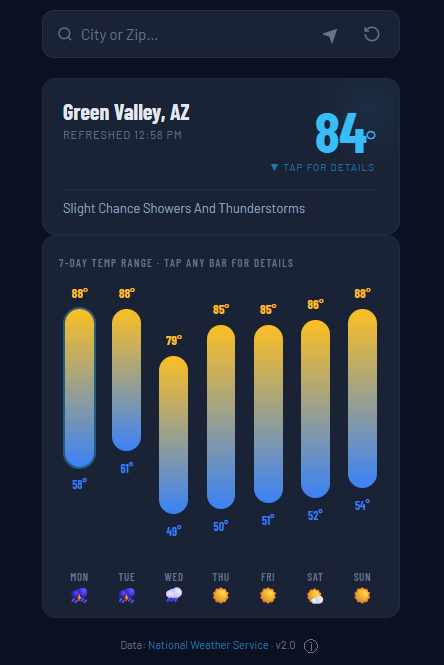
Weather Bars gives you a clean, at-a-glance 7-day temperature forecast without the clutter. No ads, no upsells, no noise.
The centerpiece is a simple bar chart — each day's high and low floating as a gradient bar on a dark background. You see the whole week's temperature range instantly. Tap any bar for the full NWS forecast text. Tap your current temperature for wind, humidity, dewpoint, and more.
Built on the National Weather Service's data. Installs on your phone like a native app. Works great on desktop too.
If you're tired of weather apps that bury the forecast under ads and unnecessary features, this one's for you.
Built a simple weather PWA over the weekend with some AI help — clean, no install, no account, no ads. If anyone's tired of bloated weather apps, give it a shot: https://t.co/G5YI0JpEwq