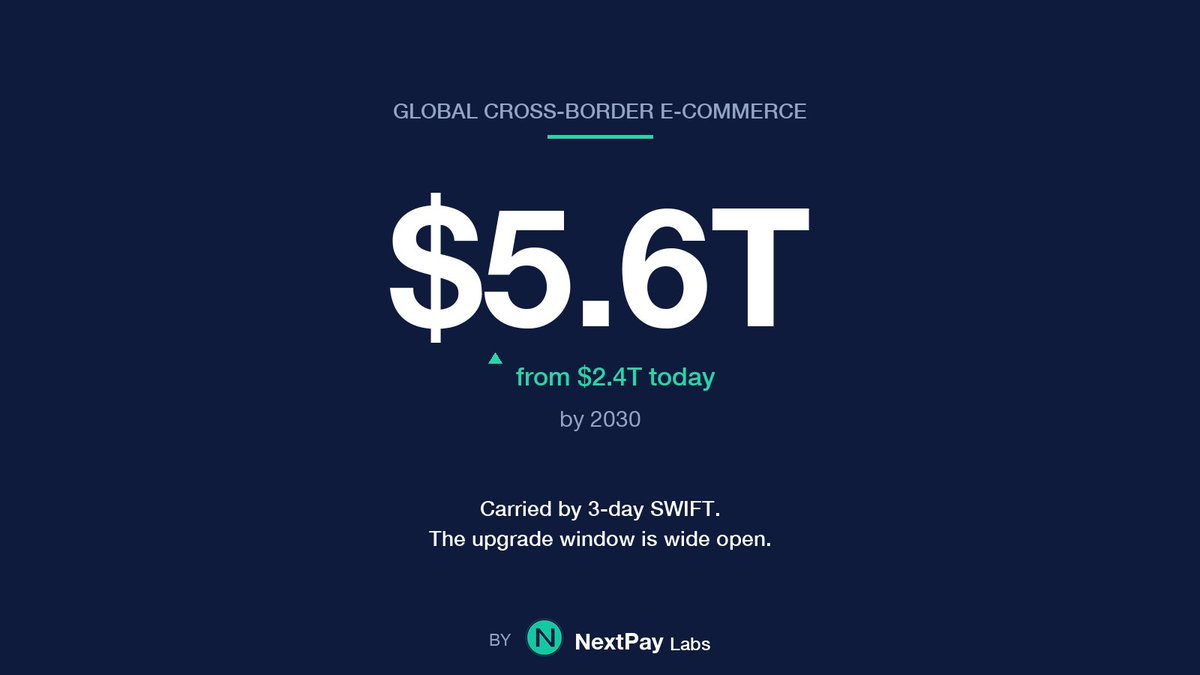
Cross-border B2C e-commerce: $2.4T today, $5.6T by 2030.
The rails carrying it are still 3-day SWIFT and 3-5% wire fees.
The upgrade window is wide open. The protocols that close it write the next decade of payments.
The deflation thesis nobody is pricing in:
When every consumer transaction burns supply — not just speculation — the demand curve gets anchored to commerce, not narrative.
That's the math behind 'burn on subscribe + burn on spend'.
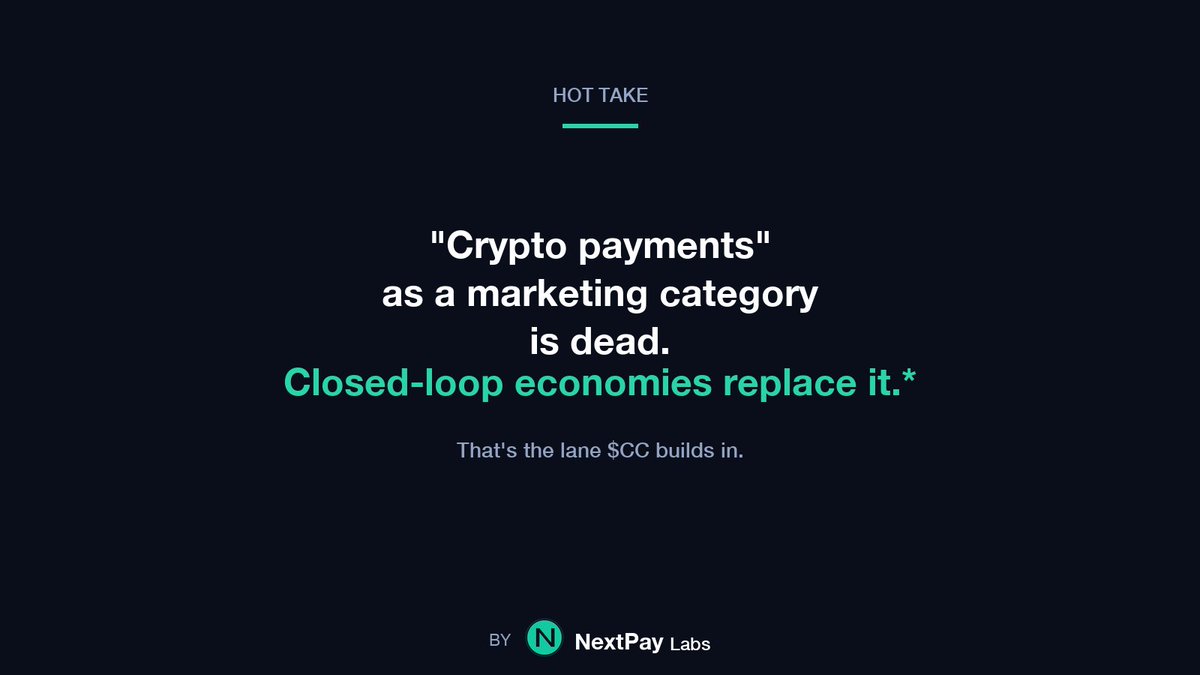
Hot take: 'crypto payments' as a marketing category is dead.
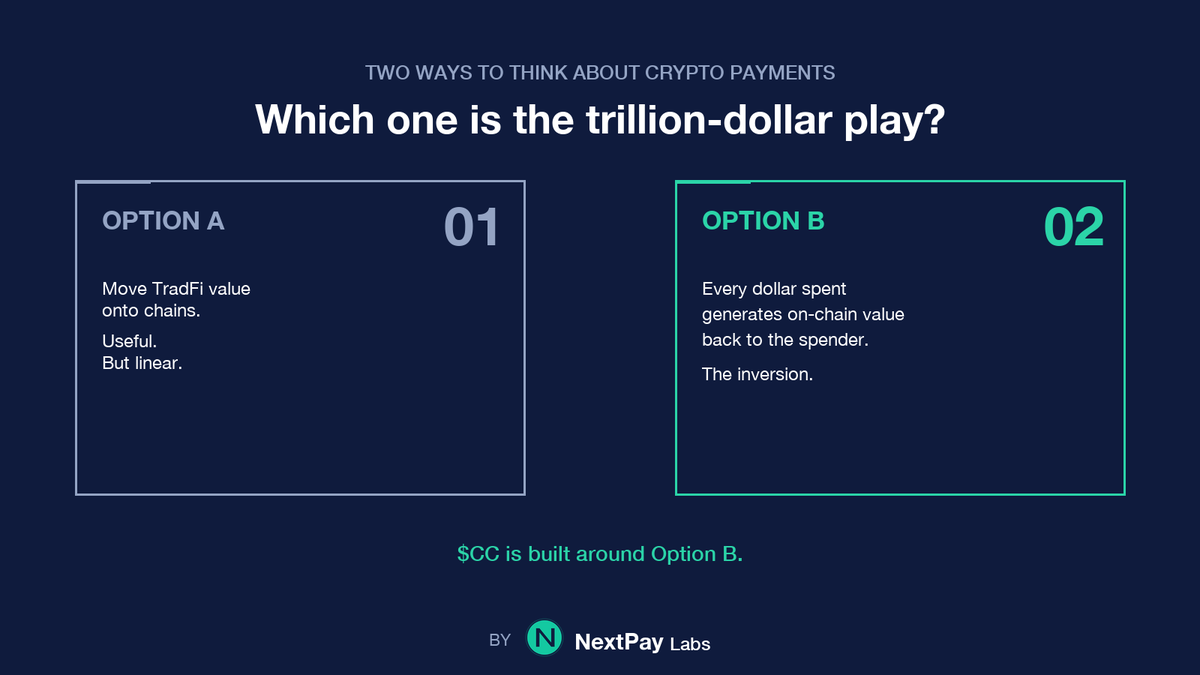
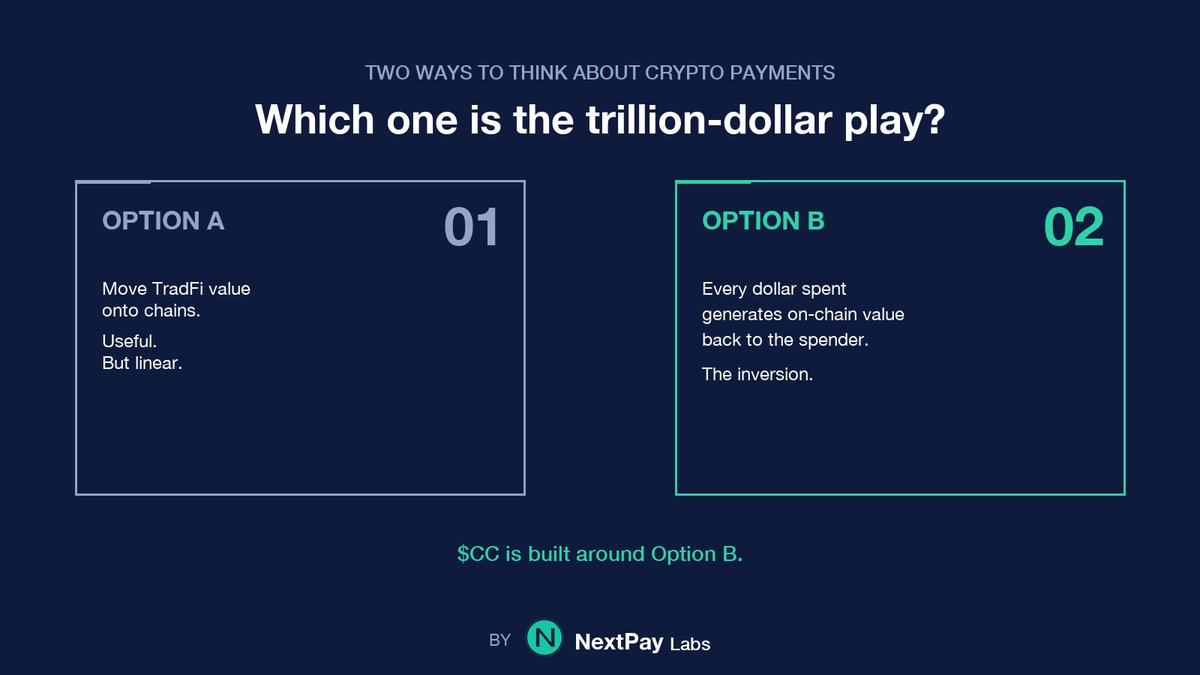
What's alive is the closed-loop economy where consumer reward and on-chain settlement are the same primitive.
That's the lane. That's where $CC builds.
Builder question for the room:
If a stablecoin settlement layer adds 'every spender earns yield' as a primitive — which existing fintech category gets hollowed out first?
Reply with your take. We're writing the answer up.
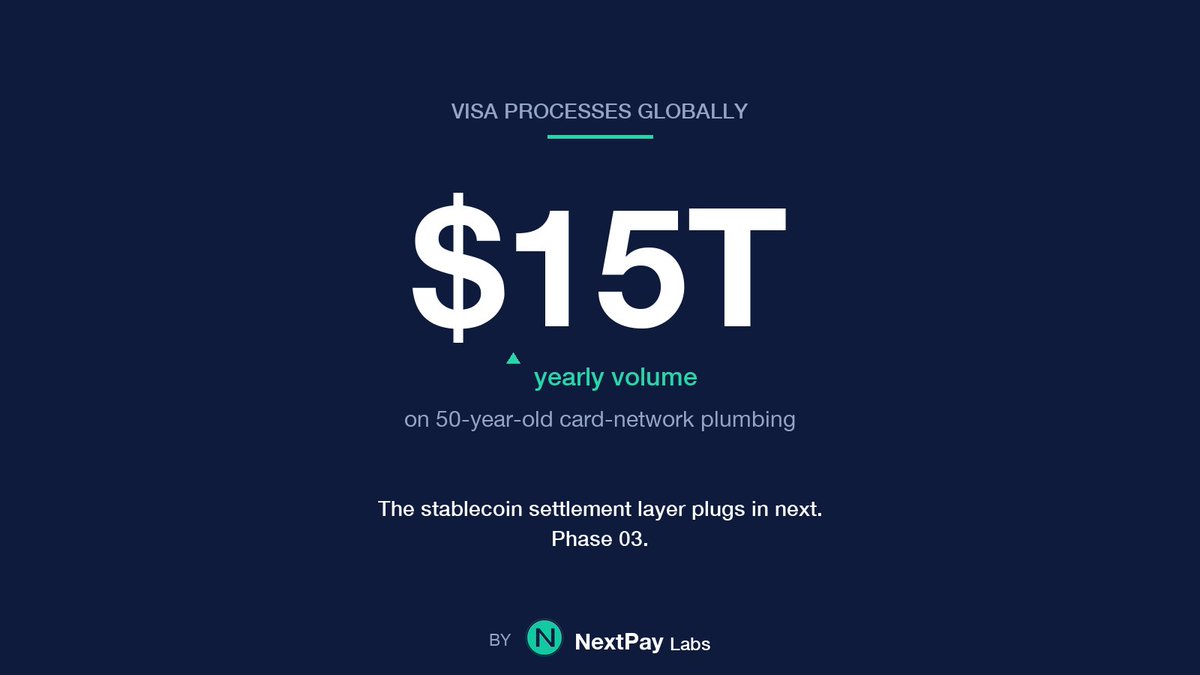
Visa processes ~$15T/yr globally. The settlement infrastructure underneath is 50-year-old card-network plumbing.
A stablecoin settlement layer that plugs into Visa acceptance is a generational opportunity.
That's the Phase 03 build.
The deflation thesis nobody is pricing in:
When every consumer transaction burns supply — not just speculation — the demand curve gets anchored to commerce, not narrative.
That's the math behind 'burn on subscribe + burn on spend'.
TYPES OF TRADERS YOU MUST KNOW
✔️ Day Traders.
Profit within the same day using rapid entries and exits.
✔️ Swing Traders.
Hold trades for days to weeks to catch medium‑term moves.
✔️ Scalpers.
Take tiny, frequent profits from ultra‑fast trades.
✔️ Position Traders.
Long‑term trend followers holding for weeks to years.
✔️ Technical Traders.
Use charts, patterns, and indicators to make decisions.
✔️ Fundamental Traders.
Trade based on economic data and intrinsic value.
✔️ Event‑Driven Traders.
Trade around news, earnings, and major events.
✔️ Options Traders.
Use options contracts for leverage, hedging, or income.
✔️ Algorithmic Traders.
Automate strategies using coded systems.
✔️ Forex Traders.
Specialize in currency markets.
Most traders chase candles.
Professionals chase liquidity.
Price moves where orders sit.
Two high-probability entries I watch every session:-
• Liquidity Run Entry → wait for the stop hunt, then trade the reclaim.
• Liquidity Gap Entry → let inefficiency fill, then strike with confirmation.
The market rewards patience, not prediction.
Stop trading emotion.
Start trading liquidity.
What setup gives you the cleanest entries?. 👇
🚨6 BULLISH CANDLESTICK PATTERNS – ENTRY & STOPLOSS
✅ Bullish Mat Hold Pattern – Long bullish continuation with brief pause
✅ Rising Window – Gap up acts as support zone
✅ Bullish Three Line Strike – Four-candle reversal pattern
✅ Three Rising Method – Small pullback within uptrend
✅ Bullish On-Neck Pattern – Small dip then close near high
✅ Upside Tasuki Gap – Gap up with a small bearish candle that fills partially
✍️Each pattern has defined entry and stoploss levels. Learn them and trade with structure today!
The 4 Pillars of a High-Probability Buy Setup.
Stop chasing green candles and start trading where the institutional money steps in.
If you want to survive the crypto markets, you need to understand exactly where demand lives.
Here are the 4 core buy zones every serious trader should have memorized:
1. The Classic Demand Zone.
The foundational area where a massive influx of buying pressure completely reversed a previous downtrend.
Wait for a clean return to this origin point. Institutional unfilled buy orders are often sitting right here waiting to be mitigated.
2. Demand Continuation.
The "pit stop" in a healthy uptrend. Price pauses, consolidates briefly to trap early shorts, and creates a fresh base of demand before exploding higher.
Perfect for missing the initial move but safely riding the macro trend.
3. The Order Block (SR Flip).
The ultimate shift in market structure. A previous major resistance level is broken with aggressive volume, turning it into a iron-clad support/order block.
Look for a retest of the broken resistance line. Old sellers become new buyers.
4. The Breaker Block (Liquidity Sweep).
The smartest money setup on the board. Price aggressively sweeps below previous lows to hunt retail stop-losses (liquidity), then violently reverses to trap the breakout sellers.
Enter once market structure shifts bullish after the liquidity hunt.
💡 An entry zone is only as good as its confluence. Look for these zones to line up with HTF (High Time Frame) trendlines, OTE Fibonacci levels, or psychological round numbers.
CHART ANALYSIS THAT GRABS ATTENTION
Master the basics: support, resistance,
breakouts, and retests are the
backbone of every clean setup. When
price breaks structure and retests
with weakness, that’s where
high‑probability trades live. Keep your
chart simple, your levels clean, and
your entries disciplined.
MASTER MARKET STRUCTURE FAST
✔ Uptrend Basics,
Higher Highs + Higher Lows
✔ Downtrend Basics,
Lower Highs + Lower Lows
✔ Sideways Market,
Same Highs + Same Lows
✔ Use Higher Timeframes,
Identify the main trend first
✔ Use Lower Timeframes,
Perfect entries with precision
✔ Trendline + MA,
Strong confirmation combo
✔ Structure Break,
Best signal for trend change
🚨USE MULTIPLE TIME FRAME ANALYSIS – TRADE WITH CONFIDENCE
✅ Daily / 4H – Set the overall direction (Bullish or Bearish)
✅ 1 Hour – Identify key liquidity zones (High / Low Liquidity)
✅ 15 Min – Spot BOS & CHOCH for trend confirmation
✅ 5 Min – Fine-tune your TP, Entry, and SL levels
🚨Stack your timeframes from high to low. Align bias, then execute!