Late-breaking DPhil opportunity to come with with @ten_photos@bathybicBee and me on a cool project on medication and brain health https://t.co/PbnnOB00M7
Get in touch if you want to know more!
Incredibly excited to see this work out! We've put in a lot of effort getting MMORF to this point, and I'm quietly pleased with just how well it performs. Please get in touch if you have any questions, or just want some pointers on trying MMORF with your own data. #FSL @OxfordWIN
At long last, @AmyFDHoward has shared her labor of love : BigMac! Amy has put a huge amount of work into acquiring & curating this Amy-zing dataset combining MRI with microscopy. Now she is sharing with the world. We hope you enjoy!
https://t.co/awkZ4v7B9Z
Looking for PhD in 2023 in AI, biomedical imaging, ot both?😉 A number of fully funded places available for 2023 entry at CDT SABS (https://t.co/0HvUXOA6AW)
If you want more information, check details here: https://t.co/xwqT3RMQko
RT please!
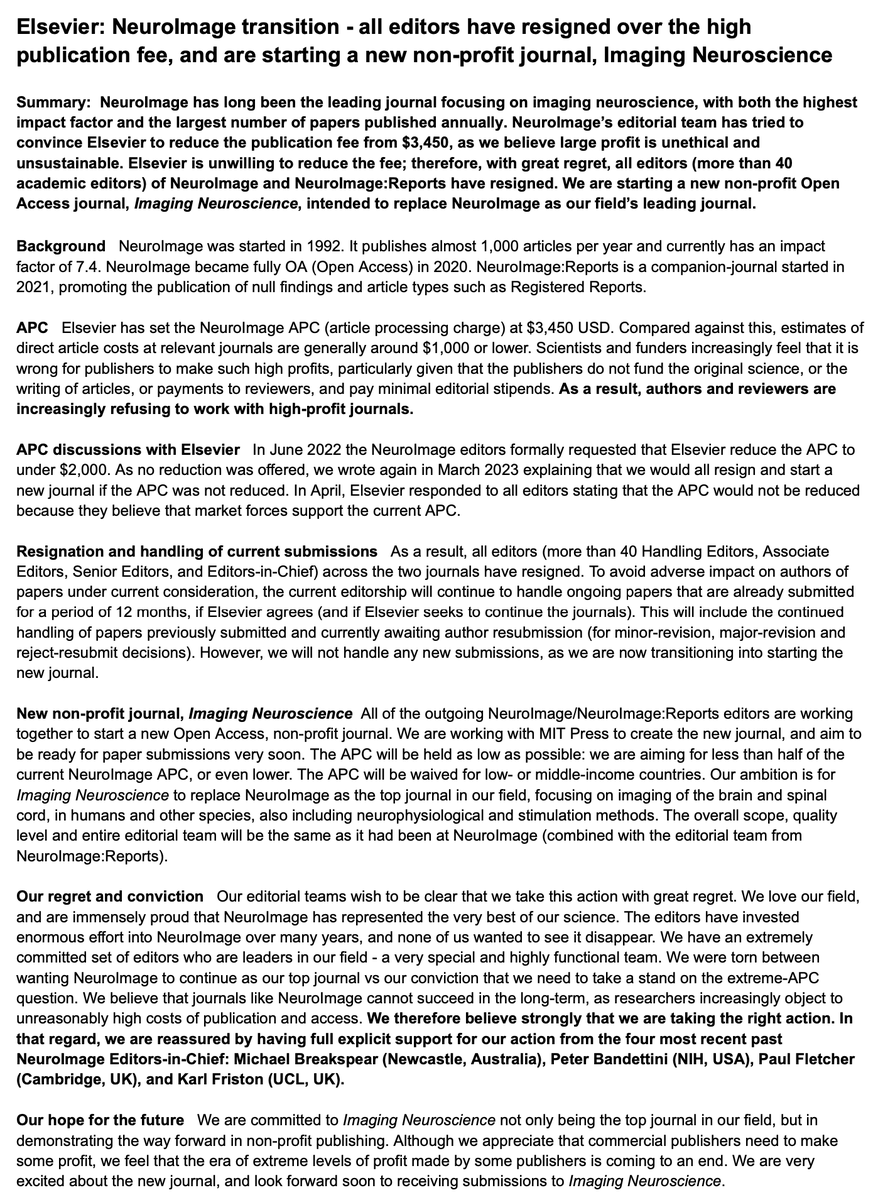
All NeuroImage and NeuroImage:Reports editors have resigned over the high publication fee, and are starting a new non-profit journal
https://t.co/DmnwDKVCK7
This comes with great regret, and a huge amount of thought and discussion- please read announcement to get more details.
The WIN Global Scholars (WINGS) Programme is open for applications for 2022-23! We are seeking early career researchers from the Global South to be remotely affiliated with WIN for one year. Please help us find the next WIN Global Scholars. 1/3
As recent guidelines (e.g. by @stevesphd and others) have emphasised, MR analyses ideally are part of a triangulation of evidence approach. When paired with a careful assessment of assumptions and results, MR can be a powerful tool in the neuroimager’s methodological toolbox.12/n
Our recent paper provides an introduction to Mendelian randomisation as motivated by neuroimaging data (with @ten_photos and @fmrib_steve) … https://t.co/ti6DcAIPUI. A short thread: 1/n
But determining a causal relationship between IDPs and higher-level traits (e.g. cognition) is much more challenging due to higher heterogeneity in effect estimates, weak genetic associations when using IDPs as exposure and likely bias from horizontal pleiotropy. 11/n
Brain regions related to smell show decline following mild #COVID. Paper by Gwenaelle Douaud and colleagues out now in @Nature. Using data from @uk_biobank. https://t.co/IxlhEDGFIo