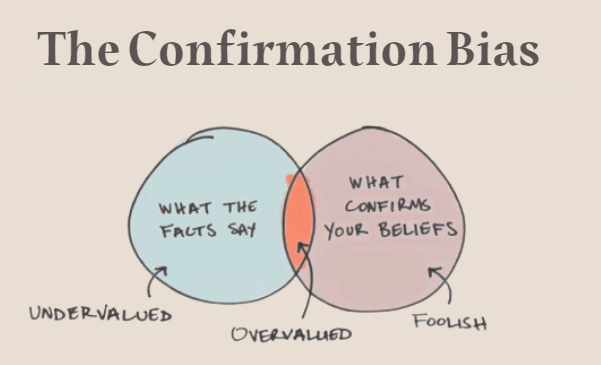
12 Biases that distort your Decision-Making:
1. Confirmation Bias - We interpret new information as confirmation of our existing beliefs.
2. Availability Bias - We tend to rely on information that comes to our mind easily/the quickest.
3. Action Bias - We favor action over inaction. That's why we sell or buy prematurely.
4. Zero-Risk Bias - If a risk is considered small, we assume there is no risk at all.
5. Overconfidence - We overestimate our own knowledge and ability.
Often because we know too little to know better. (Less knowledge => more confidence)
6. Survivorship Bias - This is a sample bias that occurs when we assess only successful outcomes and disregard failures.
7. Gambler’s Fallacy - We tend to think that past events affect future possibilities.
8. Dunning-Kruger Effect - The less you know, the more confident you are.
The more you know, the less confident you are.
9. Cause-Effect Fallacy - We always look for cause-effect relationships.
Thus, we find patterns even in totally random data.
10. Hyperbolic Discounting - We are wired to prefer instant gratification (e.g. payouts).
Even when offered significantly more in the future.
11. False Consensus Effect - Too often, we overestimate the degree to which others agree with us.
12. Psychological Denial - When something terrible happens, we tend to fall into a state of denial.
AstraZeneca teamed up with Oxford to provide a low-cost Covid-19 vaccine to the world, but production stumbles are now threatening reputational damage. #SCM361 https://t.co/3tKpqNbcOH
What will your college campus look like this fall? The answer is different depending on the school. Some quads will be empty. Others, full of mask-wearing students. https://t.co/NwgMyTTTBH
Commerce Secretary Wilbur Ross, speaking of the coronavirus outbreak in China, said: ‘I think it will help to accelerate the return of jobs to North America’ #SCM361 https://t.co/Ahft3BC6zc via @WSJ
Regulators, passengers and investors in Boeing are weighing in after the fatal crash in Ethiopia raised safety concerns #SCM361 https://t.co/jmQ9H1DbQL via @WSJ
“Sometimes China is the easiest answer” says the CEO of Yeti. “But sometimes it’s not the best one for the long term.” #SCM301#SCM361 https://t.co/FFvhsPyjZs via @WSJ