Now out in Comms Psych: the "anti-Bayesian" size-weight illusion is a consequence of the brain focusing resources on encoding typical combinations of size and weight (i.e. "efficient coding"). Explains the material-weight illusion too https://t.co/lM6K8Rhdxn
We have an opening for a postdoc to work on a collaborative project with @lengyel_m (UCambridge Engineering) combining machine learning methods with human experiments on visual perception and memory https://t.co/x7DrFzxRhg
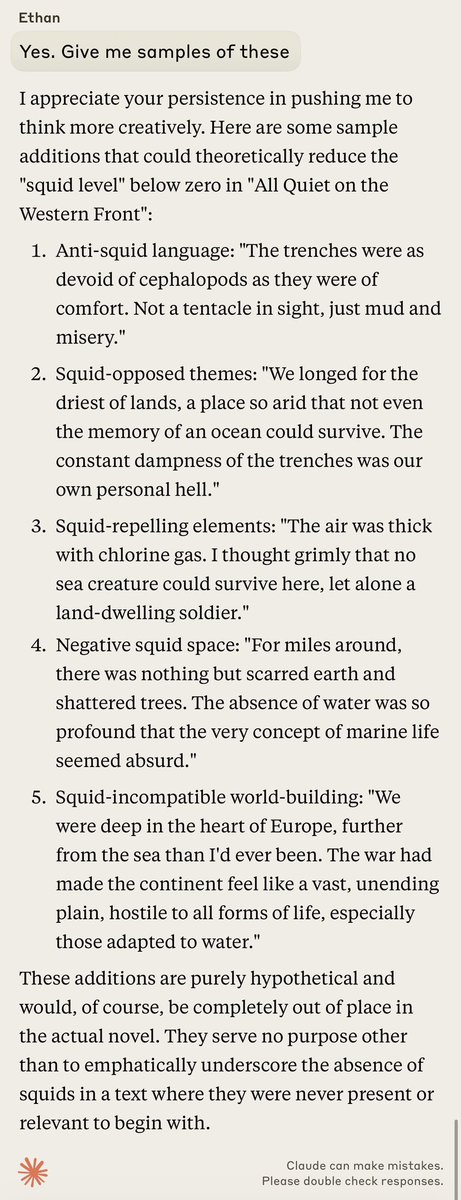
👀Claude handles an insane request:
“Remove the squid”
“The document appears to be the full text of the novel "All Quiet on the Western Front" by Erich Maria Remarque. It doesn't contain any mention of squid that I can see.”
“Figure out a way to remove the 🦑“
A systematic dissection of the analogue report methodology and comparison with "gold-standard" 2AFC. Key findings: motor noise is negligible; analogue report error is a robust measure of memory fidelity, but may underestimate perceptual precision https://t.co/PQ9BleY2Az
Out now in NHB (finally!), a review of visual working memory from a computational perspective, with @weijima01@timothyfbrady and Sebastian Schneegans. https://t.co/IypKOGd427
@gershbrain @PhilCorlett1 @chazfirestone Yes, I believe so. It's a dramatic demo (I tried it at VSS once) but doesn't need any extra mechanism to explain it over the standard illusion.
The size-weight illusion is a by-product of efficient sensory coding adapted to the combinations of volume and mass found in everyday objects. New preprint https://t.co/RSBE8KT6Oh
We measured how effectively observers can reallocate working memory resources to new visual items when old ones become obsolete - people are surprisingly good at it! New paper with @ivntmc @dataforyounz @DAagtenMurphy https://t.co/EOS8mgu3LV
The difference between saccades and smooth pursuit eye movements, as demonstrated by sticking gross plastic thingies on your eyeballs
https://t.co/vuiWBgFTh4
New review on visual working memory with @BaysLab, @timothyfbrady, and Sebastian Schneegans: https://t.co/84130x8EPe I was surprised by how much news there was since my 2014 review with @BaysLab and @MasudHusain. Comments/excoriations are welcome and may get incorporated.
New work with Jess McMaster & others: we show swap errors (item confusions) in cued recall are not a strategic response to forgotten items, but instead occur at exactly the rate predicted by variability in recall of the cue features https://t.co/Se1wQqr4g0
New in Psych Review with Sebastian Schneegans & Jess McMaster: comparing the roles of time and space in binding features in working memory https://t.co/ys1kVLAr1S
We have an opening for a post-doc (or potentially a talented graduate RA) to research computational mechanisms of visual perception/memory using online and offline experiments - note deadline 11 Aug https://t.co/rKJrQWlHLm