Lot of people hating, but this is what type-A mercenary corp execs look like. Not softies like founder types all emotional about products, teams, and missions. Just ruthless evaluation of options and highest trajectory paths. No idea of her reputation, but obv great at the game.
I am not a fan of Tucker Carlson. I disagree a lot with Carlson. But as an interviewer, Carlson actually, brilliantly, asks follow-up questions, and keeps going, in a way that pretty much no US TV interviewer has done with pro-Israel guests since Oct 7.
And Huckabee falls apart.
Manuel Akanji: “Manchester City suddenly had six fit centre-backs in the summer, but only two were available to play. When I then wasn’t playing at the start of the season, I started looking at my options with my agent.
Clubs often demand loyalty from their players, but they don’t always offer it themselves. Therefore, as a player, you sometimes have to make selfish decisions [to leave] that aren’t always understood from the outside.”
This is a great catch by Matt Levine.
KPMG is trying to force its auditor to accept less money, since accounting work can be significantly automated by AI.
But KMPG ... makes money ... from accounting. So this looks like a company accidentally announcing to the world that its business model is under attack.
Matt: "'Auditing can basically be done by Al so why should we pay for it?' is not a crazy thing for most companies to think, or to say to their auditors. But it is a crazy thing for an auditing firm to say to its auditor."
In 2008, Malcolm Gladwell explained why some people succeed & some don't.
This talk reveals:
• Why ability is overrated
• Why effort alone isn’t enough
• How systems quietly decide outcomes
12 lessons from Gladwell that'll permanently change how you think about success:
head of anthropic’s safeguards research just quit and said “the world is in peril” and that he’s moving to the UK to write poetry and “become invisible”. other safety researchers and senior staff left over the last 2 weeks as well... probably nothing.
This is what Apple should have done a year ago.
But instead Nothing is charging full-steam ahead.
If you been following along here, you know that through the last couple of years. I've been talking a lot about self-assembling apps. About how the future of software will look very different from today.
We are closing in on that future, at an accelerating speed. It's happening right now. There is no going back.
Anything you can imagine, will be made possible, any fringe and super personal app that only you would need. Could and will be built.
What happens to software at scale when everyone can make whatever their hearts desires?
The future is here right now. This implementation by nothing is so smart. They make sure the apps you build look on point, and they give you the tools (no need to be a techie) You just use plain language and they sort the rest.
This is so smooth. I hope others will follow.
This is a very mainstream approach.
I'm watching this over and over. It's so smart.
Saint-Etienne surprised lifelong fan Timothee Chalamet and launched a new jersey while he was being interviewed on French TV 🤩
Upon being presented with the new fourth shirt, Chalamet immediately kissed the badge 💚
This is amazing to me. Nearly a million views…? My thanks to @xwastheone for putting together this thread that connects quite a few things. I am honored that someone would go to the trouble of doing such deep research over such a long period.
“Playing sports in Nigeria is often seen as not taking life seriously.”
Hakeem Olajuwon, 2× NBA Champion & Finals MVP, speaking with fellow 2× NBA Champion & 2× Finals MVP, Kevin Durant on how many Nigerian parents view sports.
Sadly, that mindset hasn’t changed much.
Palm oil is in almost every Nigerian kitchen, but right now, most of what is being sold in our markets isn’t oil.
It’s a mix of water, dyes, and unsafe additives.
Uber in Nigeria is a classic example of Gresham’s Law where inferior quality drives out superior quality.
When Uber started it enforced strict standards on vehicle type age and condition.
Drivers were screened and a rating system rewarded good behavior and quality service so users got a premium experience.
Bolt entered the market lowered standards and competed mainly on price. Uber came under pressure and responded by lowering its own standards. The market shifted into a race to the bottom.
Today owning a clean well maintained car on Uber offers no real reward. You earn roughly the same as someone driving a rickety vehicle. It is like running an air conditioned bus and competing with a danfo on Lagos roads.
This is Gresham’s Law in action.
Worked 2 decades in in consulting.
Made Partner in my 30s.
Led teams of 100+ people.
Run 9-figure client portfolios.
Lived and worked in 4 continents.
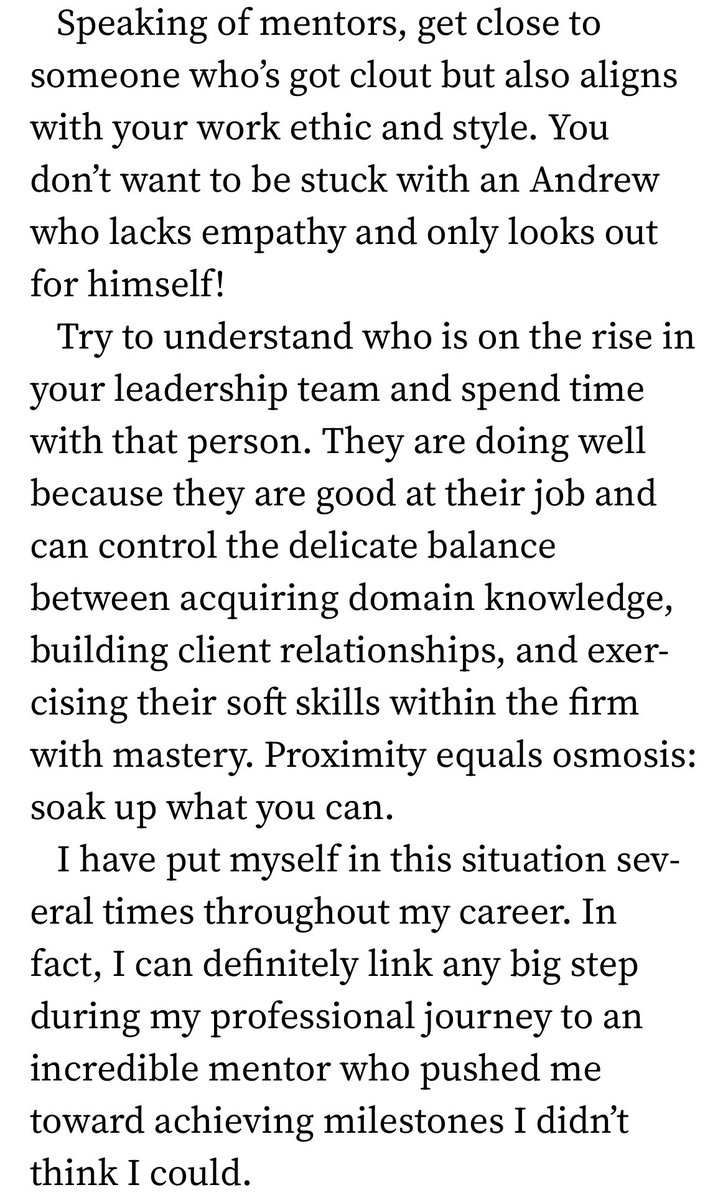
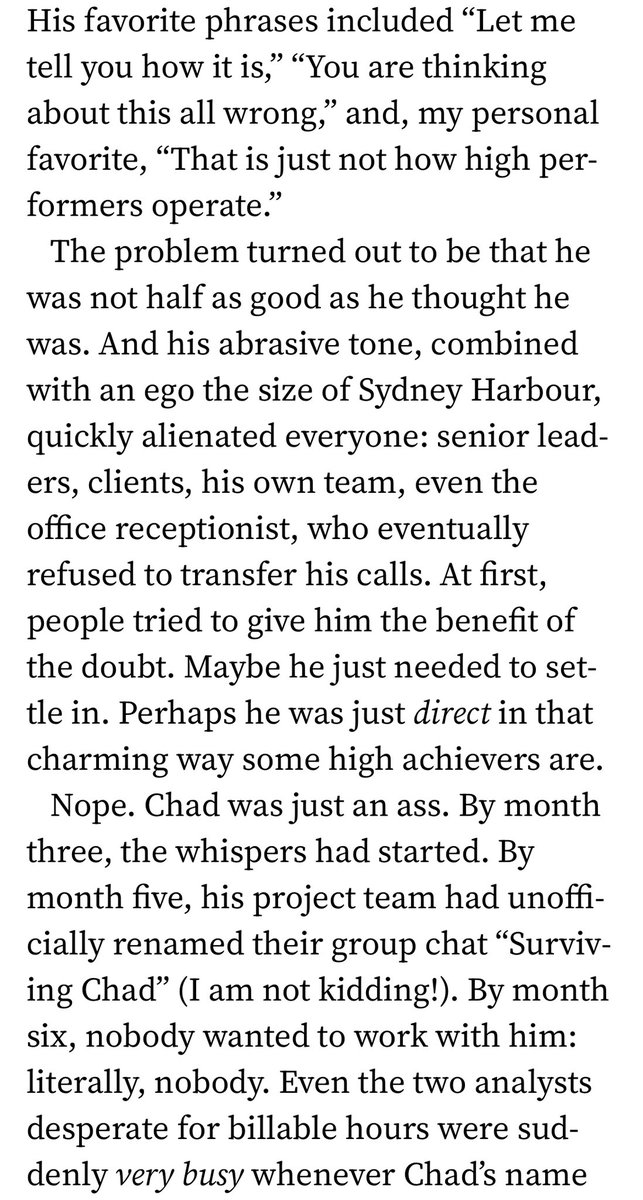
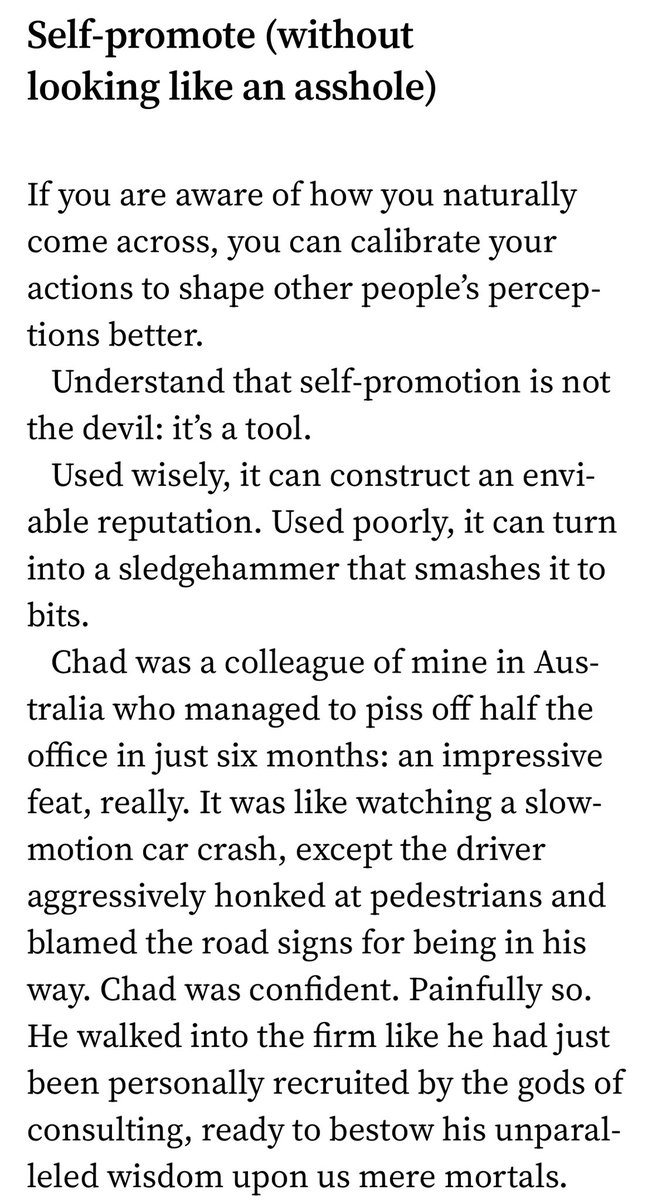
To grow fast, I had to learn practical ways to "narrate reality" to my leaders, without turning into the loudest guy in the office.
3 UNDER-DISCUSSED WAYS TO SELF-PROMOTE
1) Run "impact debriefs" after every meaningful piece of work, and make them impossible to ignore.
A lot of people finish a project… and move on.
They think "Well, my boss saw how hard I worked. They know."
No they don't.
After every major milestone (eg, a workshop, a turnaround, a nasty delivery save) write a one-page impact note and send it to the people who matter.
Frame it as a story of change: what was broken, what you changed, what business risk or cost you removed, what decision you unlocked, etc
Use numbers, but lead with stakes.
An exec doesn't care about "I consolidated 3 misaligned streams" but they get interested with "I prevented a $4M regulatory exposure by getting 4 execs to align on a single approach"...
The right people remember evidence.
⸻
2) Translate your work into executive language, even if nobody asked you to.
Early in your career you think work is about doing, but later you realize careers are built on how your work is interpreted.
Every month, force yourself to rewrite what you did in a language an exec would respect:
Risk reduced.
Revenue unlocked.
Delay avoided.
Optionality created.
Take the complex thing you did in the trenches and narrate it as cause-and-effect.
For example:
"I built a dashboard" is output.
"I gave the CFO a single source of financial truth and eliminated three weeks of reconciliation activities per quarter" is impact.
Then drip-feed that language in conversations, performance reviews, 1:1s, town halls.
You are simply making reality visible at the altitude where decisions are made.
IMPORTANT!!! If you do not narrate it, someone else will, and they will narrate themselves into your work.
⸻
3) Build a small internal audience and teach them what you are learning.
All right, this is the highest-leverage move.
Once a quarter, run a short learning session inside your team or practice: teach a principle that emerged from your work.
Explain the context and trade-offs, give details, so that people start seeing you not as a deliverable machine but as a person who creates understanding.
Understanding is political capital.
Executives hear about people who create understanding.
Careers move around those people.
⸻
Let me be even more explicit: doing important work in silence is romantic, but in reality, silence gets mistaken for irrelevance.
Be an high achiever, but don't be a QUIET high achiever.
Narrate what is true: do it with restraint, precision, and respect for the craft.
I wrote a chapter in "Beyond Slides" with more suggestions on how to "self-promote without looking like an asshole", so have a read at the below extract!
All the best!!
The real reason the US is invading Venezuela goes back to a deal Henry Kissinger made with Saudi Arabia in 1974.
And I'm going to explain why this is actually about the SURVIVAL of the US dollar itself.
Not drugs. Not terrorism. Not "democracy."
This is about the petrodollar system that has kept America the dominant economic power for 50 years.
And Venezuela just threatened to end it.
Here's what really just happened:
Venezuela has 303 billion barrels of proven oil reserves.
The largest on Earth.
More than Saudi Arabia.
20% of the entire world's oil.
But here's the part that matters:
Venezuela was actively selling that oil in Chinese yuan. Not dollars.
In 2018, Venezuela announced it would "free itself from the dollar."
They started accepting yuan, euros, rubles, anything BUT dollars for oil.
They were petitioning to join BRICS.
They were building direct payment channels with China that bypass SWIFT entirely.
And they were sitting on enough oil to fund de-dollarization for decades.
Why does this matter?
Because the entire American financial system is built on one thing:
The petrodollar.
In 1974, Henry Kissinger made a deal with Saudi Arabia:
All oil sold globally must be priced in US dollars.
In exchange, America provides military protection.
This single agreement created artificial demand for dollars worldwide.
Every country on Earth needs dollars to buy oil.
This lets America print unlimited money while other countries work for it.
It funds the military. The welfare state. The deficit spending.
The petrodollar is more important to US hegemony than aircraft carriers.
And there's a pattern of what happens to leaders who challenge it:
2000: Saddam Hussein announces Iraq will sell oil in euros instead of dollars.
2003: Invaded. Regime change. Iraq's oil immediately switched back to dollars. Saddam lynched.
The WMDs were never found because they never existed.
2009: Gaddafi proposes a gold-backed African currency called the "gold dinar" for oil trade.
Hillary Clinton's own leaked emails confirm this was the PRIMARY reason for intervention.
Email quote: "This gold was intended to establish a pan-African currency based on the Libyan golden Dinar."
2011: NATO bombs Libya. Gaddafi sodomized and murdered. Libya now has open slave markets.
"We came, we saw, he died!" Clinton laughed on camera.
The gold dinar died with him.
And now Maduro.
With FIVE TIMES more oil than Saddam and Gaddafi combined.
Actively selling in yuan.
Building payment systems outside dollar control.
Petitioning to join BRICS.
Partnered with China, Russia, and Iran.
The three countries leading global de-dollarization.
This isn't coincidence.
Challenge the petrodollar. Get regime changed.
Every. Single. Time.
Stephen Miller (US homeland security advisor) literally said it out loud two weeks ago:
"American sweat, ingenuity and toil created the oil industry in Venezuela. Its tyrannical expropriation was the largest recorded theft of American wealth and property."
He's not hiding it.
They're claiming Venezuelan oil BELONGS to America because US companies developed it 100 years ago.
By this logic, every nationalized resource in history was "theft."
But here's the DEEPER problem:
The petrodollar is already dying.
Russia sells oil in rubles and yuan since Ukraine.
Saudi Arabia is openly discussing yuan settlements.
Iran has been trading in non-dollar currencies for years.
China built CIPS, their own alternative to SWIFT with 4,800 banks in 185 countries.
BRICS is actively building payment systems that bypass the dollar entirely.
The mBridge project lets central banks settle trades instantly in local currencies.
Venezuela joining BRICS with 303 billion barrels of oil would accelerate this exponentially.
That's what this invasion is really about.
Not stopping drugs. Venezuela accounts for less than 1% of US cocaine.
Not terrorism. There's zero evidence Maduro runs a "terror organization."
Not democracy. The US supports Saudi Arabia, which has zero elections.
This is about maintaining a 50-year-old agreement that lets America print money while the world works for it.
And the consequences are terrifying:
Russia, China, and Iran are already denouncing this as "armed aggression."
China is Venezuela's biggest oil customer. They're losing billions.
BRICS nations are watching a country get invaded for trading outside the dollar.
Every nation considering de-dollarization just got the message:
Challenge the dollar and we will bomb you.
But here's the problem...
That message might accelerate de-dollarization, not stop it.
Because now every country in the Global South knows what happens if you threaten dollar hegemony.
And they're realizing the only protection is to move FASTER.
The timing is insane too:
January 3rd, 2026. Venezuela invaded. Maduro captured.
January 3rd, 1990. Panama invaded. Noriega captured.
36 years apart. Almost to the day.
Same playbook. Same "drug trafficking" excuse.
Same real reason: control of strategic resources and trade routes.
History doesn't repeat. But it rhymes.
What happens next:
Trump's press conference at Mar-a-Lago sets the narrative.
US oil companies are already lined up. Politico reported they've been approached about "returning to Venezuela."
The opposition will be installed. Oil will flow in dollars again.
Venezuela becomes another Iraq. Another Libya.
But here's what nobody's asking:
What happens when you can no longer bomb your way to dollar dominance?
When China has enough economic leverage to retaliate?
When BRICS controls 40% of global GDP and says "no more dollars"?
When the world realizes the petrodollar is maintained by violence?
America just showed its hand.
The question is whether the rest of the world folds or calls the bluff.
Because this invasion is an admission that the dollar can no longer compete on its own merits.
When you have to bomb countries to keep them using your currency, the currency is already dying.
Venezuela isn't the beginning.
It's the desperate end.
What do you think?









![cityreport_'s tweet photo. Manuel Akanji: “Manchester City suddenly had six fit centre-backs in the summer, but only two were available to play. When I then wasn’t playing at the start of the season, I started looking at my options with my agent.
Clubs often demand loyalty from their players, but they don’t always offer it themselves. Therefore, as a player, you sometimes have to make selfish decisions [to leave] that aren’t always understood from the outside.”](https://pbs.twimg.com/media/HBrc_38XEAAznfs.jpg)