For years, the AI race has been about building bigger models.
@sudip_r0y, Co-Founder of @adaption_ai, believes the next frontier is AI that continuously adapts instead.
If he's right, one of AI's biggest assumptions is about to change.
Listen to the latest episode of Nebius for Startups podcast: 🎧 https://t.co/DfBR9pjjVW
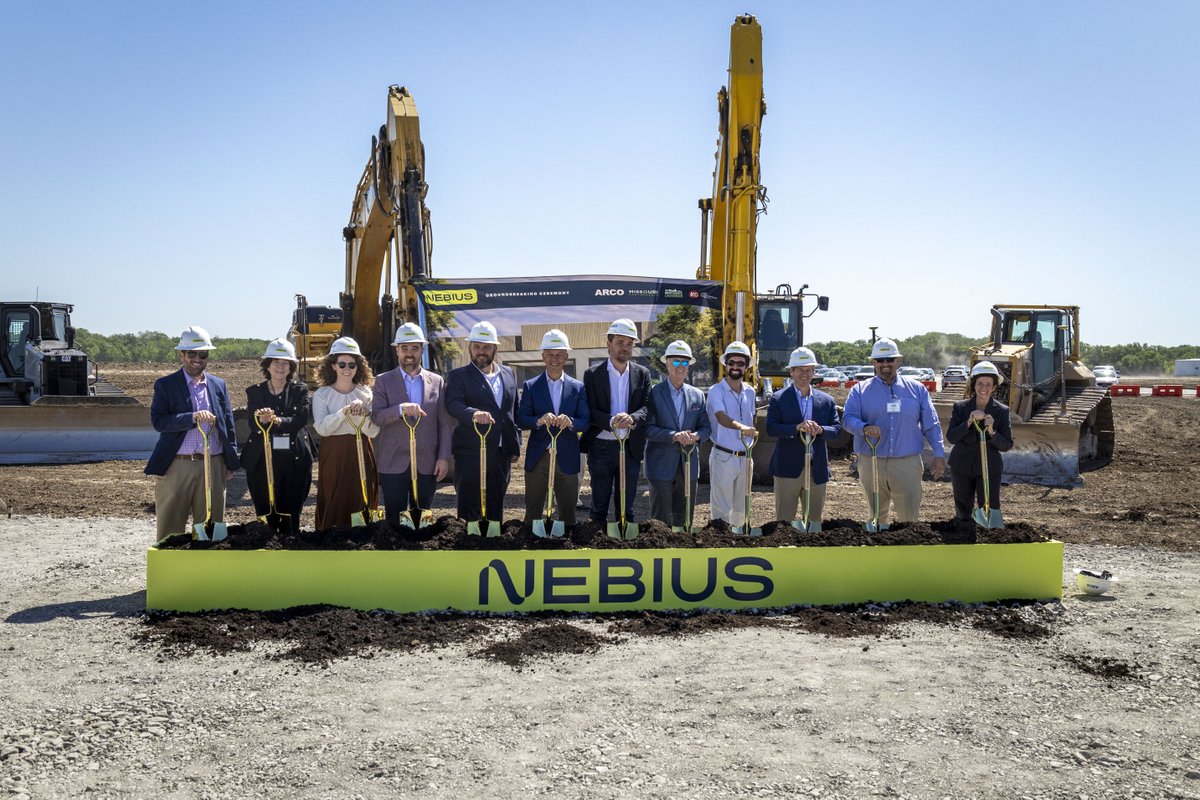
Today, Nebius broke ground on its flagship AI factory campus in Independence, Missouri – the company's first gigawatt-scale digital infrastructure project in the US.
The campus will support ~1,200 construction jobs and 130 permanent roles, alongside a community benefits plan covering local education and workforce development.
State and local leaders, economic development partners, and community members joined company representatives to mark the occasion.
Read the full release: https://t.co/FfwCeEPZi4
4/ For Cogito v2.1, we fork off the open-licensed Deepseek base model from November 2024. This is an obvious choice for a pretrained base model, as Deepseek architecture has an ecosystem of cheap inference built around it.
We have built a frontier training stack, while being an early stage startup, since we can stand on the shoulders of open source champions like @huggingface, @togethercompute, @runpod and @nebiusai, as well as stellar contributions by @Microsoft, @Meta, @nvidia and a lot of other folks in open source.
Over the last months, we have iterated and refined our post-training strategies of self-play + RL (called Iterated Distillation and Amplification - IDA) with Cogito v1 and v2.
You will see high-quality responses from Cogito v2.1 while being a bit different from usual models - we increase the model’s intelligence prior and teach it how to think via process supervision. So there are significantly shorter reasoning chains for the responses. We also use less markdown, less verbosity.
In short, we want to make the model great for API usage - faster, fewer tokens with super high quality.
It is intuitively easy to understand why self play *can* work for LLMs, if we are able to provide a value function at intermediate steps (although not as clearly guaranteed as in two-player zero-sum games).
In chess / go / poker, we have a reward associated with every next move, but as Noam points out, natural language is messy. It is hard to define a value function at intermediate steps like tokens. As a result, in usual reinforcement learning (like RLVR), LLMs get a reward at the end. They end up learning to 'meander' more for hard problems. In a way, we reward brute forcing with more tokens to end up at the right answer as the right approach.
However, at @DeepCogito, we provide a signal for the thinking process itself. Conceptually, you can imagine this as post-hoc assigning a reward to better search trajectories. This teaches the model to develop a stronger intuition for 'how to search' while reasoning.
In practice, the model ends up with significantly shorter reasoning chains for harder problems in a reasoning mode. Somewhat surprisingly, it also ends up being better in a non-thinking mode. One way to think about it is that since the model knows how to search better, it 'picks' the most likely trajectory better in the non-thinking mode.
Guess how long after signing the pivotal deal it took our CEO to ask:
“Why hasn’t this (relatively small) new customer received an answer yet?”
Less than 1 hour.
That’s the obsession we need to keep as we build a true multi-customer cloud. The MSFT deal is the fuel for growth.
Today, we are releasing 4 hybrid reasoning models of sizes 70B, 109B MoE, 405B, 671B MoE under open license.
These are some of the strongest LLMs in the world, and serve as a proof of concept for a novel AI paradigm - iterative self-improvement (AI systems improving themselves).
The largest 671B MoE model is amongst the strongest open models in the world. It matches/exceeds the performance of the latest DeepSeek v3 and DeepSeek R1 models both, and approaches closed frontier models like o3 and Claude 4 Opus.
Anyone at ICML wanna see the future of world models? We're walking around with a laptop running our world model at 500 FPS+ (fully local). Would love to demo/chat with anyone interested
If you can't tell from my "turing" handle (aka Alan Turing) I am a philospher at heart - and am certain #tech, #ai, and #philosophy are all apart of the same conversation. Recently I wrote this think piece. Would love to hear your thoughts: https://t.co/Djd577UeUK