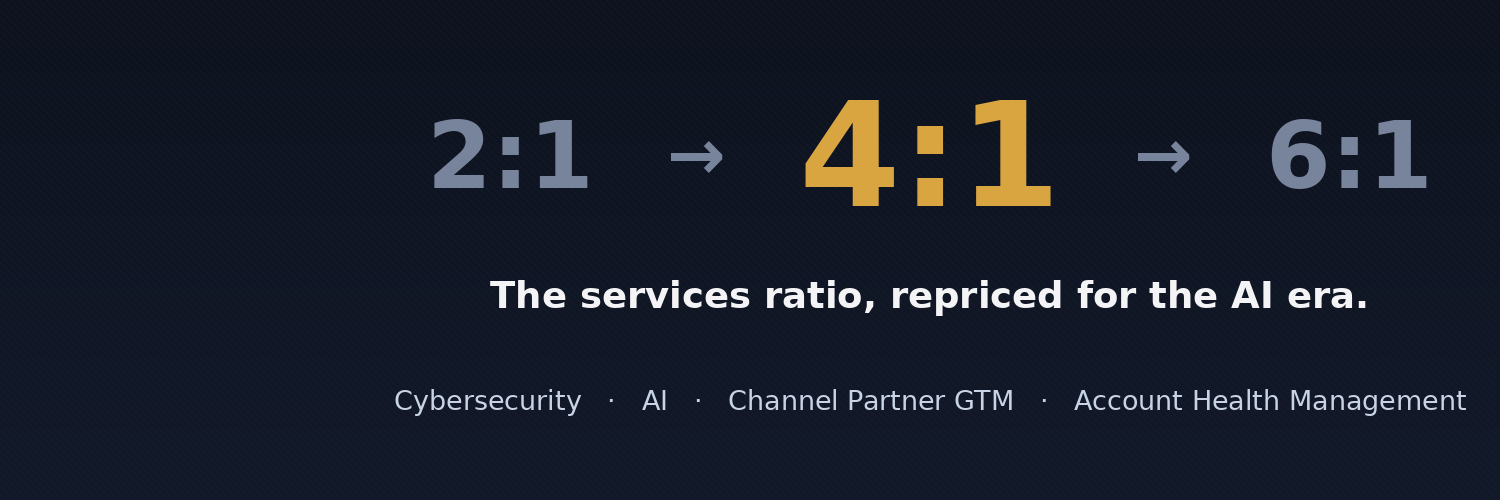
Built the services-attach playbook at scale: $8M to $700M+ | 4:1 in the AI era, 6:1 the ceiling | Channel Partner GTM | AI as the engine, not the headline
Nikesh Arora calls it a Darwinian moment for workers. The same week, data on 21,000 US firms shows heavy AI adopters grew headcount 10 percent in two years. Entry level grew 12.
Both are right. Some jobs go away. Others get created. Watch the created column.
The fastest growing new role in enterprise AI is the forward deployed engineer. The person who turns a model into an outcome at the customer. Barely existed at scale three years ago.
AI is not emptying the building. It clears the backlog and moves the work to the last mile. In platform services that lands near 4 to 1, services to product, after AI takes the setup hours.
The map for where the new jobs go already exists. Account health shows which accounts have an outcome gap. That is where the FDE lands.
Darwinian, yes. Extinction, no. The work moves to where the outcomes happen.
Starbucks answered a version of this question from the other end of the stack this week. It is building its own AI tools in house to replace parts of its Microsoft and IBM spend. Owning a layer makes sense wherever the bought version is a commodity and the value sits in your own context. The labs are building chips for the same reason enterprises are starting to build software.
Starbucks spends $400 million a year on software. This week it said it will build custom AI tools in house to replace parts of its Microsoft and IBM stack. IBM and Salesforce both sold off on the news.
Everyone is reading it as the death of enterprise software. Read the budget instead. The $400 million does not disappear. It converts from license line items into build and run work: people who know the business, wire the AI into it, and keep it producing results.
We ran a large services business through the first version of this shift. When the shelf product gets replaced, the spend moves to context work, and that work is stickier than the license ever was.
The software that keeps getting bought is the software that comes with outcomes attached. In platform deals that lands near 4 to 1, services to product, once AI takes the setup hours.
📊 News: public market reporting, July 2026 (Starbucks ~$400M annual software spend, in house AI replacements, IBM and Salesforce sell off). Build vs buy framing credit: InvestAnswers.
Agree, and the difference is when the work happens. A solutions architect designs before the deal closes. The FDE owns what happens after, getting the thing deployed and producing results, which is where most AI purchases stall today. Renaming CSAs without changing that accountability is just a title swap.
The labs are hiring for this because they learned what enterprise vendors learned a decade ago. The product only renews if somebody makes it produce results inside the customer's actual environment. Five AI companies have committed $9.75b to embedded engineering this year. Take the interviews, the leverage is on your side right now.
The token cost comparison only becomes possible after someone integrates the AI into the actual workflow and proves the output side by side. That integration is paid work and it is growing fast. Amazon committed a billion dollars to an FDE org this month and five AI companies have committed $9.75b to embedding engineers this year. The replacement and the new hiring are going to show up inside the same companies at the same time.
The repricing looks broken because buyers count the license and skip the layer that makes it deliver. We tracked percent deployed and outcome attainment across thousands of platform accounts. The ones that actually got value ran about 4 to 1, services to product. Skip that layer and you land on exactly this cost curve.
Measurable results is the phrase doing the work here. We tracked percent deployed and outcome attainment across thousands of platform accounts, and the gap between what a customer bought and what was actually live predicted renewal and expansion better than anything else. Most AI rollouts never define deployed. Starting with the measurement is why this one is working. Glad it has worked out for you.
The electricity parallel holds on the cost side too. Factories did not electrify themselves. An industry of engineers rewired them over decades and was paid well for it. Deployment cost is not a death knell for AI, it is the revenue line of whoever does the rewiring. Five AI companies just committed $9.75b to forward deployed engineering for exactly that reason.
Agree, and the constraint was never model capability, it is enterprise absorption. Two decades of selling platform transformations taught me the pace is set by process change, retraining, and integration rewiring, and those move in budget cycles, not release cycles. AI took the routine deployment hours quickly. Everything around them is where the decades go.
Deciding which parts become reusable is the line that matters economically. We ran a large platform services business and AI took the repeatable deployment work first, so what remained split exactly this way: founder judgment at the account and a product decision about what to templatize. The teams that made the second decision deliberately were the ones whose economics worked.
The Accenture comparison is the tell. That $9.75b is the deployment layer moving off the GSI P&L and onto the vendor P&L. We ran a large platform services business and watched services attach compress from 6 to 1 toward 4 to 1 as AI absorbed the routine deployment hours. The FDE budget is that compression showing up as headcount.
Going from 0.2 to 3.1 percent of companies in about 18 months is very fast for a brand new title. It matches what we saw running a large services business. AI now covers the routine deployment work, and what companies still need is a person at the customer who can turn the tools into results. That job did not have a name before, now it does.
The dot com comparison can be read the other way. The web hiring of 1999 built a job category that never went away. We ran a large enterprise services business and are watching the same pattern with FDEs: AI handles the routine deployment work now, so the budget moves to people who sit with the customer and get the product actually delivering results.
The comp data backs the anecdote. The 21,000 firm study found heavy AI adopters grew entry level headcount 12 percent, faster than overall headcount at 10. Comfort with the tools is becoming its own qualification and it is entering the org chart from the bottom. The open question for services businesses is who teaches the judgment layer once the juniors outrun the seniors on tooling.
There is a third job hiding under the builder and the bulldozer: deciding which accounts they go to first. We ran a large platform services business and the scarce input was never the engineer. It was the account level view of where the product is actually deployed, where the customer is short of the outcome they paid for, and where the partner is losing money. Aim the builder at the outcome gap and the bulldozer at the account where leadership already feels the pain, and the Levie versus Mollick disagreement mostly resolves itself.
64% is the number every platform vendor should tape to the wall. Partners do not walk over price. They walk when the account math stops working for them. We watched the mirror image on the platform side. When the vendor hands a Channel Partner the account level view of where the services dollars actually sit, the multiplier holds and the partner stays. Broadcom protected the license and lost the services business riding on top of it.
Everyone expected AI to come for consulting first. This quarter it came for the one part of services that was supposed to be safe.
Accenture's managed services bookings just fell ~15% year over year.
Autor nailed it. AI eats the repeatable task and raises the value of judgment. We see it in services. For every dollar of product in a platform deal, the attached services used to run between 4 and 6 to 1 depending on the technology. Strip out the deployment hours AI now does and we are seeing that fall to between 2 and 4 to 1, but what is left is all advisory, managed, and outcomes. Not services dying. The filler layer dying.
The multiple looks cheap only if AI eats the whole business. It does not. AI takes the implementation hours and the bodies behind them. It does not take the advice, the industry depth, or the accountability for the outcome. That part compounds. Pricing the work that is easy to automate as if it were the whole company is the real mistake.