there is a rhetoric in ai rn that vibing and half-assing is the future of technology. do not fall for this psyop. the future is deep understanding and mastery. always has been
Surprisingly good for the first try.
Nano banana pro: "create a map of the US where every state is made out of its most famous food (the states should actually look like they are made of the food, not a picture of the food). Check carefully to make sure each state is right."
New DuckDB Blog Post:
Maching Learning Prototyping with DuckDB and scikit-learn
Have you incorporated DuckDB into any of your work with scikit-learn? If so, does it look like this blog post, or different?
https://t.co/iJ4qHLyahP
"It is the gate which leads you to the state of mind, in which you live so close to your own heart that you no longer need a language.
It is utterly ordinary. It is what is in you already. Your first, most primitive impulses are right, and will lead you to do the right thing, if you will only let yourself.
There is no skill required. It is only a question of whether you will allow yourself to be ordinary, and to do what comes naturally to you, and what seems most sensible, to your heart, always to your heart, not to the images which false learning has coated on your mind."
- Christopher Alexander, The Timeless Way of Building
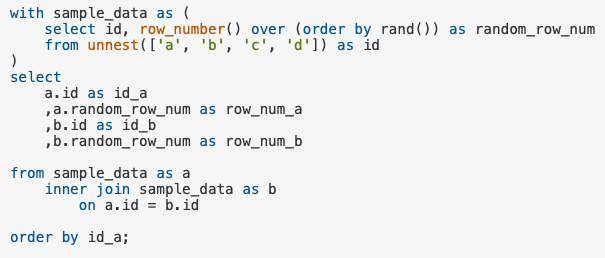
I recently encountered an interesting SQL issue.
Suppose you have a CTE that assigns random row numbers. You then join that CTE to itself, referencing the row numbers two times. They should match, right? Since they're coming from the same CTE.
Wrong!
At least in BigQuery and DuckDB, CTEs can be evaluated each time they're referenced. Here, the CTE is re-created twice, generating different random row numbers each time.
To avoid this, use a temporary table instead.
Read more: https://t.co/dS4ownXbN0