Freely chasing mammals, collab with David Fitzpatrick, we show how eye movements enable ferrets to simultaneously navigate and chase fleeing objects
Eye saccades align optic flow with retinal specializations during object pursuit in freely moving ferrets: https://t.co/O3dLvf2OGH
(1/3) Paper out in @CurrentBiology! How do predators use their vision to both navigate through the terrain whilst tracking prey running for its life?
Read our press release: https://t.co/fc5Q692qzQ
@MPFNeuro@bbo_lab
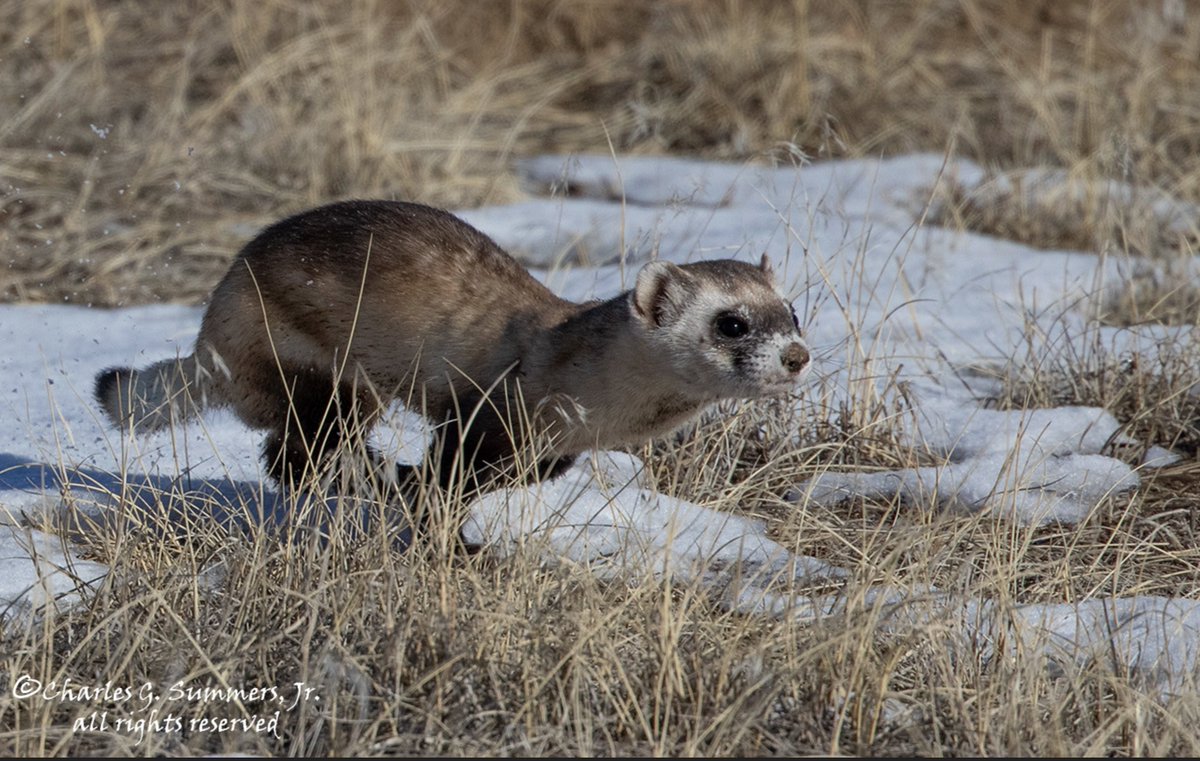
Picture by Charles G. Summers, Jr.
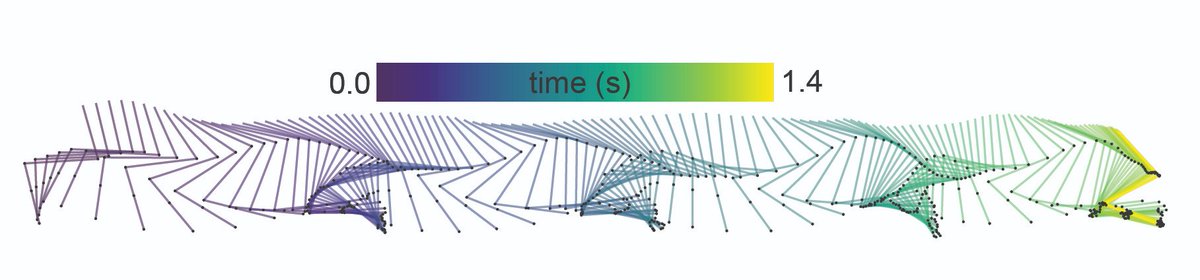
In reconstructed eye-views saccades directed the retinal specialization (area centralis) to point in the animals intended direction of movement, which was also the area of least motion blur. Saccades were independent of the target, as they also occurred during target absence.
Freely chasing mammals, collab with David Fitzpatrick, we show how eye movements enable ferrets to simultaneously navigate and chase fleeing objects
Eye saccades align optic flow with retinal specializations during object pursuit in freely moving ferrets: https://t.co/O3dLvf2OGH
We are very excited to announce that the 2nd Senses in Motion conference will go ahead in March 2024 in Berlin, thanks to the support of @maxplanckpress & @MPINB_outreach. Send us your abstracts by 16 January to participate:
https://t.co/8YhbrMkZeO
@petrznam@bbo_lab
📢 Excited to announce that the 2nd Senses in Motion meeting will take place in Berlin 11-13 March 2024! To take part, submit an abstract at https://t.co/QVrW3MvMZe by Jan 16! Thanks to the support of @maxplanckpress & @MPINB_outreach and co-organisers @SepiKeshavarzi, @bbo_lab.
Most students would love for me to write their paper for them. They know I can do it faster. They also know that I’ll rewrite a lot of what they’ve written. So why should they do it? Because, it will help them become good scientists. 12/18
Presenting our new 2 gram three-photon head-mounted microscope with a z-drive to image all cortical layers in the freely moving mouse. This microscope can be used in a fully lit environment, in the dark or in between, depending on your thing.
https://t.co/qRyUUdSSWl
It is our pleasure to announce an interview with one of our research group leaders: Dr. James Lightfoot. James answered our questions and provided interesting insights into the background of his research field https://t.co/bF75WYIPNC
@LightfootLab
#worms#neuroscience#behavior
We are excited to present our new 3-photon, 2g head-mounted microscope for imaging all cortical layers in the freely moving mouse on Saturday @sfn2022. https://t.co/CpGCCNK8FO Thanks to @TvanKerkoerle & @Prakash3Photon for organizing!
Paper out!!! #Drosophila has muscles that attach to their retinas, which it uses to move its photoreceptor sheet in ways that resemble vertebrate eye movements @Nature https://t.co/kQYT71OBy3
We have a step by step To-Do list for setting up and calibrating the cameras as well as a part-list for ordering the bits and pieces. Just email us and we will help you as much as we can to get this going in your lab.
Presenting a method for tracking skeletal joint kinetics in freely moving rats and mice that is constrained using anatomical principles such as joint-rotation limits and bone lengths as well as a simple temporal smoother. https://t.co/mx8rRI0fvW
@naturemethods We have a step by step To-Do list for setting up and calibrating the cameras as well as a part-list for ordering the bits and pieces. Just email us and we will help you as much as we can to get this going in your lab.
1/n 🚨📢The most fun #Microscopy 🔬 project I've ever worked on is now online 📢🚨: Big thanks to @FritjofHelmchen for allowing me to turn 🔭 telescopes and 🐚 scallops into #multiimmersion microscope objectives! https://t.co/blhDoh43as
Skeletal kinematics in rodents can be inferred with the help of a pose estimation algorithm that is constrained by an anatomical model.
@bbo_lab
https://t.co/Bom36qaMaR
As the brain and spinal cord drive muscles and muscles move bones, we are using this method to read out the summation of complex neural processes as animals estimate gap distances and jump (or not).
Motion kinematics of bones and joints can be accurately inferred as the animal freely behaves and performs complex behaviors. This approach gets around the problem of tracking joint kinetics when the bones are covered by fur and surface tissue.