@DGr8Awakening@sdhaddow@DaroniusS85133 The evidence of that region fits known Holocene hunter-fisher-forager/pastoral-Neolithic occupation much better than some lost so-called advanced civilization
https://t.co/tvTdokKTTv
@CBD0x@zachariaspro@grok Nothing. The dashed line below represents the threshold value of 2.5 × 10²² A·m² that appears to trigger excursions and reversals. 7 × 10²² A·m² is not a collapse; it is still close to the long-term recent-field scale.
https://t.co/11cppi6dL7
@FreyaloggingInc@ben_j_todd@_HannahRitchie Large mammals are often more vulnerable because they reproduce more slowly, need larger ranges, and have fewer microrefugia. The late Quaternary extinction pattern was also strongly size-selective toward megafauna. Your argument is not a sound objection.
@NW_patriot86@PortantIssues btw
>"Experts also told us the theory of plate tectonics was ludicrous"
This is incorrect and shows a lack of understanding of how scientific consensus evolves. Wegener’s continental drift was criticized because it lacked a mechanism not because experts reject new ideas
@NW_patriot86@PortantIssues This isn’t about “blind faith in experts”, it’s about how you filter information.
When you bypass people who publish data, methods, and uncertainties in favor of someone selling a narrative, that’s not skepticism, or genuine curiosity, that's willful ignorance.
@NW_patriot86@PortantIssues Genuine curiosity requires autonomy of reason: test claims against the best available evidence, not the most flattering narrative. Defaulting to Hancock over actual experts is a failure of critical judgment; inclination masquerading as inquiry
@NW_patriot86@PortantIssues When a belief system reaches the point where:
1) No conceivable evidence can disprove it
2) All counter-evidence is reinterpreted as support
Then, operationally it is no longer inquiry, it is doctrine. At that point, whether you call it a “cult” or not becomes mostly semantic.
@HannahBrites@farmer_tr@randallwcarlson Reviewers can be limited and errors will slip through to be potentially caught later. Retractions reflect ongoing scrutiny, not reviewer failure. That’s not incompetence, that’s the scientific process working as intended.
@RobertW12470704@ExnerPirot@K4C@liberal_party Enbridge Mainline System
Capacity: ~3.0 million b/d
Government: Liberal
Keystone Pipeline System
Capacity: ~830,000 b/d
Government: Conservative
Trans Mountain Pipeline (including TMX expansion)
Capacity: ~890,000 b/d
Government: Liberal
@Seaalex_@AzPetrich This isn’t the win you think it is. Whether it’s an F-15 or a Tomahawk from a multi-billion-dollar platform, the point is what happens when those weapons hit places like a school full of kids. Your pedantry misses the point.
@ThomasBeyer@freedomOrfamily@iamkennethchan@grok Complaining about a “two class race based society” while forgetting Douglas, Trutch, and 150 years of the Indian Act is peak historical amnesia
Many things can be true at once
1. The Ayatollah was evil and bad
2. Regime change can work, but historically regime change in Iran has not
3. Trump is probably the least competent person to handle regime change (see Venezuela)
4. This was unconstitutional
Some people asked me to elaborate on this, and I'm more than happy to do so.
So in Greenland there are two major rare earth deposits that often hit the headlines: Kvanefjeld and Tanbreez
I'll cover Tanbreez in this post (will write something on Kvanefjeld later) as it has recently been acquired by Critical Metals Corp ($CRML) which is now touting it as the 'largest rare earth deposit in the world'.
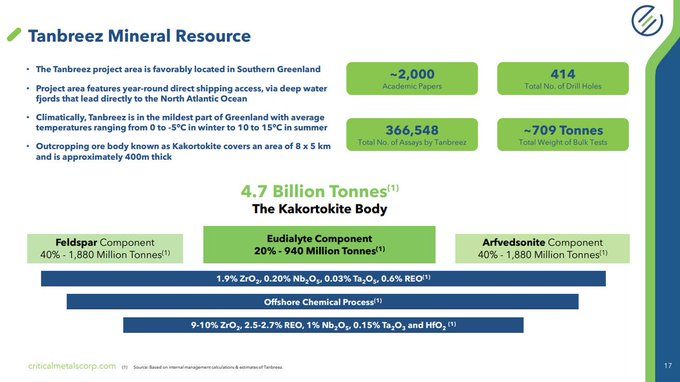
For context, see below the overview of the Tanbreez asset, a 4.7 billion mt deposit containing some 28 million tonnes of rare earths.
If we were to believe Critical Metals Corp (you shouldn't), it is 'the largest rare earth deposit in the world'
It sound fantastic does it? Yeah it does, except that you cannot get the rare earths out, which is pretty damn important when you want to use them as a "reliable supply crucial for national security" - quoted from Critical Metals
See, the rare earths are contained in a mineral called 'eudialyte'. While many don't give this too much attention, the mineral that contains the rare earths (or other metal of interest) is often exactly what makes or breaks a mining project.
See below the chemical composition of eudialyte
Na15(Ca,Ce)6(Fe,Mn)3Zr3Si(Si25O73)(O,OH,H2O)3(OH,Cl)2
The first problem is that the eudialyte mineral here only contains 3% rare earths (on a weight basis). This directly eliminates the possibility of making a eudialyte concentrate at the mine site and shipping that to a potential customer. Why? because the economics to ship a concentrate with only 3% valuable content halfway around the world simply don't add up. (yes, there are some other potential by-products in the eudialyte like Zr, Nb but the equation still holds).
That alone would make this project a no-go, but here is the real problem; eudialyte is an absolute nightmare to process (i.e. to get the rare earths out in usable form, at acceptable cost).
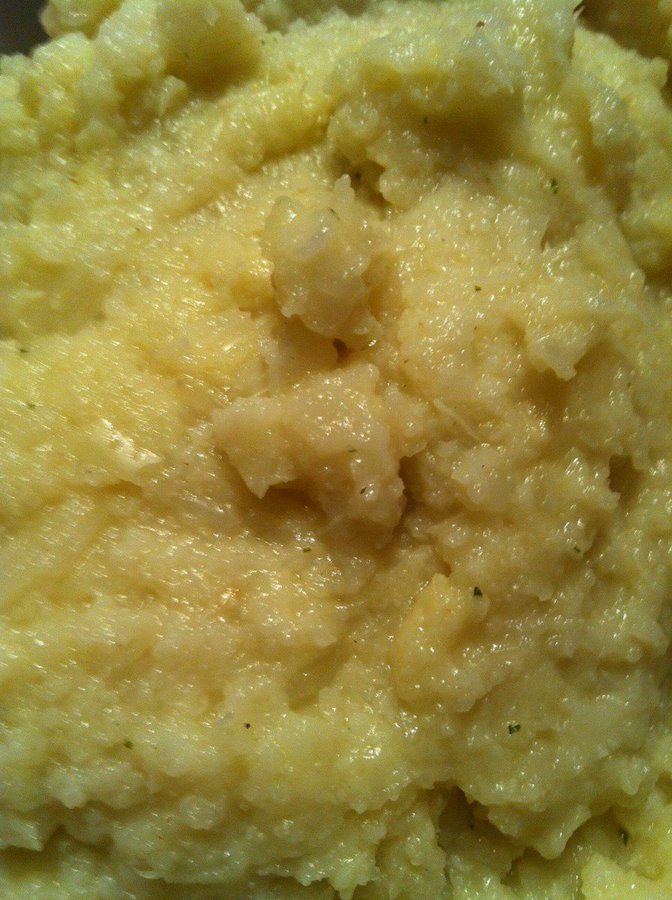
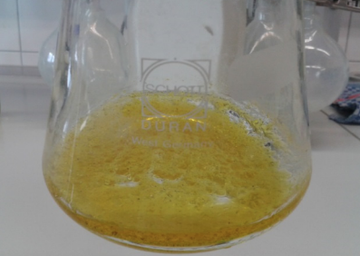
When you process eudialyte, you get stuck with a thick mush of what's called 'silica gel'. It's an absolute nightmare from a chemical processing perspective because it clogs filters, fouls equipment, and traps valuable metals in a sticky matrix that’s incredibly difficult to separate.
This gel forms when the silicate portion of the eudialyte dissolves in acid and then re-polymerizes, creating a viscous slurry that resists normal solid-liquid separation methods. Once the gel sets in, even high-pressure filtration, centrifugation, or thickening become problematic. It leads to extended downtime, increased reagent consumption, and major losses of both product and process efficiency.
China has tried processing eudialyte, and they haven't succeeded (and that should tell you something).
Critical Metals Corp of course knows this, but prefer keeping it silent (or hidden in the little footnotes that many investors will never read).
They hope to lure investors in by marketing this as the ' world largest rare earth deposit (of rare earths that you can't get out)' and by jumping on the 'Greenland resources hype' bandwagon.
Please don't listen to that - Tanbreez has been known since the 1800s (!) and the mere fact it hasn't been developed after 200 years should tell you something; it's shit - always has been, always will be.
So let's make one thing absolutely clear; don't buy Greenland for the rare earths, because you will be very disappointed in the end...