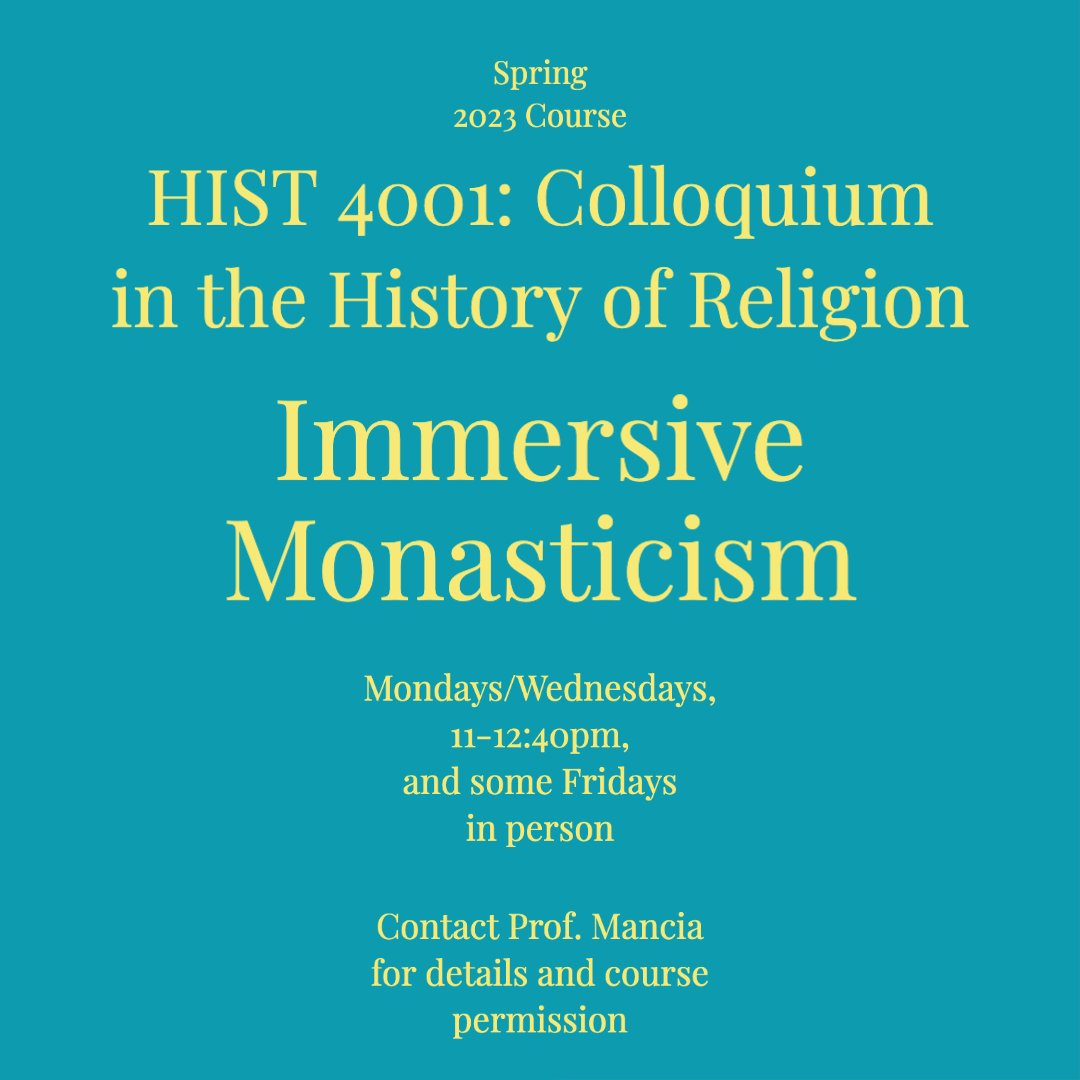
Make sense of the diversity of human experience, thought, and action, past and present. Stoke the fires of your curiosity. Study Religion at Brooklyn College.
"When done right, the work of the humanities is the work of anti-racism...of undercutting assumptions and stereotypes about the people around us and bringing nuance to our perspectives, so that...we begin seeing the richness of our human experiences." @BCThinkers
August 31 at 12:30pm, history lounge, first floor Boylan:
The undergraduate Historical Society will host Patricia H. Scroggs, Director of Diplomatic Fellowships, Howard University.
More info below:
@SSChatNetwork I feel like this is so essential: https://t.co/MhSdDRpmZc
I also love using this to look at visual culture that is happening simultaneously in the global medieval world:
https://t.co/RgOixcucua
@ElizKeoBurb @SSChatNetwork@MedievalAcademy The Brooklyn College working group on the premodern world has monthly seminars open to visitors! Will be on zoom & in person in BK. https://t.co/FeD1WRx00K (and feel free to email [email protected] for more info)!
@ElizKeoBurb @SSChatNetwork@MedievalAcademy No, unfortunately! First off, I think that we don't call it "medieval Africa" or "medieval China" at my college when we're training teachers--so we don't make these connections between europe/africa/asia explicit, which we should!
@SSChatNetwork I wonder what it would be like to not teach "China" and then "Greece" and then "Rome" and then "Mayan civ." and then (separately) Belief systems? But instead a more integrated series of units?
@SSChatNetwork One of the hard things about the NYS curriculum is that it is often taught as separate units--Europe, China, Africa, India, etc. are not taught together, as an interconnected world. When I taught high school, I wished I could teach Mali & Al Andaluz & France all at once!
@SSChatNetwork That "they" thought the world was flat... That there was "always" tension between east/west, Christians/non-Christians, Islamic world/Europe... That each continent (Europe, Asia, Africa) was isolated from the others...
@SSChatNetwork For my students who are serious practitioners of a religion, studying the history of Christianity, Judaism, and Islam in the Middle Ages is especially interesting, as is comparing Buddhist monasticism and Christian monasticism!
@SSChatNetwork I think that, for students who are immigrants, they appreciate learning about the premodern history of their culture in the U.S., because 1) it makes them feel seen, but also 2) bc it's often a story told differently here than their home country, which makes for great discussion!