Seven lessons I learned in six years at Uber:
🕸️ Decentralized talent is a superpower
🏦 Everyone needs to be an owner
🎯 Design for what matters
🚀 Moonshots take time
🍦 Build marketing into the product
🚨 Disrupt yourself–or someone else will
📈 Use data when making bets
/🧵
You have no experience.
You’ve never started a company.
You’ve never had a full time job.
Nike is going to kill you.
You’re a kid.
You don’t have technical skills.
You shouldn’t build hardware.
Apple is going to kill you.
You can’t build hardware.
You can’t measure heart rate non-invasively.
Athletes don’t care about recovery.
Under Armour is going to kill you.
It won’t be accurate.
You don’t listen.
You’re an ineffective leader.
You can’t recruit great talent.
You’re going to have to pay every athlete.
You can’t measure sleep non-invasively.
It’s too expensive to research.
Athletes are a small market.
The product costs too much to make.
The product costs too much to sell.
Your valuation is too high.
Consumers aren’t going to want it.
Hardware is too hard.
You should measure steps.
Fitbit is going to kill you.
You can’t build a marketing engine.
You can’t raise enough money.
You need a real CEO.
Google is going to kill you.
You can’t be a subscription.
You can’t build a brand.
You can’t do consumer in Boston.
Your valuation is too high.
You shouldn’t make accessories.
You shouldn’t make apparel.
Lululemon is going to kill you.
You can’t predict Covid.
Stay in your niche.
You are going to run out of money.
You can’t build a health platform.
Amazon is going to kill you.
You can’t measure blood pressure.
You can’t get medical approvals.
The market is too small.
You don’t understand AI.
The market is too competitive.
It won’t work internationally.
The supply chain is too complicated.
You can’t build an AI.
You can’t raise enough money.
It’s too competitive.
Healthcare isn’t going to want it.
…
Just keep going ✌️
Compound. Compound. Compound.
A founder in his late 70s gave me that advice ~20 years ago. This week, he sold his company, Restaurant Depot, for $29B.
You may not know the company, or its founder, 94-year-old Nathan “Natie” Kirsh. He isn’t exactly an avid social media user. An episode of Acquired or a chat with @HarryStebbings is overdue at this point.
I remember pitching Natie on becoming an LP in Founder Collective when we first started. He passed saying he didn't do funds. But his advice, “Compound. Compound. Compound,” has stuck with me.
Here’s what his advice about compounding looked like in practice:
He got his start in his family’s milling business in Potchefstroom, South Africa. Then he crossed into Eswatini and built one from scratch. The lessons were compounded into the capital to buy a distribution company.
The distribution company allowed Natie to pioneer a cash-and-carry model, think Costco without the polish, supplying small restaurants and shops at scale. The success compounded, and it became one of the largest food distribution businesses in southern Africa.
In the 1970s, he took the same playbook to New York and started Jetro, selling bulk groceries to bodega owners. In the 1990s, he acquired Restaurant Depot and began rolling out stores. Lessons and leverage compounded, and eventually, there were 166 of them across the country.
At one point, Warren Buffett tried to buy a stake. They couldn’t agree on terms, though it was a serious nod of respect from one legend of compounding to another.
The fascinating thing about Natie’s story is that technology is almost non-existent in the telling.
There’s real sophistication behind this business, decades of world-class execution, and a long list of smart decisions. Still, every business Natie built would be recognizable to a merchant 3,000 years ago. Buy low. Move goods. Repeat.
His edge was perspective not invention. He bought Restaurant Depot at 63 after four decades of grinding, literally and figuratively. Thirty years later, just after his 94th birthday, he sold it for $29B.
Compounding isn’t easy. The discipline to keep going, especially after decades of success, is rare. Failure forces change, but success typically breeds boredom. Most people want to move on.
Natie kept grinding, from his start as a 20-year-old miller to a nonagenarian billionaire. I've carried his three words for nearly twenty years. With luck, I'll spend the next forty proving I was listening. I hope you do as well.
Compound. Compound. Compound.
My co-founding partner emeritus @epaley met @WHOOP co-founder/CEO @willahmed at Harvard’s i-Lab.
In the 14 years since, the company has become the go-to accessory for elite athletes.
Today, the company is worth $10B+.
@fcollective, we simply couldn’t be prouder investors.
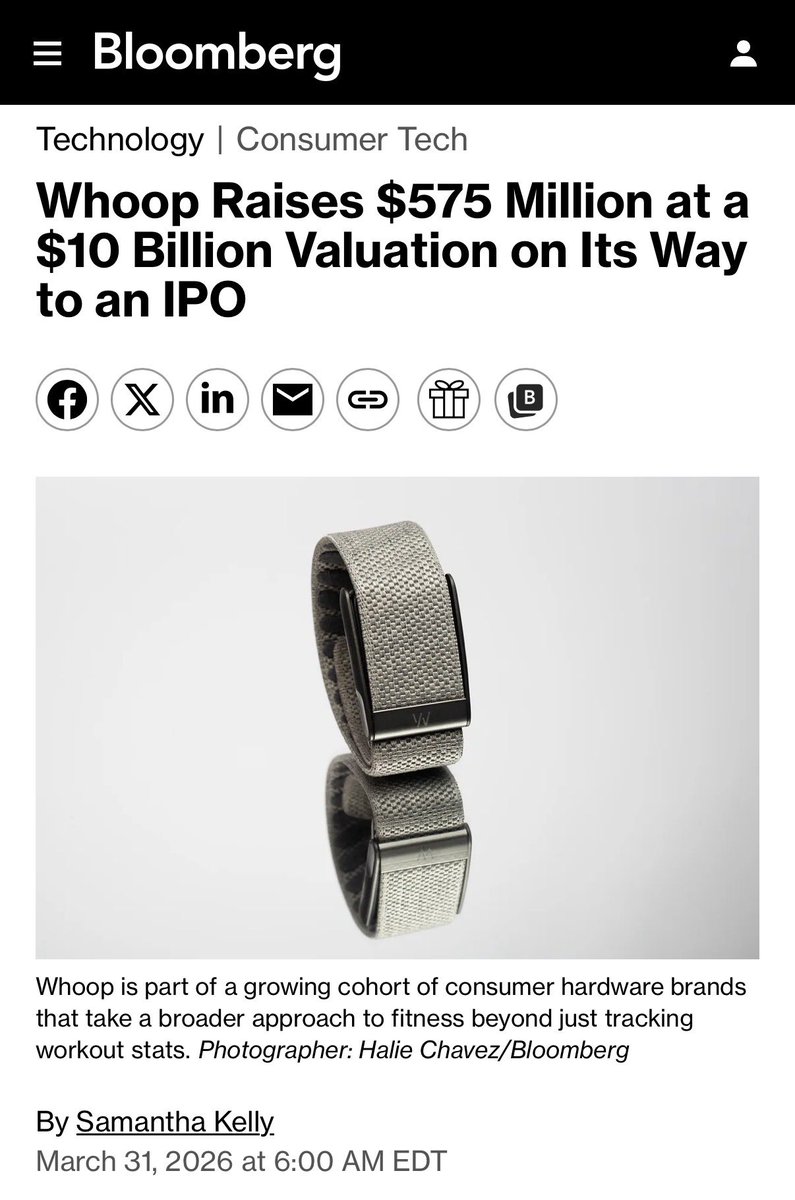
Whoop, a Wearable Health Device Maker, Raises $575 Million
https://t.co/t1ZP1rE5Cj
Congrats to @willahmed, @ed_baker_whoop, @Durkin and the entire team at @whoop on their latest round.
They are on their way to building the best/ most accessible consumer health company in the world.
BREAKING: WHOOP RAISES $575M AT $10.1B VALUATION
I am pleased to announce that we’ve raised $575M at a $10.1B valuation to accelerate our mission of unlocking human performance and healthspan globally.
This round was led by Collaborative Fund with participation from 2PointZero Group, Qatar Investment Authority (QIA), Mubadala Investment Company, Abbott, Mayo Clinic, Macquarie Capital, Glade Brook, B-Flexion, IVP, Foundry, Accomplice, Affinity Partners, Promus Ventures, and Bullhound Capital alongside a group of individual investors including Cristiano Ronaldo, LeBron James, Rory McIlroy, Virgil van Dijk, and Mathieu van der Poel.
This investor group and this moment reflect a powerful evolution underway for Whoop and the broader healthcare market.
Whoop was born in performance - trusted by the best athletes in the world to train, recover, and compete at the highest level. That foundation remains core to who we are. You see that in the iconic athlete investors joining this round.
But it also represents our push into broader health.
In the past 12 months, WHOOP has received medical clearances, launched blood testing, and created a platform that has saved lives. Abbott and Mayo Clinic - two of the most respected and influential institutions in global healthcare - are now investors in Whoop. These are organizations that have shaped modern medicine. Their decision to partner with us is a clear validation of where our technology is headed.
Healthcare systems around the world are reactive. For too long, they have waited for people to get sick, then intervene. Chronic disease is rising and costs continue to climb.
At Whoop, we believe the future looks fundamentally different. We are building the most powerful, personal, preventive health platform in the world - powered by continuous biometric data, advanced analytics, and AI to help people understand their bodies and improve their health in real time.
I am grateful to our team, our members, and our partners for believing in this vision. I’ve been building this company for 14 years and I’ve never been more excited for the future.
It seems crazy that I have to say this, but I still believe deeply in human talent.
The reason that no one likes AI is that a bunch of CEOs are running around touting how it’s going to “replace jobs” and “improve efficiency.” That may make for a good earnings call but it’s a terribly uninspiring message for the workforce.
Tech collectively needs to wake up from its echo chamber.
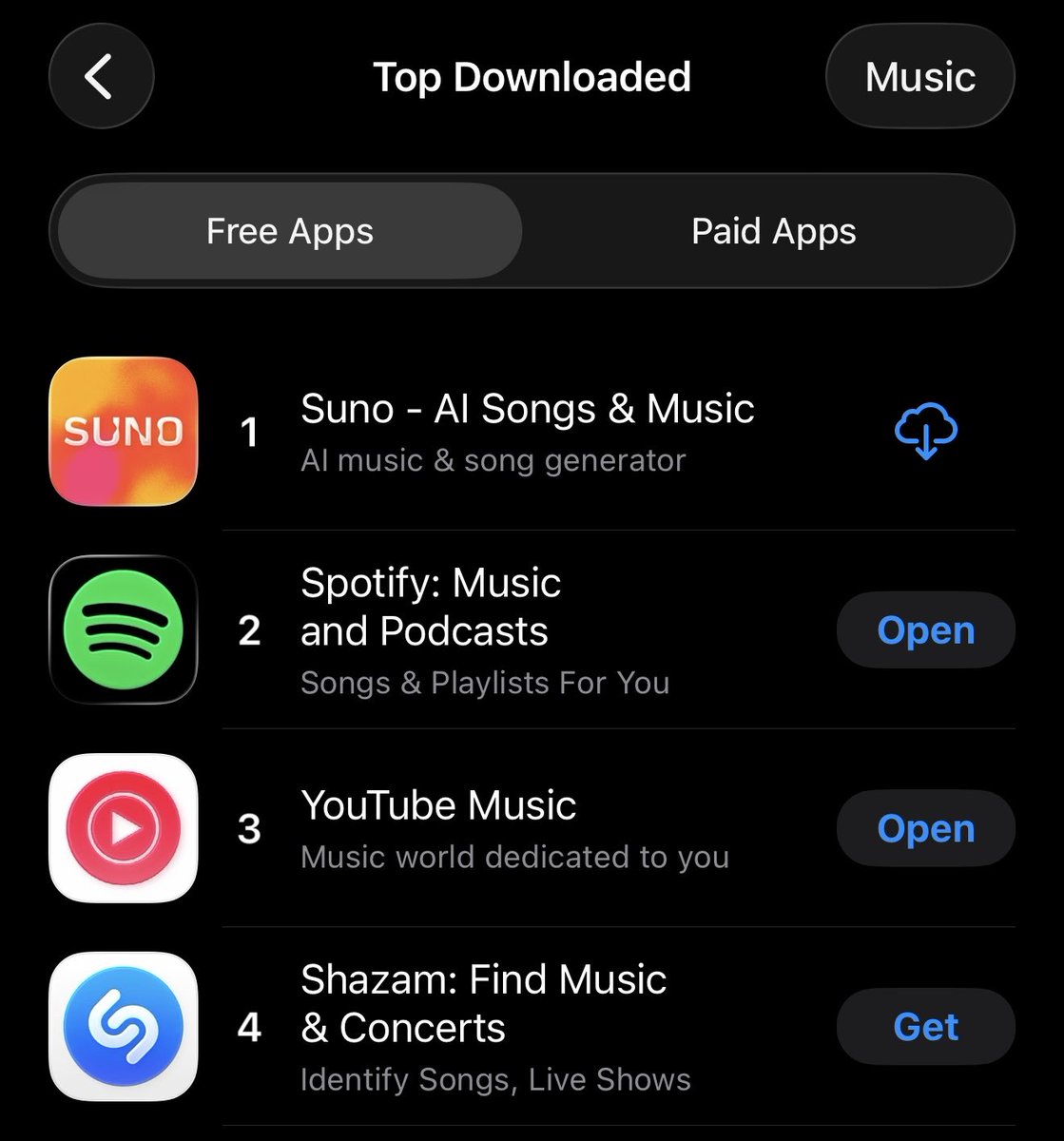
Last week, @MikeyShulman announced that @suno has surpassed two million paying customers and $300M in annual revenue.
I would love to say I had a grand theory about where AI was heading when I was the sole investor in their pre-seed round in 2022. The truth is I’m largely tone deaf to tech trends, but I do have a reasonably good eye for founders.
So far, much of the AI story has been about making engineers more efficient. Suno is about making music more experimental and accessible. That shift has a lot to do with Mikey.
He studied physics at Columbia, earned his PhD at Harvard, and later taught at MIT. That kind of academic pedigree can produce a prima donna. Mikey is the opposite, combining serious intellectual firepower with the creative instincts of a jazz band leader. (Fun fact: he’s also an accomplished bassist.)
As impressive as he is, I was encouraged by the chorus cheering him on. Hugo Van Vuuren and Nancy Zimmerman were emphatic in their praise. His co-founders and former @Kensho colleagues, Martin Camacho, Georg Kucsko, and Keenan Freyberg, were similarly lauded by every reference I checked. When people you respect harmonize like that, it’s wise to listen.
In the early days, the team was experimenting with different ways to commercialize the engine that would become @suno. They were commercially ambitious, but also deeply committed to empowering creators, and early enthusiasm from creative customers gave confidence that they were on the right track.
Major talent and Minor ego is a rare combination, but in this case has produced one of the most consequential developments in music since MTV.
Klaviyo cofounders Ed Hallen and Andrew Bialecki are donating $6 mil to MIT aimed at keeping more entrepreneurs in the Boston area instead of decamping to California.
This is one of several great initiatives designed to make Boston a fertile ground to start & scale.
We don't manually test features anymore.
You can now run continuous QA features in Claude using “Feature Review” by Ranger.
Feature Review is an always-on AI QA that runs in the background, fixing features while providing you and your team with full visibility.
Never ask Claude to fix errors again.
@mattyglesias Surprised me as well cause I love the DMV. it’s the hub of New England which is really nice. Mountains for skiing and hiking (VT/ NH) + beaches (Cape, islands, Maine). Quaint, small towns in the suburbs with top public schools and diverse career opps (bio, tech, finance, uni)
@JasonrShuman Completely agree! We talked about this all the time at FC. If you're a seed investor, by the time something is in a market map you're too late to that category.
Build and invest in companies that shape next year's theses.
@aeyal1@saullevin@EntreeCap best news ever, @saullevin is one of a kind. Equal parts wonderful person and investor. Couldn't have happened to a better person and firm!