Most Americans have seen John Trumbull’s famous painting of the Declaration of Independence (which hangs in the rotunda of the Capitol Building)…
But there’s a popular myth that Thomas Jefferson is deliberately stepping on John Adams’ foot as a sign of their rivalry.
Let’s set the record straight. 👇
🧵 1/5
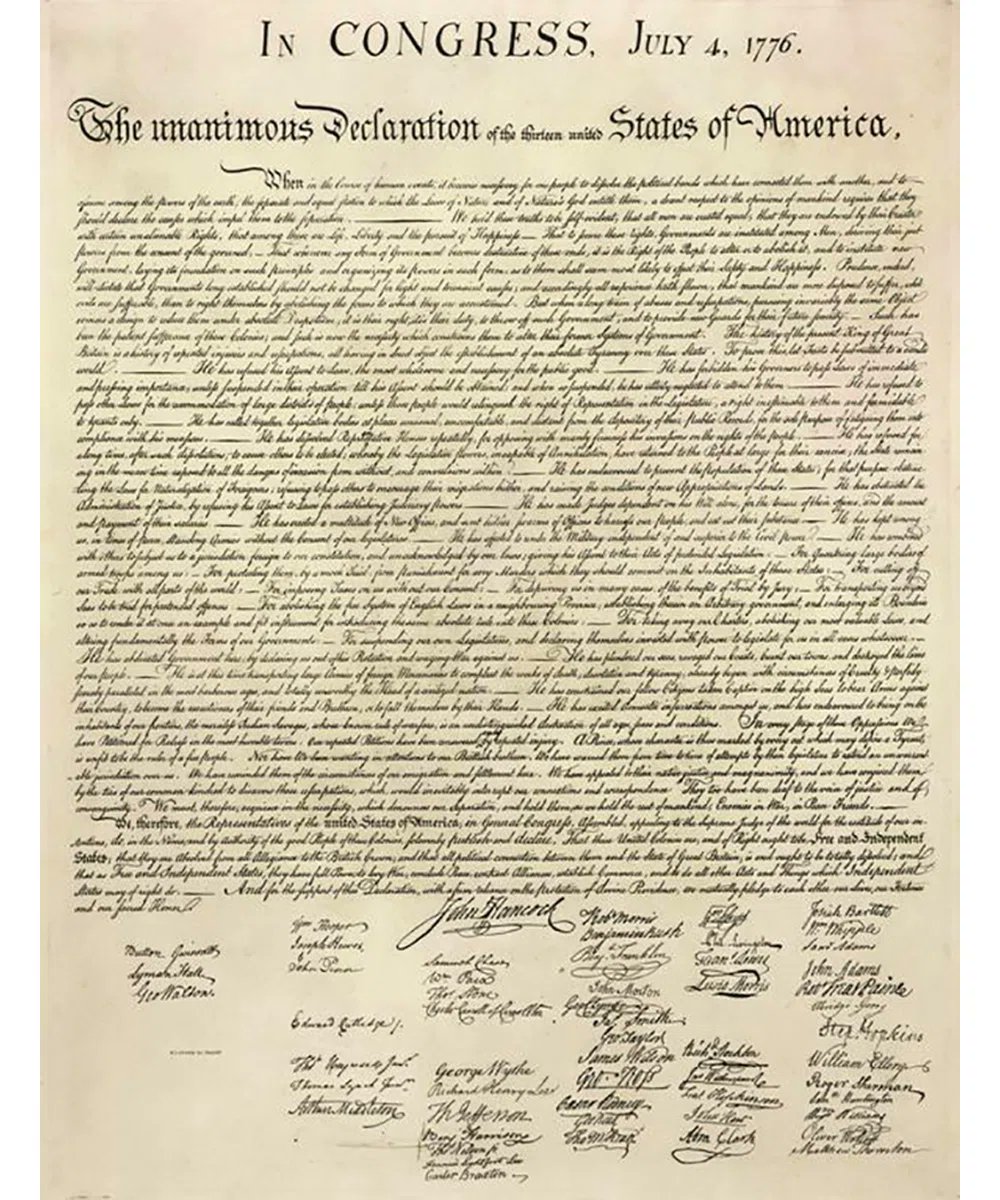
Most Americans think the Declaration was signed on July 4 by all the Founders in one dramatic moment.
The real story is even better.
Thread on some fun (and surprising) facts about the signing of the Declaration of Independence →
1/9 🧵
In September of 1814, America was once again in trouble.
The young republic was only thirty-eight years old. The War of 1812 had gone badly. British troops had marched into Washington, burned the Capitol, set the White House ablaze, and now turned their sights toward Baltimore. If Fort McHenry fell, the harbor would be open, the city would likely follow, and another devastating blow would be dealt to the fragile nation.
Amid this uncertainty, a young American lawyer named Francis Scott Key sailed under a flag of truce to the British fleet. He had come to negotiate the release of a friend, a physician the British had captured.
He succeeded.
The British agreed to free the doctor.
But there was a catch.
Because Key and his companions had seen too much of the British fleet and learned too much about its plans, they were not allowed to return to shore. Instead, they were detained aboard a ship in the harbor and forced to watch the coming battle from behind enemy lines.
On the morning of September 13, the bombardment began.
For the next twenty-five hours, British warships unleashed somewhere between 1,500 and 1,800 bombs and rockets upon Fort McHenry. These were the “bombs bursting in air” and the “rockets’ red glare” of the song—not poetic embellishments, but terrible realities.
Key stood on the deck through the endless day and the long, terrifying night. Every explosion lit the darkness for a fleeting instant before the smoke swallowed everything again. Somewhere beyond that wall of fire stood the fort. Somewhere beyond it flew an American flag if it still flew at all.
He could not see.
He could only listen.
As long as the guns continued firing, there was reason to hope. The British would not waste ammunition on a fort that had already surrendered.
Then, just before dawn…
The guns fell silent.
For the first time all night, there was only stillness.
It was the most frightening sound of all.
Had the fort finally fallen? Had the defenders surrendered? Had the flag been torn down in the darkness while no one could see?
There was nothing to do but wait.
As the first light of September 14 slowly pushed back the smoke, Francis Scott Key strained his eyes toward the distant fort.
Then he saw it. Not a British flag.
The American flag. Still there. Still flying.
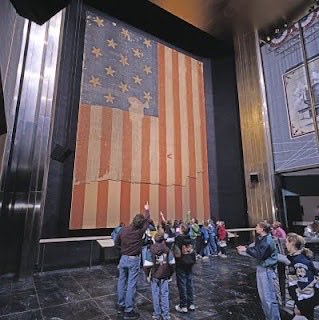
That flag was no ordinary banner. Months earlier, the fort’s commander had commissioned a Baltimore flagmaker, Mary Pickersgill, to sew a flag so enormous “that the British would have no difficulty seeing it from a distance.” It measured roughly thirty by forty-two feet, carried fifteen stars and fifteen stripes, and was so large it had to be assembled on the floor of a brewery because no ordinary room could contain it.
That was the Star-Spangled Banner.
The very flag Key saw through the morning mist.
The very flag that still survives today in the Smithsonian.
Overcome by what he had witnessed, Key reached into his pocket, pulled out an envelope, and began writing. The words came from a heart that had spent an entire night fearing his country might disappear with the dawn.
He first titled the poem Defence of Fort M’Henry.
Within days it was printed and circulating throughout the country. Before long, people began singing it to a melody they already knew—an old British tune called “To Anacreon in Heaven,” originally written for a London social club. There is something beautifully ironic in that: America’s most beloved patriotic song borrowed the melody of the very nation it had just survived. It also explains why the anthem is so notoriously difficult to sing. It was never written for ordinary voices gathered in stadiums or school assemblies.
The song spread quickly and became one of America’s favorite patriotic hymns, but it would wait more than a century before receiving official recognition. Not until 1931 did Congress declare “The Star-Spangled Banner” the national anthem of the United States.
Amen! I’ve been serving as an MHA for over 6 years under 4 different ML’s and 2 different missions. I couldn’t agree more with what you said. One of the ML’s wives once said to the missionaries, “Please be the missionary you’re telling your parents that you are!” She spoke truth!!!
He is risen! And because Christ rose again, we will too. Thanks to Him, no pain, fear, failure, or unfairness is permanent. This is greater love. This is Easter.
“Lamb of God” — a sacred oratorio by Rob Gardner about Jesus Christ’s death, Atonement and Resurrection — made its New York City debut at the Metropolitan Opera House at Lincoln Center on Monday, March 30, 2026.
The concert, conducted by Gardner, was held in collaboration with The Church of Jesus Christ of Latter-day Saints, which is focusing this Easter season on the “greater love” of Christ, a phrase from John 15:13 in the New Testament: “Greater love hath no man than this, that a man lay down his life for his friends.”
Read more by visiting the link below:
https://t.co/EIWV3NQd7N
Nearly 2000 years ago, Palm Sunday marked the beginning of the last week of the mortal ministry of Jesus Christ. Scriptures tell us that the week began with throngs standing at the gates of the city to see “Jesus the prophet of Nazareth of Galilee” (Matthew 21:11).
Though we do not stand at the gates of Jerusalem today with palms in our hands, the time will come when “all nations, and kindreds, and people, and tongues, [will stand] before the throne, and before the Lamb, clothed with white robes, and palms in their hands” (Revelation 7:9). #GreaterLove
In times of peace or turmoil, there is always hope in Jesus Christ because of his greater love for all. As we approach Easter, hear a special message about God’s love and what it means for each of us from President Dallin H. Oaks (@OaksDallinH) and his counselors (@EyringHB and @ChristoffDTodd) in the First Presidency of The Church of Jesus Christ of Latter-day Saints.
🚨🚨Senior Trump Administration officials telling me that credible intelligence indicated Iran planned preemptive missile strikes against US military targets in the region, and against civilian targets as well. Failure to act would’ve resulted in mass US casualties.
An inspiring story about the hockey goalie on the men’s team….he had failure after failure but persevered with grit to become the MVP of the Olympics 🇺🇸 Pretty awesome story!
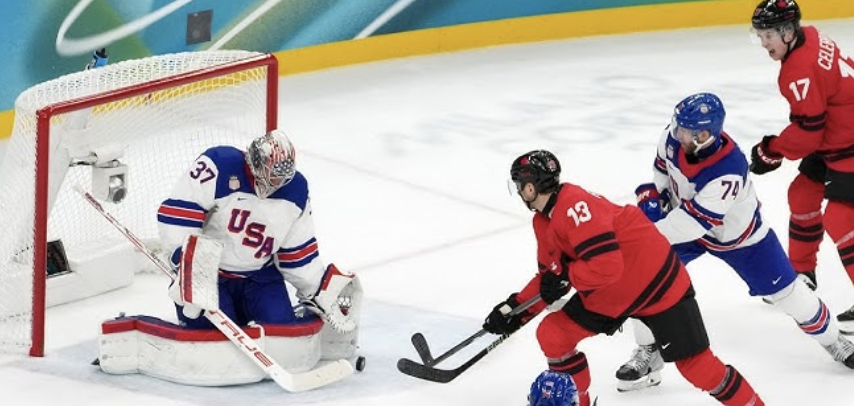
Connor Hellebuyck made 41 saves in the gold medal game for team USA. Canada outshot the US by 15.
Without Hellebuyck, the US gets blown out.
But a decade ago, not a single major junior league in North America thought he was worth drafting.
The story of how he got from there to here tells you everything about what resilience actually looks like.
Hellebuyck came out of Walled Lake Northern High School in Commerce, Michigan.
They weren't a hockey factory, and he was basically a nobody as a prospect.
He went undrafted by both the the two main junior leagues that feed college and pro hockey.
No one wanted him.
So as an 18 year old, he drove 12 hours by himself from Michigan to Minnesota for an open tryout.
He got one shot...for the Odessa Jackalopes. So he moved to Texas...
His former GM and goalie coach Joe Clark remembers: "We had like eight goalies at tryouts, no one knew anything about him. Connor stood out. He made the team and he was a no-brainer for us as a staff. But he really had no resume whatsoever before that."
Hellebuyck led the league in games, minutes, and total saves. Won Rookie of the Year and Goaltender of the Year.
All in a city where football is religion and few know hockey even exists
Even with his performance, his next opportunities were few and far between...
UMass Lowell was the only school to offer him a spot. His first college start went so poorly that he got pulled and benched for over a month.
Most players spiral in that moment: "I'm not good enough, the stage is too big, I don't belong here."
Hellebuyck called Joe Clark and said, "The game is not as fast as I just made it out to be."
Clark couldn't believe it. He'd just gotten pulled and his takeaway was that he'd been over-prepared. That he expected the game to be faster.
It gave a clue into how he saw failure, and why he's so resilient.
When something bad happens, we have a choice: how are we going to integrate this into our story.
Story one: I got pulled because I'm not ready or good enough.
Story two: I got pulled because I was putting too much pressure on myself and expecting the game to be better than it was.
Hellebuyck chose the latter.
"I was more ready, more prepared than I had given myself credit for."
By the end of the season, he'd backstopped UMass Lowell to its first Frozen Four in program history.
The numbers after that benching are absurd. In two college seasons, he had a 38-12-2 record, .946 save percentage, and 12 shutouts.
He won the inaugural Mike Richter Award as the best goalie in college hockey.
All from a kid who couldn't get drafted by a junior league three years earlier.
"All the hardships that I had to go through early in my career were lessons learned. That's all I use them for. I didn't let them knock me down. I just kind of created a version of myself where I was just going to continue to adapt."
Even after college dominance, it wasn't smooth.
He was drafted in the 5th round, 130th overall by the Winnipeg Jets. He worked his way up from the AHL to becoming the starter in 2017.
He's now won three Vezina Trophies. The Hart Trophy as league MVP. And according to most measure, he's the best regular-season goalie of his generation.
But the one knock that wouldn't go away? He couldn't win in the playoffs. Whent he lights shined brightest, the media and fans said he struggled. Last spring, he got pulled three times in the first round of the playoffs against St. Louis.
Just like before, others were trying to write his story: great in the regular season, can't show up when it matters.
And once again, he showed that resilience is about ignoring what others write, and penning your own narrative.
Canada threw 41 shots at him. He stopped all but one. Star Connor McDavid had a breakaway in the second period that he denied. Devon Toews had a wide-open rebound with Hellebuyck out of position. He got his stick on it.
He played out of his mind. Or as the hockey saying goes, he was standing on his head.
"Those critics, they can keep writing. But they don't understand goaltending. They don't understand my game. I know what I'm putting forward. I know what I'm building. These are the moments that prove it — not that I need to."
We often get resilience wrong. We think you either have it or don't. That it's about toughening it out. It's what I kept coming across while researching my book toughness, Do Hard Things.
But Hellebuyck's story gives us the nuance:
It's a skill built through repeated encounters with failure...but only if you process those failures correctly.
Every stop in his career told him he wasn't enough. Undrafted. Benched. Cut from camp. Pulled in the playoffs.
But at each stop, he chose the same interpretation: this is information, not my identity.
Most people let setbacks become self-definitions. Hellebuyck let them become data points.
And the guy who processes failure as calibration rather than catastrophe is the guy you want when 41 shots are coming at him in a gold medal game.
Hellebuyck described his own story today the way he always has: "I would probably say the underdog story. Constantly going and being an underdog and just making it work, persevering and getting through."
He drove 12 hours alone to a tryout in Minnesota when no one wanted him. His only shot was in the Friday Night Lights town of Texas. He got pulled from his first college start and decided the problem was that he'd overestimated the difficulty, not underestimated his own ability.
He got pulled three times in last year's playoffs and showed up to the Olympics as the best goalie in the tournament.
Write your own story. And tell it well.
@willcain There is no demographic more powerful than a woman who just discovered a niche sports rivalry. The NHL marketing department couldn’t dream of this ROI.
🇺🇸 THE ULTIMATE AMERICAN REVENGE STORY 🇺🇸
The script couldn't have written it better. In 1989, Arthur Liu fled China as a political refugee after the Tiananmen Square massacre. He came to America with nothing but a dream for a free life.
Decades later, his daughter Alysa Liu became the face of Team USA.
But the CCP didn’t forget. Before the 2022 Beijing Olympics, the FBI uncovered a "brazen" spying operation. The target? Alysa and her father. The Chinese government tried to:
Stalk them on U.S. soil.
Intimidate her into silence.
Pressure her to turn her back on the country that gave her family refuge.
The FBI had to give them 24/7 security just so she could compete. 🛡️
She faced the intimidation. She refused to be a pawn. She walked away from the sport for two years to find her soul again—and then she came back with a vengeance.
TODAY, THE STORY IS COMPLETE. In a flawless performance to Donna Summer’s “MacArthur Park,” Alysa Liu just did the impossible.
🥇 OLYMPIC GOLD. 🥇 The first American woman to win individual gold in 24 years.
She didn’t just skate for a medal. She skated for the freedom her father risked everything for. She didn’t just win for herself; she won for the flag that protected her family when the world felt small.
This is what a Patriot looks like. 🇺🇸✨
#AlysaLiu #TeamUSA #OlympicGold #MilanoCortina2026 #AmericanDream #FigureSkating #USA #Inspiration
🇮🇹 The great Italian tenor, Andrea Bocelli, performs Puccini's classic "Nessun Dorma" at the opening of the 2026 Winter Olympics in Milan.
Italy is back, with class and style, and while cherishing her past, she has a renewed hope for the future.
#Olympics2026
What a kid. Absolute bravery.
A 13-year-old Australian boy swam four hours through freezing, dangerous ocean to save his mum and younger siblings after they were swept miles out to sea.
No life jacket. Massive waves. Alone.
Austin Appelbee says he prayed the entire time and promised God he’d get baptised if he survived.
“It wasn’t me — it was God. I just kept praying and swimming.”
He collapsed on the beach… then ran nearly a mile to get help.
According to Associated Press, the family drifted nine miles from Quindalup and spent 10 hours in the water before a helicopter rescue brought them home safe.
That’s bravery.
That’s faith.
That’s a real hero.