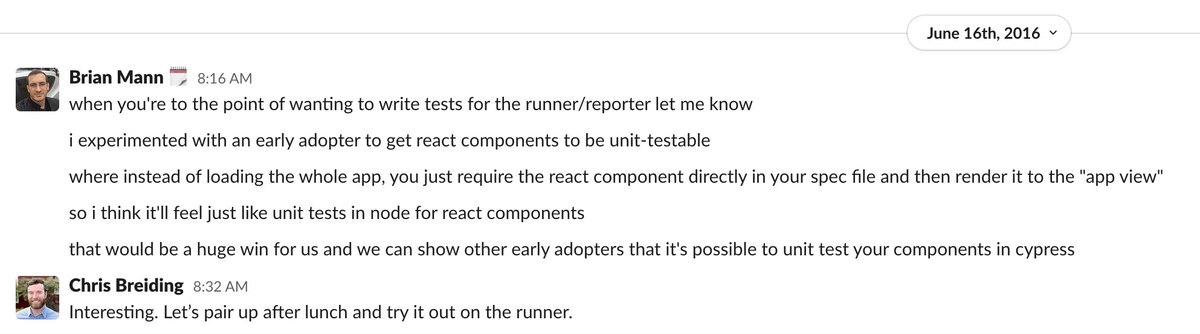
@bahmutov Gleb- while I recognize your early contributions and promotion of Component Testing, not only did the idea pre-date your employment here by almost 18 months, it was present even in early funding cycles. It was also a collective company decision to greenlight. Here's 1 receipt.
@housecor@MuratKeremOzcan @bahmutov @Cypress_io So the idea is to bring it back but fully endorse and adopt its power across a series of new features and workflows
@housecor@MuratKeremOzcan @bahmutov @Cypress_io For component testing in particular I see this working even better than e2e with the ability to use the dependency graph to do bidirectional source and spec watching. For instance - modifying a component and it running across multiple specs and tests that import it
@housecor@MuratKeremOzcan @bahmutov @Cypress_io It requires rebuilding from scratch and 3 separate UI and subsystems to be built to fully accommodate it.
@housecor@MuratKeremOzcan @bahmutov @Cypress_io The existing implementation was broken in a lot of cases. To do the right and well is non trivial and we decided not to port the existing implementation. I recognize it worked for certain primitive situations but overall for us it was very problematic
@housecor@MuratKeremOzcan @bahmutov @Cypress_io We are planning to add it back in a way that’s functionally “correct” and allow you to do the proper multi spec mode
@housecor@JordanPowell88@Cypress_io @bahmutov Yeah I need to add a fully detailed summary in the discussion. The short answer is there were multiple technical problems that caused all kinds of issues for different setups
@bahmutov @anthonygore Try it out with cy.session() and then wrap those into a custom login command. It'll then authenticate once and then reapply the saved session to avoid logging in to subsequent tests or full page refreshes.
@jennifershehane I think it’s more about the idea that they can’t accept that “this is the best the USA has to offer and the difficulty, cost, scrutiny, and elongated timeline doesn’t match their internal notion that people just simply walk across the border”
@estefafdez@morvader@Cypress_io In the future you should expect us to introduce at least 2 options to fine tune the control of the final determination of the test. For instance, to retry the test by default, but always fail if any attempt fails. Or to require a certain threshold pass to overcome failures.
@StooCrock @Cypress_io Yes - when we introduce those new options it'll highlight the efficacy of test retries irrespective of how a test is considered "passed or failed". It's fundamentally about calculating determinism to separate out flake from undermining reliability.
@tim_abell@Cypress_io It would be nice if GitHub created an assignable and enforceable CLA process as part of PRs. But without it we’re left to home roll our own solution. We’ve tried to make it as clear and not onerous as possible. I wish we didn’t have to do it but it’s necessary for everyone.
@tim_abell@Cypress_io Our CLA in particular ensures that INBOUND contributions are made under the same MIT license we use for distribution precisely so that we have the ability to license it out as MIT. Without that we would not be free and clear to do so.
@tim_abell@Cypress_io The CLA is the actual vehicle for defining the license that INBOUND contributions are made under. Without it - there is no specification. The default mode is that there is no license. That would be very problematic. The CLA is actually enforcing MIT. They go hand in hand.
@tim_abell@Cypress_io This is a commonly misunderstood area of open source. Licenses are a two way street. The MIT license that Cypress is distributed under is an OUTBOUND license to the user. However when accepting INBOUND contributions the MIT license is irrelevant....