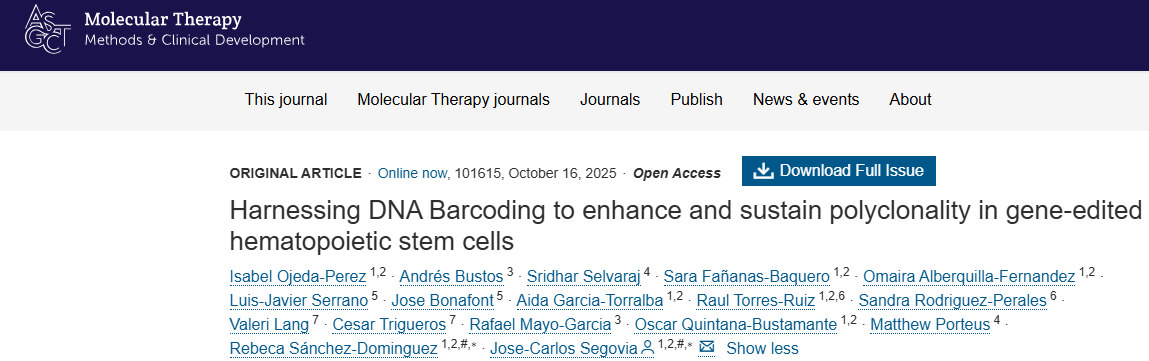
🎉We are happy to share with you a recent paper published by Dr. Isabel Ojeda and colleagues from Dr. Jose Carlos Segovia’s lab about a new gene editing strategy in Pyruvate Kinase Deficiency (PKD) model. Go check it at https://t.co/mjb7JliIXb
En este vídeo 🎥, presentamos a las mujeres que forman parte de nuestra unidad 👩🔬🔬. Su trabajo es un testimonio del poder transformador de la ciencia y de la importancia de fomentar la igualdad en todos los campos ⚖️ 🧬🔬 @CIEMAT_OPI
Una pequeña muestra de todo el trabajo llevado a cabo en la Unidad de Innovación Biomédica del @CIEMAT_OPI . 🥂 Para que el 2025 sea aún más productivo!
More than happy to join the Fanconi Cancer Foundation Scientific symposium / FA adults Retreat. 36th edition, this year in North Carolina! Fantastic oportunnity for us as scientists to meet patients and clinicians 🥼👍🏻👣
En la @SETGyC estamos orgullosos de contar con tantas científicas brillantes, entregadas a la investigación y con activa participación.
Queremos dar un especial reconocimiento a todas las socias junior, investigadoras del presente y próximas referentes en las terapias avanzadas.
From lab to approval in 11 years 🧬
And the thing is, medical applications of CRISPR are just getting started...
Just yesterday, the @doudna_lab released two juicy preprints on improved delivery methodologies for CRISPR editing machinery:
1. Lung and liver editing by lipid nanoparticle delivery of a stable CRISPR-Cas9 RNP [1]
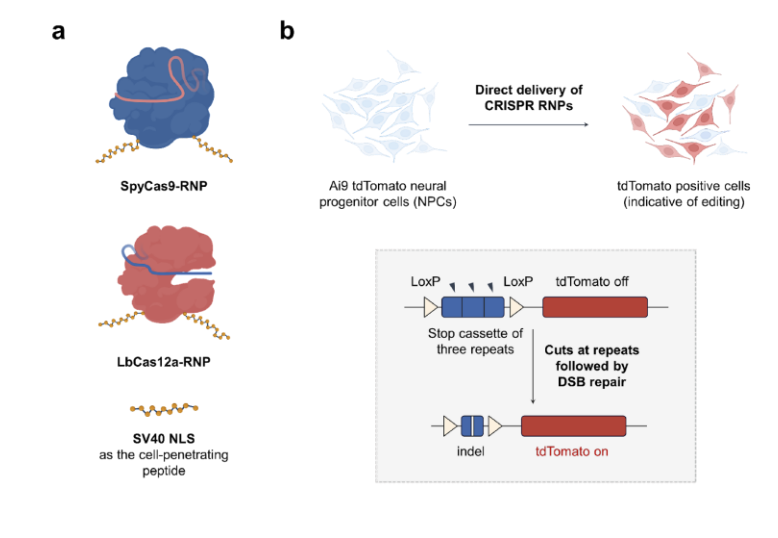
2. Engineering self-deliverable ribonucleoproteins for genome editing in the brain [2]
In the first paper, they took a thermostable variant of the Cas9 enzyme from a thermophilic bacteria (Geobacillus stearothermophilus), and used directed evolution to engineer >100x greater editing efficiency.
This thermostable Cas9 could be more efficiently encapsulated in LNPs, meaning that the actual protein could be delivered in a scalable vector instead of mRNA encoding the protein.
This has potential benefits for avoiding immune activation and having potentially higher editing efficiency—the translation efficiency of the mRNA can be a bottleneck.
They demonstrated in vivo lung and liver targeting (@justsaysinmice).
The second preprint was also very cool. What if CRISPR could just deliver itself (almost like an antibody or other biologic) instead of being packaged in the first place?
To achieve this, they screened for self-delivering Cas9 proteins that were fused to cell-penetrating peptides (CPPs) that could help escort them into cells.
They showed some POC data for in vivo delivery into the brain via injection into mice.
It's absolutely insane to see the pace of progress for CRISPR therapeutics. From basic research result to a new approved modality in 11 years.
Just a day before the approval, a pair of brand new delivery strategies released from a single lab.
Genomic medicine is only just getting started...
What a time to be a biologist!
[1] https://t.co/8YaCMkaTvh
[2] https://t.co/ZmO7KwgXjl