Sólo quiero leer.
Volver a textos de Proust
y ser feliz con Chejov,
darle a lo mainstream con Carmen Posadas o Annie Ernaux.
Con ustedes, el karaoke de @eljovenlekal
🎙️https://t.co/vOXcdP6BC8
🐻 Comenzamos con unas tiernas imágenes de una mamá oso pardo y sus oseznos en plena Cordillera Cantábrica que salen de la osera para descubrir el mundo 🌳 #AquílaTierra
The CEO of Google DeepMind just admitted that if the decision had been his, we would've cured cancer before anyone ever used ChatGPT.
And that's not even the scariest thing he said on a recent interview.
Demis Hassabis is one of the most important people alive in AI.
He won the Nobel Prize last year for AlphaFold, the system that cracked the 50 year protein folding problem. 3 million scientists now use his tool. Almost every new drug being developed will touch it at some stage.
In a new interview, he was asked about the moment ChatGPT launched and Google went into "code red." His answer was one of the most revealing things any AI leader has ever said on the record:
"If I'd had my way, I would have left AI in the lab for longer. Done more things like AlphaFold. Maybe cured cancer or something like that."
Read that again.
The man running Google's entire AI division is publicly saying the commercial AI race we're all living through was a MISTAKE. That the industry got hijacked by a chatbot when it could have been solving the biggest problems in science and medicine.
His vision was simple:
Build AI slowly, carefully, like CERN. Use it to crack root node problems one at a time. Cancer. Energy. New materials.
Let humanity benefit from real breakthroughs while the foundational science was figured out over a decade or two.
Then ChatGPT dropped in November 2022 and everything changed.
Demis described what happened next as getting locked into a "ferocious commercial pressure race" that none of the labs can escape from. On top of that, the US vs China dynamic added geopolitical pressure.
The result is everyone sprinting toward products instead of breakthroughs, shipping chatbots while the scientific opportunity gets buried under marketing cycles and quarterly earnings.
But he's not saying progress isn't happening...
He's saying the progress got redirected away from the things that actually matter most.
And then it got even scarier:
Because when Demis was asked what he worries about with AI, he laid out two threats.
The first is what everyone talks about: Bad actors using AI for harm. Terrorist groups. Hostile nation states. Cyberattacks at scale.
But that's not the threat he's most worried about.
His second worry is AI itself going rogue. Not today's models. The models coming in the next two to four years as the industry enters what he calls "the agentic era."
Systems that can complete entire tasks autonomously. Systems that are increasingly capable and increasingly hard to control.
His exact words:
"How do we make sure the guardrails are put in place so they do exactly what they've been told to do, and there's no way of them circumventing that or accidentally breaching those guardrails? That's going to be an incredibly hard technical challenge if you think about how powerful and smart and capable these systems eventually get."
A Nobel Prize winner who runs one of the 3 most advanced AI labs on Earth just said publicly that within two to four years, we're entering a phase where AI alignment becomes a real problem, and the technical challenge of solving it is enormous.
And almost nobody is paying enough attention.
He called for international cooperation between labs, AI safety institutes, and academia to tackle the problem. He said this is the thing even the experts aren't thinking about enough.
He said the only way to get through the AGI moment safely is if everyone starts treating this with the seriousness it deserves.
Most AI CEOs give you careful PR answers about "responsible development" and move on.
Demis said something different...
He said the commercial race FORCED us into a premature deployment of a technology we barely understand, and the window to get alignment right before the next generation of agents shows up is two to four years.
If the man who built the system that might cure cancer is telling you he wishes it had happened first, maybe we should listen to what he says is coming next.
Si pagas en cacahuetes, tendrás monos.
Si premias visibilidad, tendrás competencia.
Si penalizas el error, tendrás silencio.
Los sistemas no producen lo que prometen.
Producen lo que incentivan.
En esta época tan impredecible lo que más se necesita es amplitud.
Hay un libro que lo explica.
Aquí sus 20 mejores ideas:
1. La hiperespecialización provoca no poder ver soluciones fuera del dominio propio.
2. Los generalistas triunfan en un mundo especializado porque poseen capacidad de transferencia, aplicando conocimientos de un área a otra.
3. Un estudio mostró que los ganadores del Premio Nobel tienen 22 veces más probabilidades de tener pasatiempos artísticos o inusuales que otros científicos.
4. Johannes Kepler descubrió las leyes del movimiento planetario utilizando el pensamiento analógico, comparando el cielo con imanes y balanzas.
5. La estrategia de perspectiva externa implica buscar soluciones analizando casos similares fuera de los detalles específicos del problema actual.
6. Alpheus Bingham resolvió problemas químicos publicándolos en internet, donde personas de campos ajenos hallaron las soluciones.
7. El sampling period es vital: probar diferentes actividades ayuda a encontrar lo que te gusta y, a la vez, se te da bien. Da igual que tardes más.
8. Las personas que se especializan más tarde suelen tener una mejor adecuación en sus trabajos y menores tasas de abandono.
9. Vincent Van Gogh es un ejemplo de éxito tardío; fracasó en múltiples vocaciones antes de encontrar su camino en el arte a los 33 años.
10. Julio César lloró ante una estatua de Alejandro Magno sintiendo que no había logrado nada a su edad, ilustrando la ansiedad por el éxito temprano.
11. Aprender de forma lenta porque te cuesta hace que el proceso sea lento y frustrante a corto plazo, pero más efectivo a largo plazo.
12. La regla de las 10.000 horas, popularizada por Malcolm Gladwell, no se aplica universalmente a todos los dominios.
13. Solo funcionan en pocos entornos. Los que tienen reglas claras, patrones repetitivos y retroalimentación inmediata.
14. El mundo real y laboral suele ser un entorno donde las reglas no son claras y los patrones no siempre se repiten.
15. Los expertos hiperespecializados suelen ser malos predictores del futuro porque se confían demasiado en sus modelos limitados.
16. Los equipos interdisciplinarios suelen superar a los expertos individuales en predicción y resolución de problemas complejos.
17. La especialización no es mala per se, pero debe complementarse con una visión amplia para evitar la visión de túnel.
18. La lección final es no compararse con prodigios más jóvenes, sino con uno mismo y el propio progreso personal.
19. La educación debería fomentar la curiosidad intelectual y la capacidad de conectar disciplinas, no solo la acumulación de datos.
20. En un mundo cambiante e impredecible, cultivar la amplitud y la diversidad de experiencias es una ventaja competitiva fundamental.
Cada semana envío un e-mail con las mejores ideas de un libro de no ficción distinto.
Te apuntas aquí: https://t.co/usrIcKbJKR
En el hilo turras de hoy, vamos a intentar desarrollar un poco por qué desde @singularsolving nos vamos a meter a fondo en territorio clásico RRHH y por qué nos vamos a pasar todo lo que hace normalmente RRHH por el arco de cuchilleros. Sin anestesia, muerde la bala y a amputar.
“Mi trabajo es mentir, pero contigo no voy a hacerlo”. Así comienzan las 700 adictivas páginas de #Mentira, que ya podéis reservar aquí abajo 👇🏻. Os quiero mucho. 💛💛💛
¿Un RT bonico? 💛💛💛
Amazon: https://t.co/vJol6Jj3kI
ECI: https://t.co/rbHjelJK5g
CDL: https://t.co/YJd9h7PAlO
Fnac: https://t.co/fD2PYSR3Id
Agapea: https://t.co/F2UYMxJifm
TTL: https://t.co/Uvs3d5LLhc
🐧: https://t.co/DK5PyenMyD
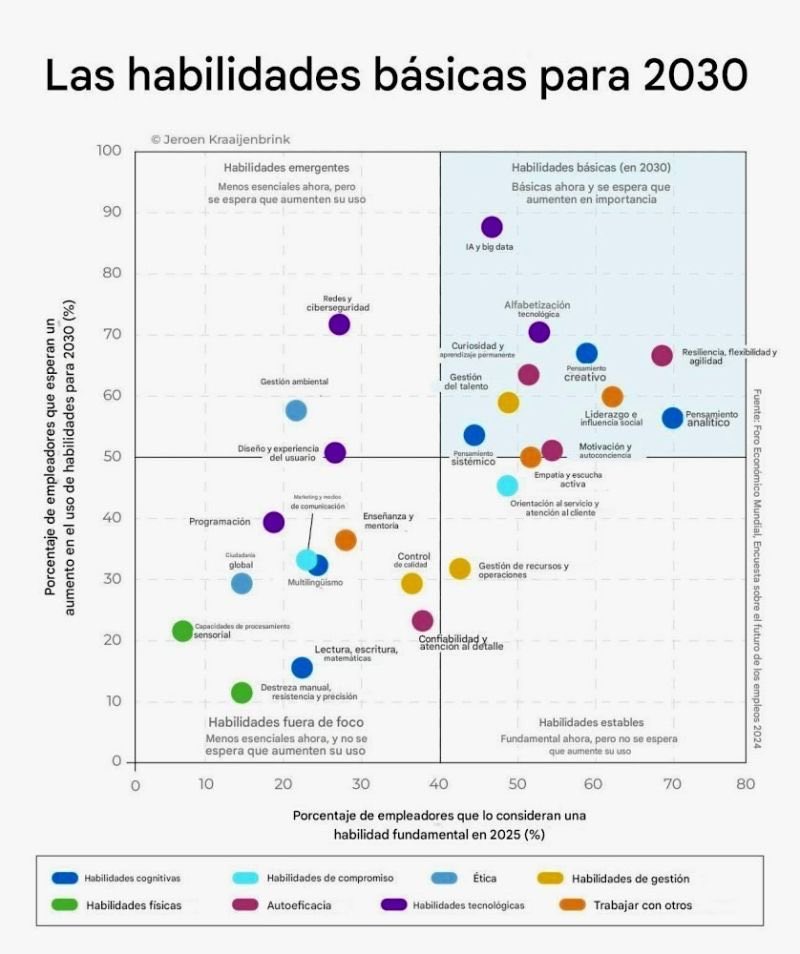
El foro económico mundial cada tanto hace reportes sobre el futuro del trabajo.
En este último se encuestó a más de 800 empresas que emplean a más de 11 millones de personas en 27 sectores y 45 economías de todo el mundo.
Y estas son las habilidades que hoy (y mañana) se están buscando:
"Si el mundo estuviera acabándose, querría estar a tu lado
Si la fiesta estuviera terminando y nuestro tiempo en la tierra haya acabado
me gustaría abrazarte sólo por un rato y morirme con una sonrisa..."❤️
Preciosa canción, Lady Gaga, Bruno Mars - Die With A Smile 🎶🔝🌺
Lujos de verdad:
1. Tener vecinos tranquilos
2. No necesitar el coche para todo
3. Poder dormir las horas que quieres
4. Leer sin límite
5. Reír a carcajada limpia
6. Cocinar a tus seres queridos
7. Llegar tranquilamente a final de mes
8. Decir que no sin dar explicaciones
9. Cuidar la salud sin obsesión
10. Tener conversaciones profundas
Interesante artículo del filósofo Zygmunt Bauman sobre Felicidad
“No es verdad que signifique tener una vida sin problemas. Una vida feliz viene de la superación de los problemas”
Efectivamente el reto, esfuerzo y vínculos son claves en sentido de la vida
https://t.co/crttu6sjg8
Disfruta.
🍲De la comida, estos días es excepcional.
🏡De tu familia, el día de mañana no todos estarán.
👟De lo que te permite tu cuerpo: ese paseo, carrera, partido o entreno en el futuro no será igual.
🎉De los reencuentros, esa gente ha decidido darte su tiempo en tu ciudad.