The opportunities and the warning signs arrived together.
But the warning may matter even more.
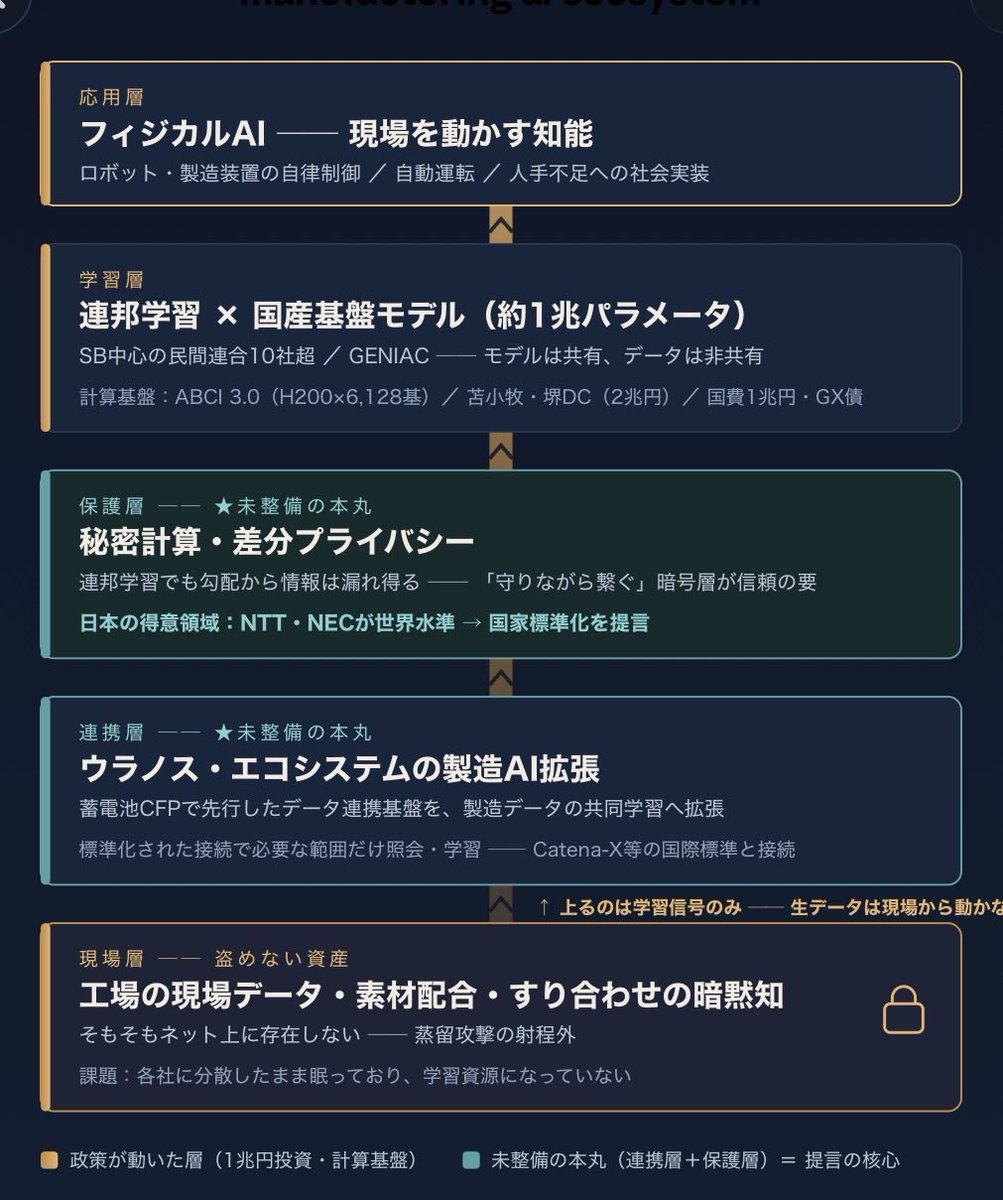
NVIDIA isn’t just here to sell GPUs. It is building a bridge between Omniverse, Cosmos, and the decades of operational know-how embedded in Japan’s factories.
Toyota. Kawasaki Heavy Industries. Hitachi.
If the operational data layer of Japanese industry becomes connected through NVIDIA’s platform first, that architecture could become the de facto standard before Japan builds its own sovereign industrial data infrastructure.
The race is no longer about GPUs. It’s about who owns the operating system for industrial intelligence.
Doctrinally speaking, this is actually twisted in two ways.
First, in Shia theology, martyrdom is not a defeat but the highest honor.
The moment you declare someone a "martyr," that death should stand as a completed religious victory.
Treating it instead as a debt that demands revenge is a political exploitation of the very concept of martyrdom.
Second — and this is the more serious one — velayat-e faqih (guardianship of the Islamic jurist) was, at least in principle, a system where the leader is chosen by scholarship, not bloodline.
Yet the succession has now passed from father to son, and that son is holding up "revenge for my father" as a national duty.
This is the structure of a dynastic blood feud — a vendetta — and it contradicts both the republic's own founding premise and the legal principle that jihad must never be a private grudge.
The very phrase "this is what the people demand" is a rhetorical device for transferring a personal vendetta onto the nation.
This expansion is not merely about diversifying operations; it is positioned as an integral part of the Japanese government’s growth strategy and financial strategy.
The “financial strategy to promote growth investment,” to be finalized this month by the Asset Management Nation Promotion Subcommittee under the Japan Growth Strategy Council, is expected to explicitly state that GPIF will advance the sophistication of its operations for alternative investments toward the 5% upper limit.
• The current allocation to alternative assets stands at approximately 1.6–1.7% (around ¥4.2 trillion as of the end of March 2025), leaving significant room before reaching the 5% cap.
The government is actively pushing to increase this allocation to channel funds into domestic growth sectors.
The specific aim is to leverage the high affinity with startup investments, supporting the nurturing of domestic unicorns and providing capital to government priority areas such as AI, semiconductors, and shipbuilding.
In short, your observation that “they will focus investments on the government’s growth strategy” aligns perfectly with the reported content. The policy intent is clear: to utilize long-term pension capital not just for returns, but as a tool to support the growth of the Japanese economy.
Note:
GPIF’s current alternative assets primarily cover private equity, infrastructure, and real estate. Crypto assets (such as Bitcoin) are not explicitly included in the announced categories, though private equity could indirectly touch related growth sectors. Cointelegraph’s coverage likely highlights potential ripple effects in the broader alternatives space.