Y de pronto supe cuál es la razón
Al menos unas pocas horas
Y me agarro a aquel recuerdo que guardé
Dentro de mi memoria
Y todo se recolocó
Se hizo la luz en el infierno
Y todo gracias a nosotros dos
Que estábamos luciendo
Según el minimalismo japonés, lo que guardas “por si acaso” no es aleatorio.
Es un reflejo de los miedos, apegos y versiones antiguas de ti que todavía ocupan espacio en tu vida.
1. Ropa que no usas =...
A @nosoloviernes2, Marc Biarnés, le han intentado tumbar la cuenta.
Este es el vídeo sobre la “no condena” a Víctor de Aldama que les ha molestado tanto 👇
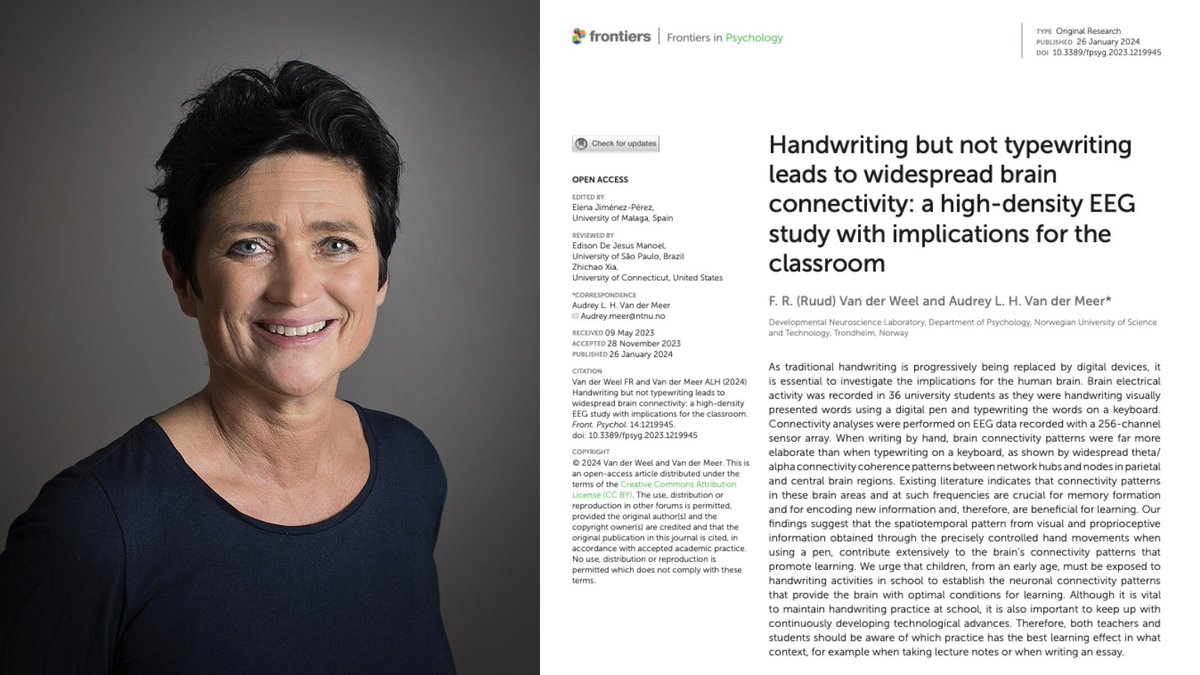
A Norwegian neuroscientist spent 20 years proving that the act of writing by hand changes the human brain in ways typing physically cannot, and almost nobody outside her field has read the paper.
Her name is Audrey van der Meer.
She runs a brain research lab in Trondheim, and the paper that closed the argument was published in 2024 in a journal called Frontiers in Psychology. The finding is brutal enough that it should have changed every classroom on Earth.
The experiment was simple. She recruited 36 university students and put each one in a cap with 256 sensors pressed against their scalp to record brain activity. Words flashed on a screen one at a time.
Sometimes the students wrote the word by hand on a touchscreen using a digital pen, and sometimes they typed the same word on a keyboard. Every neural response was recorded for the full five seconds the word stayed on screen.
Then her team looked at the part of the data most researchers had ignored for years, which is how different parts of the brain were communicating with each other during the task.
When the students wrote by hand, the brain lit up everywhere at once.
The regions responsible for memory, sensory integration, and the encoding of new information were all firing together in a coordinated pattern that spread across the entire cortex. The whole network was awake and connected.
When the same students typed the same word, that pattern collapsed almost completely.
Most of the brain went quiet, and the connections between regions that had been alive seconds earlier were nowhere to be found on the EEG.
Same word, same brain, same person, and two completely different neurological events.
The reason turned out to be something nobody had really paid attention to before her work. Writing by hand is not one motion but a sequence of thousands of tiny micro-movements coordinated with your eyes in real time, where each letter is a different shape that requires the brain to solve a slightly different spatial problem.
Your fingers, wrist, vision, and the parts of your brain that track position in space are all working together to produce one letter, then the next, then the next.
Typing throws all of that away. Every key on a keyboard requires the exact same finger motion regardless of which letter you are pressing, which means the brain has almost nothing to integrate and almost no problem to solve.
Van der Meer said it plainly in her interviews.
Pressing the same key with the same finger over and over does not stimulate the brain in any meaningful way, and she pointed out something that should scare every parent who handed their kid an iPad.
Children who learn to read and write on tablets often cannot tell letters like b and d apart, because they have never physically felt with their bodies what it takes to actually produce those letters on a page.
A decade before her, two researchers at Princeton ran the same fight using a completely different method and ended up at the same answer. Pam Mueller and Daniel Oppenheimer tested 327 students across three experiments, where half took notes on laptops with the internet disabled and half took notes by hand, before testing everyone on what they actually understood from the lectures they had watched.
The handwriting group won by a wide margin on every question that required real understanding rather than surface recall.
The reason was hiding in the transcripts of what the two groups had actually written down.
The laptop students typed almost word for word, capturing more total content but processing almost none of it as they went, while the handwriting students physically could not write fast enough to transcribe a lecture in real time, which forced them to listen carefully, decide what actually mattered, and put it in their own words on the page.
That single act of choosing what to keep was the learning itself, and the keyboard had quietly skipped the choosing and skipped the learning along with it.
Two studies. Two countries. Same answer.
Handwriting makes the brain work. Typing lets it coast.
Every note you have ever typed instead of written went into your brain through a thinner pipe. Every meeting, every book highlight, every idea you captured on your phone instead of on paper was processed at half depth.
You did not forget those things because your memory is bad. You forgot them because typing never woke the part of the brain that would have made them stick.
The fix is the thing your grandmother already knew.
Pick up a pen. Write the thing down. The slower road is the faster one.
"La eliminación de archivos en papel y su reemplazo por archivos digitales, les permite borrar la historia. Un día, intentarás acceder a la información y encontrarás el mensaje de "esta página no existe", y al día siguiente, los verás negar que eso haya ocurrido"
Julian Assange
Al conductor de autobús que se ha levantado en una parada y ha dicho "Los móviles con auriculares, por favor. Un respeto a los demás": Te deseo que nunca vuelvas a quemarte con una croqueta, siempre recuerdes tus contraseñas y encuentres aparcamiento a la primera.
“No busques ser cool. Sé apasionado, sé comprometido, sé tú mismo. La autenticidad es más punk que cualquier chaqueta de cuero. Escribe, canta, crea, aunque nadie escuche. Porque el arte verdadero nace del alma, no del aplauso.”
.— Patti Smith
Ella es Iris, una trabajadora que lleva 26 años en la empresa... o llevaba, porque ayer la despidieron. Que, por cierto, es mi madre.
Hasta hace 3 días la subían a redes sociales como imagen de la marca.
La han despedido de forma disciplinaria, alegando que se le olvidaban cartones en el suelo o que dejaba artículos caducados en pasillos cuando se realizaban los inventarios.
Son 26 años dedicados a una empresa para que te despidan mediante una carta donde los motivos que exponen rozan la falta de respeto, la humillación y, cómo no, donde se dicen mentiras.
¿Creéis que ella, siendo tan 'mala trabajadora', hubiera estado en una empresa 26 años o hubiera sido utilizada como imagen de la marca en redes sociales en tantas ocasiones?
Todos sabemos que la intención es ahorrarse el dinero que le deben.
Si tomáis la decisión de despedir a una de vuestras trabajadoras más veteranas, experimentadas y profesionales, por lo menos afrontad las consecuencias y dadle el dinero que le debéis.
Sinvergüenzas. @CarrefourES
Los griegos ya lo sabían.
Aristóteles daba clases caminando con sus alumnos por el Liceo de Atenas porque había descubierto algo que hoy la neurociencia confirma y es que caminar activa el pensamiento divergente, el tipo de pensamiento que genera ideas y conexiones nuevas.
Hoy tenemos esa evidencia científica y aun así hemos construido un sistema donde los jóvenes pasan seis horas sentados memorizando respuestas que alguien ya tuvo antes que ellos.
Y luego me dicen que cambiar la disposición del aula y salirse de lo "que siempre se ha hecho" no ofrece mejores resultados...
Nada supera la resiliencia palestina. "No perdieron la esperanza, se aferraron a ella a pesar de todo. Hoy, están presentando sus exámenes en la playa, después de haber perdido sus escuelas y edificios."
McGowan: «Estás diciendo que murieron 46 estadounidenses, así que deberíamos atacar Irán. 68.000 estadounidenses mueren cada año porque no tienen seguro médico. ¿No tendría más sentido gastar ese dinero aquí, en sanidad, en vez de bombardear otro país?»