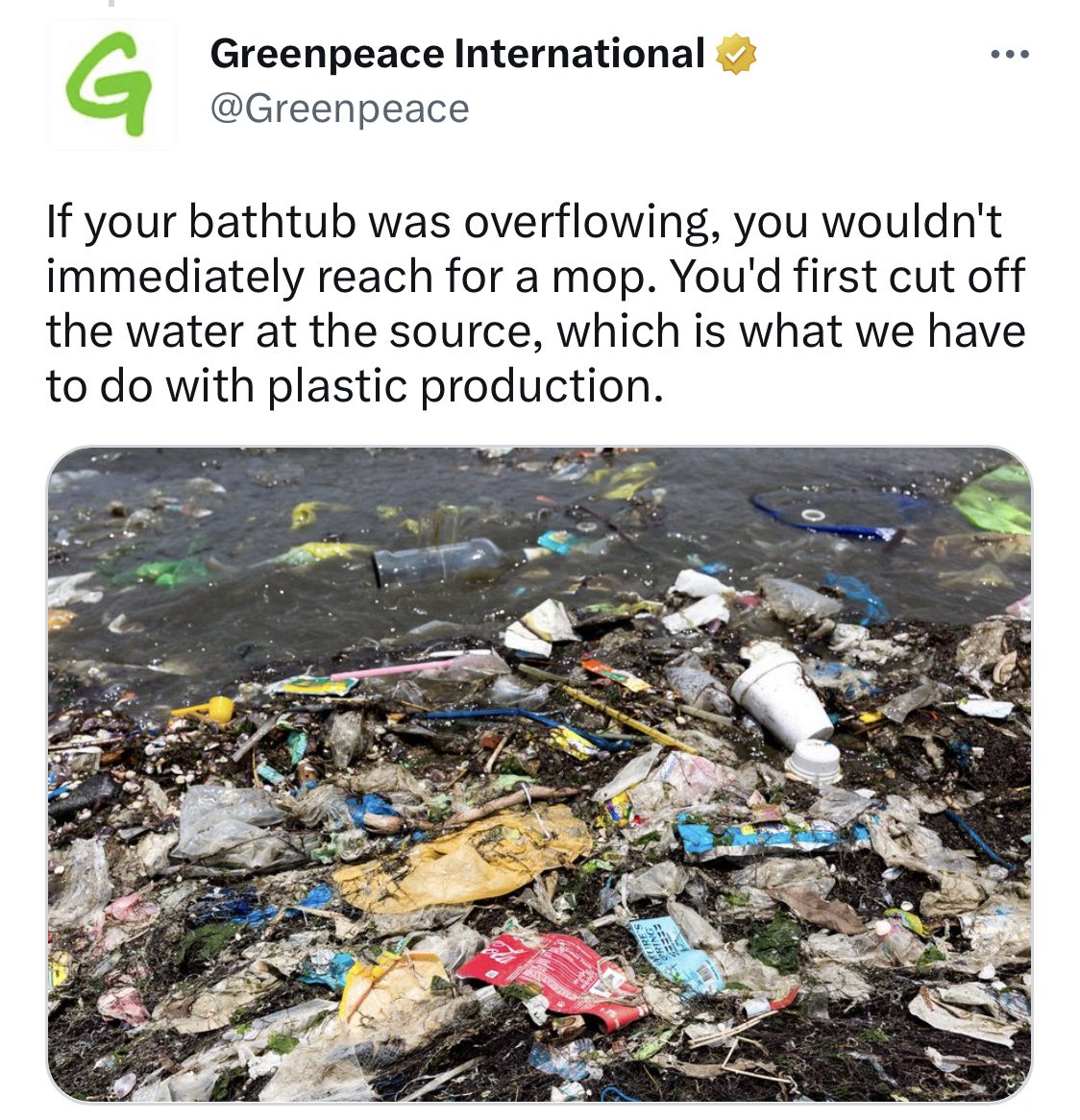
If I had a dollar for every time someone criticizes The Ocean Cleanup with the phrase “if your bathtub is overflowing, you wouldn’t get a mop, but you would first turn off the tap”, we wouldn’t have to accept donations anymore.
It is not only a cliché, but it’s also just plain wrong, for a few reasons:
1. Humanity can do more than one thing at the same time. Why not do both? Get a friend to start mopping while you work on closing the tap! One does not compete with the other; the cost of cleaning up the legacy pollution is negligible compared to what we spend on dealing with the waste on land.
2. The analogy can be used to criticize the *timing* of cleanup, but instead it’s being used to criticize spending *any* effort on anything cleanup-related. When your bathtub is overflowing, surely you’re happy there were people who developed the mop? Presumably you still have a mop at home?
3. The longer the water is on your nice wooden floor, the more damage it does, so you’d still want to mop up the water rather quickly. Similarly, the longer the accumulated plastic remains in the ocean, the more harm it causes.
4. We don’t disagree that stopping the inflow should have highest priority. Yet, due to the persistency of the plastic, that’s not the only thing we should do if we want to return to clean oceans.
5. The Ocean Cleanup works on closing the tap, too! The closest analogy to the faucet are rivers and that’s exactly where are are intercepting it to prevent it from flowing into the ocean. Instead, these activists often put river interception under the header of ‘cleanup’ too.
6. Many of those that use the bathtub analogy argue we should stop producing plastic. If we take the analogy seriously, that’s not ‘closing the tap’ but closing down the complete water supply.
7. The analogy suggests that you’d have to clean up as fast as it is flowing in to have any effect, but that’s not how the plastic problem works. Almost all the plastic that flows into the ocean washes up back onto land within a few months of being emitted, essentially removing itself. Only a tiny fraction persists. This means that just a single full scale ocean cleanup system in the Great Pacific Garbage Patch, which specifically addresses that persistent fraction, will, in fact, be capable of removing persistent plastic faster than it is flowing in.
Let’s retire this dreaded analogy.
My hope is that, soon, we will see a day when it has become unthinkable that we just let plastic leak into our oceans uninterrupted. People will look back at today's status quo in disbelief. If we can flip the definition of what's 'normal', our scale-up will become inevitable.
Listen in full: crew member Florent Beauverd speaks about the damage caused by plastic pollution to communities and wildlife in Guatemala, and why documenting the largest cleanup in history is so important for the future of our planet: https://t.co/El8Q1RZYZ2.
From trying to stop trash tsunamis in Guatemala to regular extractions in the Great Pacific Garbage Patch, our crew is working on all fronts at the moment. Here’s the latest catch from System 002 (extracted May 30 2022).
In New York, this conductor thought nobody knew it was his birthday.
He was wrong.
This is how his orchestra surprised him.
It's the joy we need in the world right now.
🎶❤️
On a day like today, a reminder of the good that's in the world:
In Texas, a Starbucks barista noticed a young girl was uncomfortable after she was approached by a man she didn't know.
So the barista handed her a coffee cup, with a message on the back.
Look after each other.
Another 6820kg out of the ocean marks Jenny’s 23rd extraction so far and the last one before heading back to port for a crew change and offload. System 002's total catch is 55,020kg so far; 1/1500th of the Great Pacific Garbage Patch.
The tennis sensation, who made history at Wimbledon this year and just reached her maiden Grand Slam quarter final at the US Open, talks to Olivia Marks in the October issue of British Vogue. https://t.co/oRvXK0deRV