How does URA decide who to investigate?
From perpetual losses and VAT–WHT mismatches to related-party debt and transfer pricing, this article breaks down the key red flags that can trigger a tax audit in Uganda.Preparation is the best defense.
#TaxLaw#URA#TaxCompliance
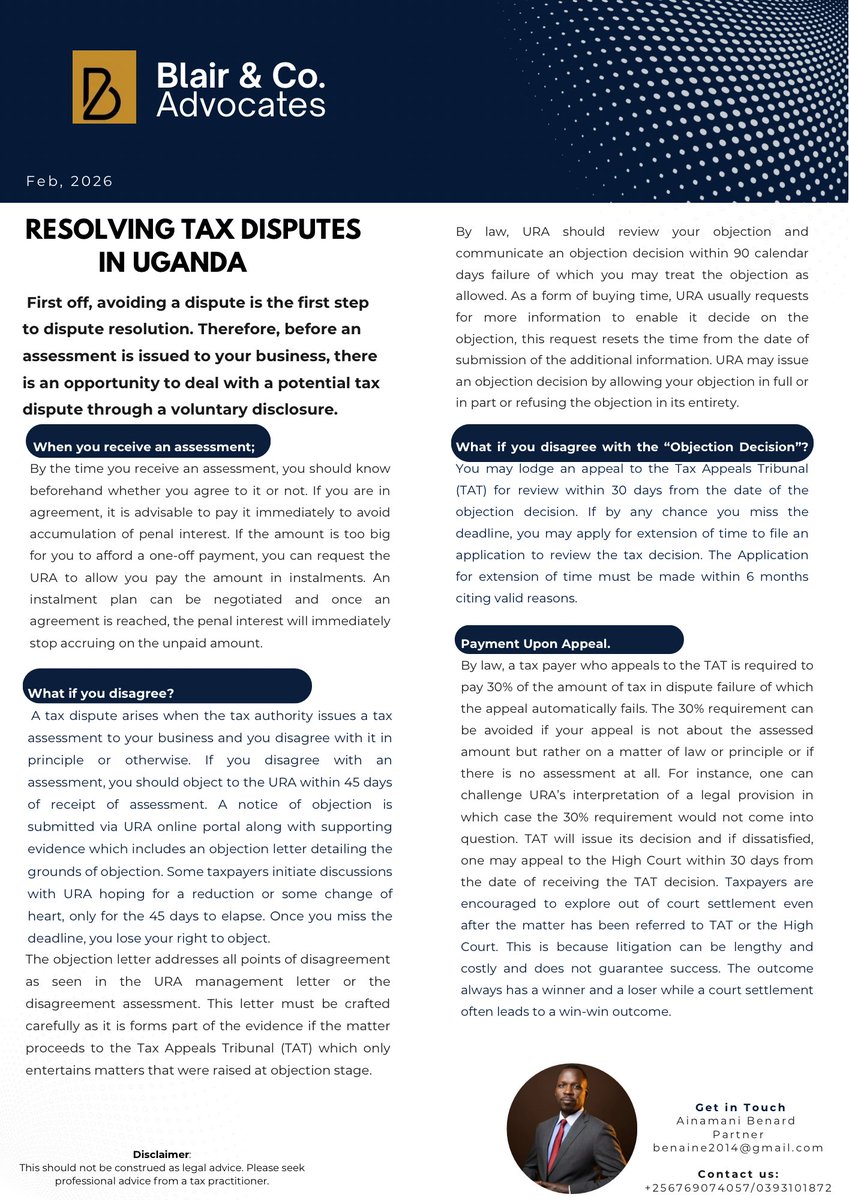
A tax assessment from URA is not a conclusion. It is the beginning of a structured legal process. You have 45 days to lodge a valid objection. URA is required to issue an objection decision within 90 days. An appeal to the Tax Appeals Tribunal must be filed within 30 days.
Happy Birthday to our Senior Partner, a remarkable leader, mentor, and pillar of excellence. Wishing you continued success and fulfillment in the year ahead.
Unpacking Uganda's New Competition Act: A Game Changer for Mergers, Acquisitions, and Market Fairness
In 2022, Uganda’s Minister of Trade, Industry, and Cooperatives introduced the Competition Bill to Parliament. After several revisions, it was enacted and assented to by the President on February 2, 2024. Prior to this, Uganda relied on sector-specific competition laws for industries such as banking, telecommunications, and energy. The new Competition Act, 2023 fills this legislative gap by establishing Uganda’s first national competition law.
The primary objective of the Act is to promote fair competition and prohibit practices that distort market dynamics. It addresses anti-competitive practices, agreements, abuse of dominant market positions, and mergers, acquisitions, and joint ventures that harm competition. The Act will come into force upon gazettement, as it currently lacks a formal commencement date.
This article highlights key provisions of the Act, focusing on mergers, acquisitions, and joint venture transactions.
Anti-Competitive Behavior
Section 9 of the Act prohibits three categories of anti-competitive conduct:
1. Anti-competitive practices and agreements
2. Abuse of dominant market positions
3. Mergers, acquisitions, and joint ventures that negatively impact competition
Below is a closer look at each category:
Anti-Competitive Practices and Agreements
The Act prohibits both horizontal and vertical agreements that are deemed anti-competitive.
• Horizontal agreements involve competitors operating at the same level of the supply chain—for instance, manufacturers or service providers in the same market segment. These include arrangements to fix prices, allocate markets, or control supply sources based on territory or customer categories.
• Vertical agreements involve parties at different levels of the production or distribution process, such as suppliers and retailers. Prohibited conduct may include exclusive supply or distribution agreements that unfairly limit market access.
Abuse of Dominant Position
A business is deemed dominant if it can operate independently of its competitors or customers in a way that impedes market competition. Section 11 of the Act sets out criteria for establishing market dominance. For example, an entity is presumed dominant if it controls at least 30% of a particular market, or if three or fewer entities collectively control 60% or more. The Act also considers dominance arising from legal monopolies or government-owned entities.
Abuse may occur through actions such as:
• Imposing unfair terms and conditions in contracts
• Price squeezing
• Predatory pricing
• Discriminatory practices targeting specific suppliers or consumers
However, not all regulatory contract requirements are considered abusive.
Mergers, Acquisitions, and Joint Ventures with Negative Effects on Competition
While the Act does not define “adverse effect,” it outlines several factors the Ministry will assess to determine the competitive impact of a transaction. These include:
• Market share of the involved parties
• Elimination of effective competition
• Risk of creating a monopoly
• Innovation trends in the affected market
• Whether the benefits of the transaction outweigh the negatives
Any entity proposing a merger, acquisition, or joint venture must notify the Ministry and obtain approval before proceeding. Failure to notify renders the transaction void.
The Minister will establish the threshold for notifiable transactions through a statutory instrument, which is yet to be published. As the Act does not include transitional provisions, further guidance on pending transactions is anticipated.
Acquisition of Control
Control is presumed when an entity:
• Holds at least 49% of the voting rights
• Has the ability to appoint a majority of the board of directors
• Exercises influence over the company’s operations
The 49% threshold is notably lower than the 51% benchmark typically applied in global equity transactions.
Notification Timelines and Approval Process
The timing for notifying the Ministry varies based on the transaction type:
• Mergers or amalgamations – after board approval
• Acquisitions– after executing the acquisition agreement
• Joint ventures– after signing the joint venture agreement
These timelines align with standard regulatory practices that require approval before closing.
Once notified, the Ministry has 120 days to review the transaction. It may also require the parties to publish transaction details. If the Ministry does not communicate its decision within this period, the transaction is automatically considered approved. The approval process is intended to be efficient, transparent, and flexible, with the possibility of conditional approvals and consultative engagement.
Interface with COMESA
The Act does not clarify how it will interact with regional competition frameworks like that of COMESA. This may necessitate dual filings with both Uganda’s Ministry and the COMESA Competition Commission (CCC). It is expected that the Ministry will defer to regional regulators, such as the CCC or the East African Community Competition Authority (once operational), in cases where regional thresholds are met to avoid overlapping regulations.
This article is part of the MSME Legal Literacy–Africa, a legal awareness initiative of @CEOEastAfrica Africa Magazine and @JuralMedia Media. The MSME Legal Education Project (MSME Legal) leverages technology to equip Micro, Small, and Medium Enterprises with relevant legal knowledge and tools to navigate complex legal landscapes, avoid disputes, and foster sustainable growth—providing long-term stability and competitive advantage. Supporting MSMEs directly contributes to national goals such as improving household incomes, creating employment, and achieving development objectives under Uganda’s Vision 2040, with a strong focus on inclusion for youth and women.
. Enforceability: How Contracts Have Your Back
Legal contracts turn verbal promises into enforceable agreements. That means:
🔒 Protection in Court
If a dispute ever arises (over pay, performance, responsibilities, termination, etc.), a written contract gives you legal proof of what was agreed. Without one, it’s your word vs theirs.
Example: An employee claims they were promised a bonus — but you didn’t agree to that. If it’s not in the contract, it could become a real headache in court.
⚖️ Legal Compliance
A contract helps show that you're complying with employment laws—around wages, classification (employee vs contractor), working hours, etc. That can shield you during audits or investigations by labor boards.
🧾 Enforceable Clauses
Well-drafted contracts can include legally binding clauses like:
Non-disclosure (protecting confidential info)
IP ownership (so you own what they create)
Notice periods
Non-solicit or non-compete (where enforceable)
As long as they’re reasonable and clear, a court is more likely to enforce them.
🛡️ 2. Avoidance of Disputes: Preventing Headaches Before They Start
Clear contracts prevent misunderstandings — which is where most workplace drama starts.
📘 Everyone’s on the Same Page
It lays out:
What the employee is supposed to do
How much they’ll be paid and when
Time off rules, sick leave, benefits
How things end if either party wants out
That clarity avoids the classic “But I thought…” moments.
🤝 Sets Expectations Early
Setting boundaries and expectations from Day 1 fosters professionalism and fairness. Employees know where they stand, and you’re not left improvising policies on the fly.
🛑 Reduces Verbal Disputes
No more relying on memory. If something’s disputed, you can pull out the contract and say, “Let’s refer back to what we agreed.” That often ends the issue right there.
In Short:
Legal contracts aren’t just paper — they’re armor.
They keep your business safe, reduce risk, and help you avoid unnecessary conflict. And if conflict does happen, they give you the upper hand.
As a business owner, always make sure there’s a plan for when things go left. What happens if there’s a disagreement? Are we going to court, arbitration, mediation, or are you calling your lawyer friend for last minute advice that will cost you an arm and a leg. A proper dispute resolution clause answers that and can save you time, money, and plenty of headaches if it is made prior to any disputes arising.
The bottom line? A contract isn’t a mere formality — it’s protection. Read it, understand it, and make it work for you.
How to Write A Dispute Resolution clause
A Dispute Resolution clause is a provision commonly included in contracts to address the process of resolving conflicts between the parties involved. This clause outlines the methods and procedures that will be followed in the event of a dispute, aiming to provide a clear and agreed-upon path for resolution.
One common approach is the inclusion of an arbitration clause, which requires the parties to agree that their dispute will be resolved through arbitration rather than pursuing litigation. Arbitration is an alternative method of dispute resolution where an impartial third party, the arbitrator, reviews the case and makes a binding decision. It is often faster and less expensive than going through the court system. It also mantains business relationships unlike litigation where the court environment could breed an atmosphere of hostility among business partners.
While arbitration is increasingly favored in many contracts, some agreements may still allow for traditional legal recourse, such as litigation in a court of law. The choice between arbitration and litigation depends on various factors, including the nature of the dispute, the preferences of the parties, and the specific contract provisions.
By including a well-drafted Dispute Resolution clause, parties can establish a clear framework for resolving conflicts, helping to streamline the process and potentially avoid prolonged and costly litigation.
Arbitration Clause Template:
“Any dispute, controversy, or claim arising out of or relating to this contract, or the breach, termination, or invalidity thereof, shall be settled by arbitration in accordance with the rules of ICAMEK. The arbitration shall be conducted by 3 arbitrators, appointed in accordance with the rules. The place of arbitration shall be [city, country]. The language to be used in the arbitral proceedings shall be in English. The award rendered by the arbitrators shall be final and binding upon the parties and judgment upon the award may be entered in any court having jurisdiction thereof.”
Litigation Clause Templates:
“In the event of any dispute, controversy, or claim arising out of or relating to this contract, or the breach, termination, or invalidity thereof, the parties agree that any such dispute shall be resolved by filing a lawsuit in the appropriate court. Both parties hereby agree to the exclusive jurisdiction of court. The laws of The Republic of Uganda shall govern this contract and any legal proceedings arising from it.
Mediation Clause Template:
“In the event of any dispute, controversy, or claim arising out of or relating to this contract, or the breach, termination, or invalidity thereof, the parties agree to first attempt to resolve the dispute amicably through mediation. The mediation shall be conducted in accordance with the rules of the mediation institution or organization chosen. If the dispute is not resolved within 28 days from the commencement of mediation, either party may initiate binding arbitration or pursue other available legal remedies.”
Tips
Here are some more practical tips to consider along with examples for drafting a Dispute Resolution clause:
1. Incorporate Step-by-Step Resolution:
Include steps that parties must follow before resorting to formal proceedings. For instance:
"In the event of any dispute arising out of this Agreement, the parties shall first attempt to resolve the dispute through friendly negotiations within 14 days of written notice. If no resolution is reached through negotiations, the parties shall proceed to mediation..."
2. Specify Arbitration Institution:
Clearly mention the chosen arbitration institution and its rules:
"Any dispute arising out of or relating to this Agreement shall be submitted to arbitration in accordance with the rules of the International Chamber of Commerce (ICC) ,or ICAMEK by three arbitrators appointed in accordance with said rules."
3. Address Confidentiality:
Emphasize the confidentiality of the arbitration proceedings and the information shared during them. This is done to keep company information private, incase of disputes where information is voluntarily shared by both parties .An example of a confidentiality clause;
"All information exchanged during the dispute resolution process, including documents, statements, and awards, shall be treated as confidential and shall not be disclosed to any third party except as required by law or with the parties' consent."
4. Address Costs:
Clarify how the costs of the resolution process will be divided among the parties to avoid disputes about who pays for what.
"Each party shall bear its own legal fees, expenses, and costs incurred in connection with the dispute resolution process. The costs of arbitration, including arbitrators' fees and administrative fees, shall be paid equally by the parties ."
5. Specify Governing Law:
Indicate the jurisdiction whose laws will govern the interpretation of the clause and the dispute resolution process.This is essential for cross-boarder or international contracts where laws are applied differently in each country or jurisdiction. For example the laws governing contracts in one country could be different from the contract laws in your country of origin.
"This Dispute Resolution clause shall be governed by and construed in accordance with the laws of the State of Uganda."
6. Prescribe Time Limits:
Set clear timeframes for each stage of the dispute resolution process:
"The mediation process shall commence within 7 days of written notice of a dispute, and the mediation sessions shall conclude within 28 days thereafter. If mediation is not successful, arbitration proceedings shall be initiated within 7 days of the conclusion of mediation."
7. Address Applicable Remedies:
State which types of remedies are available or not available within the chosen resolution method:
"The parties acknowledge and agree that arbitration shall be the sole remedy for resolving disputes under this Agreement.
Hearts in Service: A Gift of Love
One of the most moving highlights of the @CivLegacy_F Leaders’ Summits is the opportunity to give back. We don’t just witness the incredible work happening in the community—we leave a love gift that helps water the seeds of hope already growing.
For the 2025 Summit, we joined hearts and hands with the @MasakaSch4Deaf, offering our love gift and learning from this inspiring community.
There, we were welcomed by the vibrant Headteacher, Sarah, whose energy lit up every corner of the school. She graciously guided us on a tour, answering our questions with patience and joy.
We were captivated by Sarah’s depth of knowledge, her passion for the vision, her unwavering strength, and her boundless love for the children she fondly calls her “beauties and handsomes.” Her dedication to these little ones is a living embodiment of our Summit’s theme: Leading With Heart.
The children, in turn, shared their world with us—through song, dance, and laughter. And in true African spirit, we danced with them, our hearts beating in harmony. Some of our Summit participants were even honored with sign names by the children—a moment of pure, unfiltered joy.
We discovered that the school’s netball team is a force to be reckoned with, having won the national championship three years running (2022, 2023, 2024). They graciously challenged us to a match—and naturally, they beat us hands down!
We ended our time together in celebration, sharing cake and snacks. The men among us stepped forward to serve the children, a powerful symbol that men, too, are vital champions for the rights of all children, especially those at the margins.
We left Masaka School for the Deaf with hearts full of gratitude. Witnessing, learning and sharing in this space was humbling and profound. It was a reminder that giving is not just about resources—it is about connection, humility, and heart.
The school stands as a shining testament to what it means to Lead With Heart.
#HeartsInService
#LeadWithHeart
#LoveGift
#LeadersSummit2025
@majau_k I am surprised at how green the scenery is...for a minute there I thought you were in Uganda. Then I saw the meat. That is definitely Kenyan meat!
Empowering the next generation: 1,500+ legal minds graduate at the Law Development Center's 51st ceremony in Kampala. A milestone for justice and excellence!
Full story : https://t.co/PIRgYiFsLk
#JuralMedia#NewsUpdates
UK High Court orders Sudhir Ruparelia to provide a personal guarantee to DFCU Bank – what could this mean for the longstanding dispute?
https://t.co/Y00uTw803T.
#JuralMedia#NewsUpdate
@AU_DARBE and @GGGIAfrica rolled out the pilot gender-responsive climate finance training under the Transformative Climate Finance Program (#TCFP) under the AU Green Recovery Action Plan (#AUGRAP). The event started today (28 October) and ends on 30 October 2024 in Addis Ababa 🇪🇹














![MSMELegalUG's tweet photo. As a business owner, always make sure there’s a plan for when things go left. What happens if there’s a disagreement? Are we going to court, arbitration, mediation, or are you calling your lawyer friend for last minute advice that will cost you an arm and a leg. A proper dispute resolution clause answers that and can save you time, money, and plenty of headaches if it is made prior to any disputes arising.
The bottom line? A contract isn’t a mere formality — it’s protection. Read it, understand it, and make it work for you.
How to Write A Dispute Resolution clause
A Dispute Resolution clause is a provision commonly included in contracts to address the process of resolving conflicts between the parties involved. This clause outlines the methods and procedures that will be followed in the event of a dispute, aiming to provide a clear and agreed-upon path for resolution.
One common approach is the inclusion of an arbitration clause, which requires the parties to agree that their dispute will be resolved through arbitration rather than pursuing litigation. Arbitration is an alternative method of dispute resolution where an impartial third party, the arbitrator, reviews the case and makes a binding decision. It is often faster and less expensive than going through the court system. It also mantains business relationships unlike litigation where the court environment could breed an atmosphere of hostility among business partners.
While arbitration is increasingly favored in many contracts, some agreements may still allow for traditional legal recourse, such as litigation in a court of law. The choice between arbitration and litigation depends on various factors, including the nature of the dispute, the preferences of the parties, and the specific contract provisions.
By including a well-drafted Dispute Resolution clause, parties can establish a clear framework for resolving conflicts, helping to streamline the process and potentially avoid prolonged and costly litigation.
Arbitration Clause Template:
“Any dispute, controversy, or claim arising out of or relating to this contract, or the breach, termination, or invalidity thereof, shall be settled by arbitration in accordance with the rules of ICAMEK. The arbitration shall be conducted by 3 arbitrators, appointed in accordance with the rules. The place of arbitration shall be [city, country]. The language to be used in the arbitral proceedings shall be in English. The award rendered by the arbitrators shall be final and binding upon the parties and judgment upon the award may be entered in any court having jurisdiction thereof.”
Litigation Clause Templates:
“In the event of any dispute, controversy, or claim arising out of or relating to this contract, or the breach, termination, or invalidity thereof, the parties agree that any such dispute shall be resolved by filing a lawsuit in the appropriate court. Both parties hereby agree to the exclusive jurisdiction of court. The laws of The Republic of Uganda shall govern this contract and any legal proceedings arising from it.
Mediation Clause Template:
“In the event of any dispute, controversy, or claim arising out of or relating to this contract, or the breach, termination, or invalidity thereof, the parties agree to first attempt to resolve the dispute amicably through mediation. The mediation shall be conducted in accordance with the rules of the mediation institution or organization chosen. If the dispute is not resolved within 28 days from the commencement of mediation, either party may initiate binding arbitration or pursue other available legal remedies.”
Tips
Here are some more practical tips to consider along with examples for drafting a Dispute Resolution clause:
1. Incorporate Step-by-Step Resolution:
Include steps that parties must follow before resorting to formal proceedings. For instance:
"In the event of any dispute arising out of this Agreement, the parties shall first attempt to resolve the dispute through friendly negotiations within 14 days of written notice. If no resolution is reached through negotiations, the parties shall proceed to mediation..."
2. Specify Arbitration Institution:
Clearly mention the chosen arbitration institution and its rules:
"Any dispute arising out of or relating to this Agreement shall be submitted to arbitration in accordance with the rules of the International Chamber of Commerce (ICC) ,or ICAMEK by three arbitrators appointed in accordance with said rules."
3. Address Confidentiality:
Emphasize the confidentiality of the arbitration proceedings and the information shared during them. This is done to keep company information private, incase of disputes where information is voluntarily shared by both parties .An example of a confidentiality clause;
"All information exchanged during the dispute resolution process, including documents, statements, and awards, shall be treated as confidential and shall not be disclosed to any third party except as required by law or with the parties' consent."
4. Address Costs:
Clarify how the costs of the resolution process will be divided among the parties to avoid disputes about who pays for what.
"Each party shall bear its own legal fees, expenses, and costs incurred in connection with the dispute resolution process. The costs of arbitration, including arbitrators' fees and administrative fees, shall be paid equally by the parties ."
5. Specify Governing Law:
Indicate the jurisdiction whose laws will govern the interpretation of the clause and the dispute resolution process.This is essential for cross-boarder or international contracts where laws are applied differently in each country or jurisdiction. For example the laws governing contracts in one country could be different from the contract laws in your country of origin.
"This Dispute Resolution clause shall be governed by and construed in accordance with the laws of the State of Uganda."
6. Prescribe Time Limits:
Set clear timeframes for each stage of the dispute resolution process:
"The mediation process shall commence within 7 days of written notice of a dispute, and the mediation sessions shall conclude within 28 days thereafter. If mediation is not successful, arbitration proceedings shall be initiated within 7 days of the conclusion of mediation."
7. Address Applicable Remedies:
State which types of remedies are available or not available within the chosen resolution method:
"The parties acknowledge and agree that arbitration shall be the sole remedy for resolving disputes under this Agreement.](https://pbs.twimg.com/media/GtOfcyaWAAE232o.jpg)


