Now may be a good time to remind everyone that on June 7-8, 2000 many doctors met in private to discuss serious concerns from their own government study linking Thimerosal to developmental issues. Anyone can read the transcript and their worry. Weeks later, Frank Egan, an attendee and FDA doctor in charge of OVRR, testified under oath there was no evidence of a problem. This is not their first rodeo. This is what they do. Discuss issues in private. Protect the product, the program, the producer, and the provider over the individual person in public. #Simpsonwood @AgeofAutism@uTobian@katiewr31413491@dragonfishy@maryhollandnyc
I wholeheartedly agree that “working together is better than splintering” and that “keeping the autism community together”—as stated by Dr. Joshua Gordon, former NIMH Director and former IACC Chair—should be a priority.
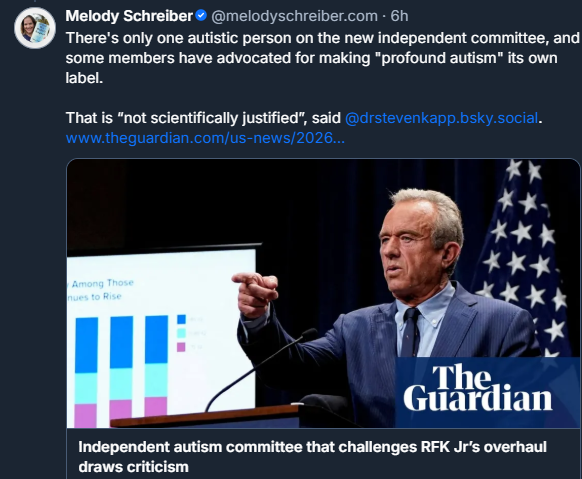
Which makes it difficult to reconcile Dr. Gordon’s participation in a splinter effort—the “Independent Autism Coordinating Committee,” a group with no statutory authority—alongside his repeated public criticism of current IACC members.
If unity is the goal, this is a curious way to pursue it. 🧐
The current IACC brings together clinicians, researchers, self-advocates, community leaders, and many with daily lived experience. Many of us provide direct care to individuals who require 24/7 support—including my own son. That level of need was not meaningfully represented in prior iterations of the IACC, nor was there sufficient progress in treatment, biological mechanisms, prevention, or causation.
After years of limited progress for many families, unity should be more than rhetoric—it should be reflected in conduct.
I welcome direct engagement, even from our most vocal critics. But repeated public attacks and unfounded accusations contribute to the very “splintering” Dr. Gordon cautions against.
@FogelSylvia Previous iterations of IACC had decades to effect change, yet they were never able to do so. Change and meaningful support for families are desperately needed.
Glad to see strong interest in the newly constituted IACC.
However, concerns about “balance” would carry more weight if the past decades had delivered meaningful progress in causality, treatment, or lifespan supports—especially for individuals with the highest support needs. As both a clinician and a parent of a child with profound autism, I hear consistently from families who do not feel that existing efforts have translated into meaningful improvements in daily life.
The charge before the IACC is to do better—advancing rigorous science while prioritizing tangible outcomes: effective treatments, prevention of the most disabling manifestations, and real-world supports across the lifespan.
As Chair, I welcome collaboration and constructive input. But I reject the claim that the current committee lacks breadth of lived experience. That assertion is simply not accurate and dismissive of the individuals serving, who collectively bring deep experience as clinicians, researchers, self-advocates, parents, and leaders of national organizations.
Our focus now should be on the work ahead. We share the goal of improving lives and outcomes—let’s not obscure that common purpose with unfounded criticism.
https://t.co/bK50TJvnFX
The Interagency Autism Coordinating Committee includes three autistic self-advocates and a dozen members who are parents of children with autism, including many with high support needs. This lived experience brings urgency and purpose to the Committee’s statutory mandate under the Autism CARES Act of 2024.
The @guardian declined to clarify or correct its reporting.
@LauraCellini@SenBillCassidy@cdc@SecKennedy Yes! I wholeheartedly agree with your comments, Laura. I hope @SenBillCassidy understands how complex the dev of ASD is & doesn't discount your observations. Been studying what happened to our kids for over 25 years & still learn new things. Hope he can too!
The President’s comments on autism sparked backlash, but here’s why we should listen:
For the past six months, I have had the privilege of working alongside a team of distinguished autism scientists. These are individuals whose papers I studied for years and whose work shaped my own understanding of the biological complexity underlying autism. To now call them colleagues and friends has been one of the most rewarding and intellectually challenging experiences of my life. It’s been an incredible honor to learn from them.
Together, we have been working to unravel some of the deeper biological processes that contribute to the development of autism, processes that are rarely discussed outside scientific journals, but which are critical to any honest conversation about prevention, treatment, or care.
On Monday, the President made remarks cautioning against the use of acetaminophen in pregnancy and briefly suggested that vaccine schedules and multiple administration might be worth re-examining. The reaction was swift: medical organizations, media outlets, and political opponents rushed to dismiss the comments as reckless. But setting politics aside, the question is worth asking — might there be scientific validity to these concerns?
Autism is not simply one thing. It is a spectrum of biological and clinical subtypes: neurodivergent, profound, regressive, immune-driven, mitochondrial, neuroinflammatory, and metabolic. Each with different strengths and vulnerabilities. It’s like NYC with different neighborhoods: Manhattan, Queens, Tribeca, the Upper East Side — one city but with distinct, diverse and unique communities. To understand its rise, we need to stop lumping everyone together and start studying cohorts, and subtypes.
We also need to stop examining one factor at a time in isolation. That’s not how biology works. Real life is layered and converging: a fetus or infant may be exposed to infections, medications, clustered immunizations, nutritional deficits, environmental chemicals — all interacting with unique biology. For some children, systems have exceptional resilience and they bend. For others, exceptional vulnerability and they break.
A more honest framework acknowledges three layers:
* Primers are the background susceptibilities each of us is born with. These include genetic variations, maternal immune activation during pregnancy, nutritional status, or early environmental influences. Some children enter the world with higher resilience, others with lower thresholds for disruption.
* Triggers are events or exposures that activate those vulnerabilities. These can range from infections to toxins, from inflammatory hits to common medications.
* Amplifiers are the self-reinforcing loops that keep the system out of balance once triggered: oxidative stress feeding mitochondrial dysfunction, immune activation altering synaptic pruning, or epigenetic changes that lock in atypical developmental trajectories.
Then we can consider the following:
Correlation → “We observe a link.”
Association → “It holds up across multiple datasets.”
Contributory cause → “It fits within a plausible biological mechanism.”
Proximate cause → “It directly triggers a cascade.”
This framework does not blame one factor as a singular cause. Rather, it reveals autism as a complex process shaped by interactions across multiple biological systems, with outcomes that depend on timing, context, and factors that confer exceptional vulnerability.
Acetaminophen is one of the most widely used medications in pregnancy. For decades, it has been considered the safest option for fever and pain. But newer studies suggest the story is more complicated.
Mechanistic biology is clear. A small fraction of acetaminophen is metabolized into NAPQI, a toxic byproduct that consumes glutathione, the body’s master antioxidant. Prolonged use depletes glutathione reserves, leaving cells more vulnerable to oxidative stress. In pregnancy, this stress can spill into one-carbon and folate metabolism, lowering methylation capacity at the exact moment when fetal brain cells are undergoing rapid wiring.
Epidemiology shows a pattern. Large prospective cohorts in Denmark and Norway have reported that prolonged maternal use—often defined as more than 28 days—correlates with a 20–30% increased risk of autism or ADHD diagnoses in offspring. The Boston Birth Cohort, using cord-blood biomarkers rather than self-report, found even sharper gradients: children in the highest exposure tier had nearly fourfold higher odds of ASD compared to those in the lowest.
Subsets matter. Genetic variations in detoxification and folate pathways (e.g., GSTM1 deletions, GCLM polymorphisms, MTHFR variants) likely define which children are most susceptible. For some, brief use of acetaminophen may be harmless. For others, it may be the tipping point.
None of this proves that acetaminophen “causes autism.” But it does establish that in a subset of pregnancies, prolonged or repeated use may act as a trigger — interacting with existing primers and setting amplifiers into motion. Studies do seem to indicate that there may be an association. It can increase oxidative stress in a developing brain, and this can lead to downstream effects.
The same framework applies to vaccine administration, timing and spacing and consideration for the unique characteristics of the recipient. Vaccines are an important public health tool for prevention of serious communicable diseases, but for children with certain immune or metabolic primers, a tightly clustered set of immune challenges may function as an acute trigger. For a child with fragile mitochondria, or with inflammatory signals already in play, an immune surge may be harder to recover from.
Infants whose mothers experienced maternal immune activation or dysregulation may be primed to be more sensitive to postnatal immune responses. Once the cytokines are chronically activated to produce inflammation signals, the microglia may not prune synapses properly.
Mitochondria may send energy outside of the cell, an evolutionarily conserved metabolic reaction to stress or threat. When cells detect danger (infection, toxins, injury), they shift into a defensive mode: metabolism changes, ATP is released as a danger signal, and normal cell-cell communication is altered to prioritize survival over growth.
Again, the point is not to pit “for” or “against” but to recognize biological heterogeneity. Risk is not evenly distributed. Importantly, these triggers rarely act in isolation.
It is the cumulative and interactive effect of multiple risk factors that may be most consequential for tipping a child into the autism spectrum. Future research should be prioritized to examine the synergistic effects of the multiple exposures and timing for exceptionally vulnerable populations.
Autism research and policy need to advance. Oversimplified genetic theories and one-size-fits-all epidemiological studies have stalled progress. What we need is an approach that reflects biology as it is: dynamic, multifaceted, layered, and extraordinarily complex.
If this week’s remarks from the President open the door to that nuanced and critical conversation — to acknowledging both the suffering some on the spectrum endure and the science that explains it — then this may truly be a watershed moment.
It’s worse than that, they continue to deny the epidemic. From a policy standpoint, it’s a disaster we can’t sustain. Demand for HCBS for state/federal waivers is resulting in decades long waiting lists in some states. School districts are overwhelmed by the costs of providing specialized services. Families are struggling to afford care, many go without. The politicians, medical organizations and media that insist on this old narrative of denial hurt families and children, and they are fiscally irresponsible.
About 40% of autism cases are regressive, children lose skills they once had, revealing a biologically vulnerable subgroup.
That means some kids are more biologically fragile than others. For these exceptionally vulnerable kids, big stressors like a high fever, illness, surgery, or even a vaccine at a critical time can tip the body into regression. Parents have seen this happen over and over again.
The hopeful part is these biological processes may be modifiable. We can restore folate transport, support mitochondria function, redox activity, immune response, and correct gut dysbiosis. These types of interventions open the door to true precision care.
Amplifiers are what keep the system stuck — chronic inflammation, mitochondrial stress, redox imbalance, gut dysbiosis. These loops explain why autism looks so different across individuals: different primers drive susceptibility, different triggers, different amplifiers. Each contributing to a unique trajectory.
Triggers are the hits or stressors: infections, toxins, metabolic strain, clustered immune challenges. For a child with strong resilience, triggers may not matter. For a child with primers, even a small trigger can start the cascade. 🧵
Autism isn’t one thing. It helps to think in terms of a city with unique neighborhoods. The trajectory to development consists of a convergence of various primers, triggers, and amplifiers.
Primers are built-in vulnerabilities — genetics, prenatal factors, or immune fragility — that make a system easier to tip out of balance. 🧵
We must move beyond treating autism as a single entity in research. A systems biology approach demands that we get precise and cohort and subcohort, recognizing distinct biological signatures. Autism’s origins are multifactorial, shaped by genetic and prenatal predispositions (primers) interacting with environmental, metabolic, and immune-related triggers that can derail development. These triggers ignite cascading pathways — neurometabolic disruption, persistent neuroimmune signaling, and shifts in gut flora — that interfere with healthy brain maturation and function. Each of these trajectories is based on the unique individual and critical windows of development. #autism #biology