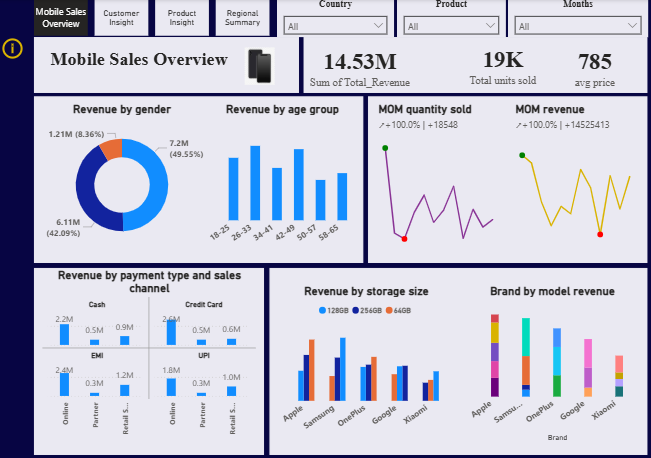
This dataset brought out the Economist in me 😁. I was able to calculate and visualise the following;
1. Month on month percentage change in revenue.
2. Month on month percentage change in quantity sold.
3. Sales Pareto by product.
4. Sales Pareto by country.
#datafam
From Monday, 19th January 2026, to today, Friday, 23rd, 2026, I had 7 interviews, and across those 7 interviews, here are the most common recruiter questions I’ve been getting this week:
Background and fit
Walk me through your CV and current role in 2 minutes.
What are your key strengths as a data professional?
Why are you looking to move now?
What does the ideal next role look like for you?
Role and company motivation
What interests you about this company and this role specifically?
Which of your recent projects best maps to what we need here?
How do you measure the impact of your work on the business?
Technical screening
What is your core stack day to day? (SQL, Python, dbt, Spark, Airflow, Power BI/Tableau, cloud)
Rate your proficiency in SQL and Python and give examples of recent use.
How have you modelled data for analytics? Star vs snowflake, facts and dimensions.
Talk me through an end-to-end pipeline you’ve built or improved.
How do you ensure data quality and reliability?
Testing, observability, monitoring
Experience with cloud platforms? (AWS Azure GCPWhat services did you use and why?
Have you worked with stakeholders to define metrics or a semantic layer?
Any exposure to machine learning or experimentation?
What was your role and outcomes?
How do you handle performance optimisation in SQL or Spark?
Experience with data governance, privacy and GDPR in practice.
Behavioural and delivery
Tell me about a time you managed conflicting stakeholder priorities.
Describe a tough data problem you solved under time pressure.
A project that didn’t go to plan and what you learned.
How do you plan work, estimate, and communicate risks?
Example of influencing non-technical stakeholders to drive a decision.
Product and business impact
Which KPIs have you owned or improved?
By how much and over what timeframe?
How do you choose the right metric and avoid vanity metrics?
Example where your analysis changed a roadmap or saved costs.
Ways of working
Preferred working style and team setup.
Individual contributor vs mentoring.
Experience in Agile.
Ceremonies you participate in and how you handle sprint goals.
Collaboration with engineering and product.
Handover and documentation habits.
Practicalities and eligibility
Right to work in the UK and any need for visa sponsorship.
Security clearance status or eligibility if applicable.
Willingness to commute, preference for hybrid work, and tolerance for travel.
Notice period and earliest start date.
Salary expectations in £ base plus bonus and benefits.
Openness to bands.
Contracting vs permanent preference.
Track record and references
Which achievements are you most proud of and why?
Who could speak to your recent performance and in what context?
Closing checks
Where else are you interviewing and how far along are you?
What would make you accept an offer and what would be a red flag?
Do you have any upcoming time off we should be aware of?
i want to marry into a functional family... the kind with cookouts, game nights, holiday dinners, and birthday parties. i want breakfast dates with my mother-in-law, shopping trips with siblings, a life that feels shared and warm. i don’t want it to be just "US" i want a family that’s truly family oriented
Most people are playing the wrong game.
They wake up.
They do their job.
They collect the paycheck.
They scroll at night.
Repeat.
After years of coaching ambitious professionals, I have realised that the ones who actually move forward aren't working harder.
They're working differently.
They are thinking differently.
They're asking the hard questions.
They know that ‘normal’ won’t bring them extraordinary results.
They know that if they are to succeed, they must have the right information.
The right information that tips the scale in their favour.
They know that what they know matters.
They know that who they know matters.
They know that opportunities will not be created for them if they are not willing to become creators themselves.
They pay attention to the future and think in terms of ‘years’.
They ask meaningful questions and are not afraid of the answers they’d get.
They don’t chase trends, promotions and the next best thing because it’s fancy to have.
They chase because it is anchored with their purpose.
They also know that when they experience disappointments, it is the season and with everything else, ‘this too shall pass’.
Your career isn't something that happens to you; it's something that you make happen.
You build it deliberately and intentionally, with full awareness.
Make Sense?
Go and be fantastic today.
Grow here. Go further.
We’re excited to welcome our 2025 graduate trainees as they begin a journey of learning and impact. We are committed to helping them grow in ways that turn their success into our clients’ advantage.
Join us in welcoming them.
#GrowHereGrowFurther
People mock what they don’t understand.
Last year, I dressed like my miracle, even made a paper boarding pass with my name on it, acted in faith, and waited on God. It was funny, and I probably looked mad because I was dressed in a winter jacket in my room, holding a travel box.
I was expecting responses from several schools, the most competitive one called me for an interview that finally got me in hours after my boyfriend sent an email affirming faith that I got into that particular school with funding. Guess what, I got into that same competitive school. Sitting down to write that email at midnight must have seemed foolish at the point.
But the same faith that looked foolish then is the same faith that brought me here today.
Because “faith without works is dead.” (James 2:26)
Sometimes, “the work” is acting like what you’re praying for is already done.
“Faith is the substance of things hoped for, the evidence of things not seen.” (Hebrews 11:1)
We forget that Abraham was called crazy until Isaac came (Romans 4:18–21).
Noah looked stupid until the rain started (Genesis 6:22).
Hannah was mocked until Samuel was born (1 Samuel 1:19–20).
The woman with the issue of blood didn’t wait for an instruction; she touched His garment and was healed (Mark 5:27–29).
So yes, I’ll do it again this year Hallelujah Challenge. I’ll dress like my miracle because I’ve seen what faith can do when it’s backed by preparation and belief.
And before you call it delusion, remember: “Blessed is she who believed that the Lord would fulfil His promises to her.” (Luke 1:45)
Faith doesn’t always look logical, but it’s never wasted. You can’t mock what you’ve never tried to understand.
And for those who say they can’t take Christianity seriously, maybe it’s not because faith is unserious. Maybe it’s because they’ve never seen the power of belief beyond logic.
That’s fine.
Some of us have seen it, and once you’ve tasted and seen that the Lord is good (Psalm 34:8),
You stop explaining faith, you start living it.
Let me explain the difference between traditional and Western medicine with this pepper soup issue.
Let's say a Western scientist heard this rumor. They'd immediately conduct a study with peppersoup and check if it's correct.
Now let's say they actually found a positive result, i.e, it actually worked, they wouldn't stop there.
They'd reason that surely it can't be the whole pepper soup that's responsible for the effect they're seeing. I mean, first of all, pepper soup is almost entirely water. So what is it? Is the meat? Is it the spices?
So they'd split their study into groups. Some would be fed only the meat, some, only the actual soup.
Let's say the soup group came back positive; they still wouldn't stop there. Surely there are over half a dozen spices in pepper soup. Either it's one of those spices that's causing the effect, or the spices are interacting to cause that effect.
So they'd split up the groups again and cook different kinds of pepper soup, omitting each ingredient each time.
Let's say they did this for a while, and then discovered that the effect only persists when three particular spices are combined and boiled. They still wouldn't stop there.
They'd start studying the chemical properties of those spices before and after they've been cooked. What compounds are in one but not the other?
MEANWHILE, while all of this is going on, there would be another research group trying to analyse what actually happens when women are taking this pepper soup. What happens to their blood pressure? their heart rate? What about their blood lipids?
There would be groups taking blood and adding pepper soup to that blood, and looking at it under the microscope.
All these different groups would be firing papers at one another.
Usually, what this leads to is the isolation of a single compound that was actually responsible for the effect THE ENTIRE TIME.
Then once we have the compound, we can start studying its properties, using the research from the peppersoup blood guys. Does this thing accumulate in the bloodstream? Does it trigger immune responses or cause inflammation? Does it degrade into a known dangerous chemical? Does it trigger cancerous cells? That's how we understand all the known side effects.
And the funniest thing is that this compound may also appear in another random place. Like maybe it also comes out as a waste product when refining petrol or some shit.
Then, since we have the compound, we know how it works, and we know it's a byproduct of an industrial process, we start setting up a factory to mass-produce it for the public.
After all this, we have gone from
> Drinking pepper soup to flush things.
to
> Taking a single pill that's 100x cheaper and 100x more concentrated and effective, to do the same thing.
A layman could look at this and be like, "Why the hell are these people using waste product from refineries to us as drugs?" but they wouldn't get it.
They just wouldn't get it.