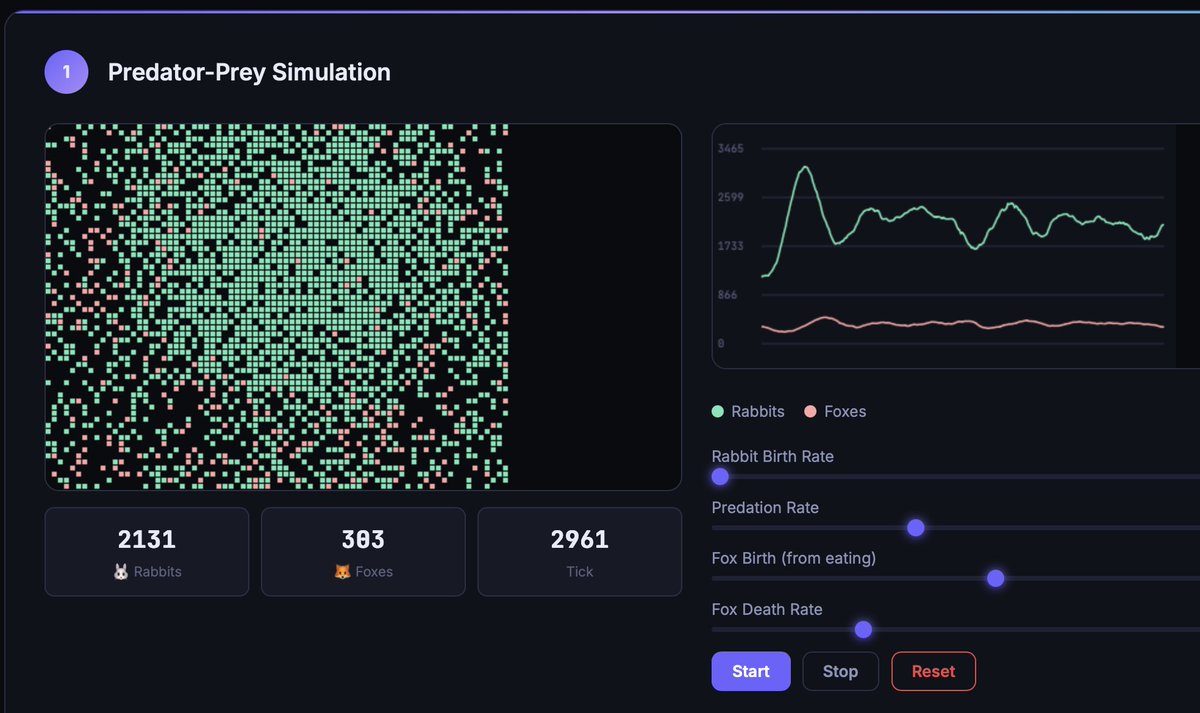
We're happy @appy_ai to support HTML output!
HTML has become my go-to format to present results internally, the format is much more human friendly.
Share interactive and visually organized deliverables with your team.
Check out some examples 🧵
This works really well btw, at the end of your query ask your LLM to "structure your response as HTML", then view the generated file in your browser. I've also had some success asking the LLM to present its output as slideshows, etc.
More generally, imo audio is the human-preferred input to AIs but vision (images/animations/video) is the preferred output from them. Around a ~third of our brains are a massively parallel processor dedicated to vision, it is the 10-lane superhighway of information into brain. As AI improves, I think we'll see a progression that takes advantage:
1) raw text (hard/effortful to read)
2) markdown (bold, italic, headings, tables, a bit easier on the eyes) <-- current default
3) HTML (still procedural with underlying code, but a lot more flexibility on the graphics, layout, even interactivity) <-- early but forming new good default
...4,5,6,...
n) interactive neural videos/simulations
Imo the extrapolation (though the technology doesn't exist just yet) ends in some kind of interactive videos generated directly by a diffusion neural net. Many open questions as to how exact/procedural "Software 1.0" artifacts (e.g. interactive simulations) may be woven together with neural artifacts (diffusion grids), but generally something in the direction of the recently viral https://t.co/z21CP5iQfu
There are also improvements necessary and pending at the input. Audio nor text nor video alone are not enough, e.g. I feel a need to point/gesture to things on the screen, similar to all the things you would do with a person physically next to you and your computer screen.
TLDR The input/output mind meld between humans and AIs is ongoing and there is a lot of work to do and significant progress to be made, way before jumping all the way into neuralink-esque BCIs and all that. For what's worth exploring at the current stage, hot tip try ask for HTML.
Most of the AI industry is trying to make intelligence work better on today's computing hardware.
We think that's the wrong question. The more consequential one: is that hardware the right foundation for intelligence at all?
🧵
And, as others have noted, the ability to search/anneal within the latent space may become more important anyways.
A "shotgunned" solution from a fast model may (at least sometimes) provide better token spend than one slow reasoning trajectory.
Exploration vs. Exploitation
A technically "more intelligent" model on the benchmarks is probably just dominated by a somewhat lower performing model that is faster at inference.
What matters most is the ability to align/error correct into a solution in a given time constraint regardless of "one shotting".
New Anthropic research: A global workspace in language models.
Of everything happening in your brain right now, only a tiny fraction is consciously accessible—thoughts you can describe, hold in mind, and reason with.
We found a strikingly similar divide inside Claude.
AKA “pessimistic meta-induction”
Current theories will probably be wrong because past theories were, but the convergent realist will say that they are more likely to be less wrong in each subsequent iteration.
For those baffled by @sapinker comment on elite intellectuals who believe in "miracles, magic, souls, spirits, ESP, divine providence, karma, & all the rest" I hear their arguments regularly. Here it is:
Science is not an asymptotic curve approaching reality.
Kuhn showed that science is embedded in paradigms that constantly change, not necessarily closer to truth.
Science history is littered with mistaken theories overturned by new theories.
This will go on indefinitely.
It is only a matter of time before current physics is overturned and new physics allows for miracles, magic, souls, spirits, ESP....
In the 1890s physicists thought nearly everything was explained down to the 6th place after the decimal point.
Then came Einstein, Quantum Physics, etc.
Some of the "alternative theories" of physics floating around today may show these phenomena are real.
So it's not only okay to believe these mysteries are real, it's a signal that you are an intellectual sophisticate.
I explain why this is wrong in Truth:
On @appy_ai the creation, viewing, hosting, and publishing of the HTML output all occurs within a controlled environment allowing for quick iteration.
https://t.co/JLPsayO8YM
We're happy @appy_ai to support HTML output!
HTML has become my go-to format to present results internally, the format is much more human friendly.
Share interactive and visually organized deliverables with your team.
Check out some examples 🧵
This works really well btw, at the end of your query ask your LLM to "structure your response as HTML", then view the generated file in your browser. I've also had some success asking the LLM to present its output as slideshows, etc.
More generally, imo audio is the human-preferred input to AIs but vision (images/animations/video) is the preferred output from them. Around a ~third of our brains are a massively parallel processor dedicated to vision, it is the 10-lane superhighway of information into brain. As AI improves, I think we'll see a progression that takes advantage:
1) raw text (hard/effortful to read)
2) markdown (bold, italic, headings, tables, a bit easier on the eyes) <-- current default
3) HTML (still procedural with underlying code, but a lot more flexibility on the graphics, layout, even interactivity) <-- early but forming new good default
...4,5,6,...
n) interactive neural videos/simulations
Imo the extrapolation (though the technology doesn't exist just yet) ends in some kind of interactive videos generated directly by a diffusion neural net. Many open questions as to how exact/procedural "Software 1.0" artifacts (e.g. interactive simulations) may be woven together with neural artifacts (diffusion grids), but generally something in the direction of the recently viral https://t.co/z21CP5iQfu
There are also improvements necessary and pending at the input. Audio nor text nor video alone are not enough, e.g. I feel a need to point/gesture to things on the screen, similar to all the things you would do with a person physically next to you and your computer screen.
TLDR The input/output mind meld between humans and AIs is ongoing and there is a lot of work to do and significant progress to be made, way before jumping all the way into neuralink-esque BCIs and all that. For what's worth exploring at the current stage, hot tip try ask for HTML.
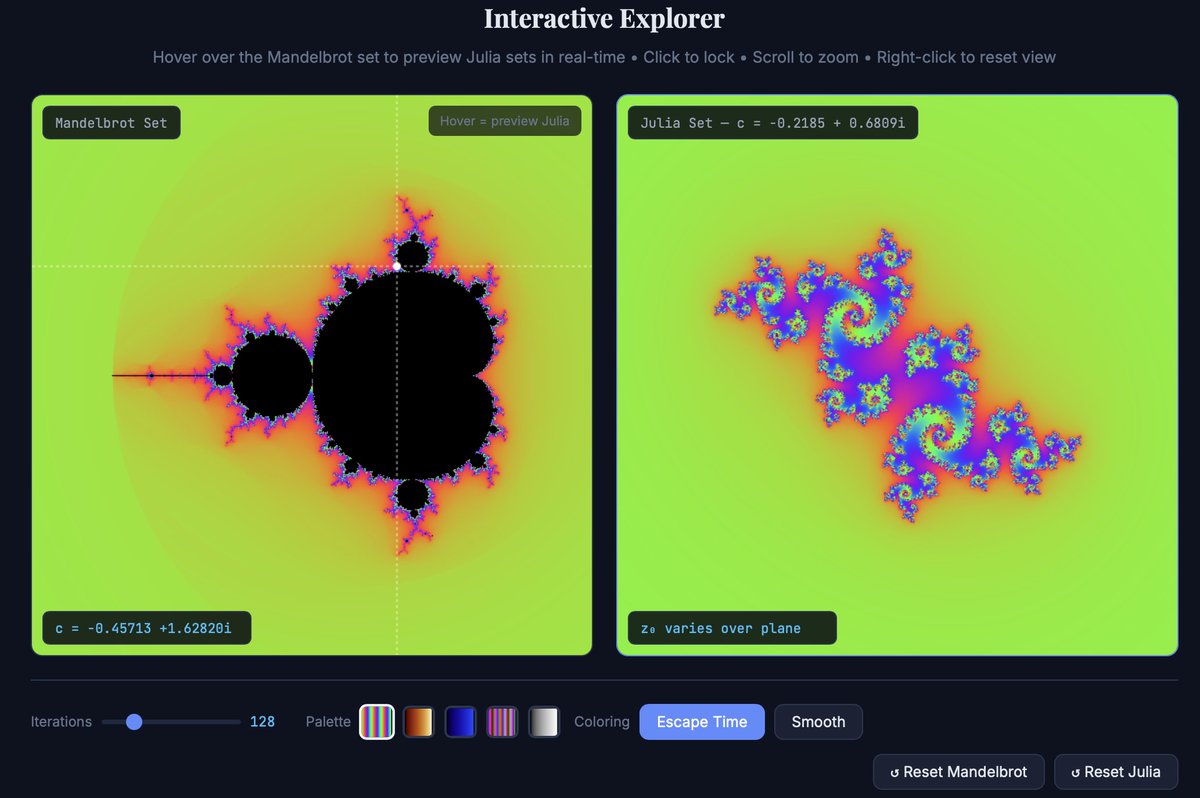
Interactive reports or essays that are bespoke and focused. Like this one on the Mandelbrot and Julia sets (fractals are pretty!)
https://t.co/Zy5WjAgdOH
The bitter lesson in 26 words:
Don’t be distracted by human knowledge, as AI has been historically.
Instead focus on methods for creating knowledge that scale with computation, like search and learning.
Sub-agents are a promising inference-time scaling primitive:
• Expand an agent's working memory
• Divide-and-conquer hard problems
• Solve problems faster with parallel execution
But how do we train a model to best take advantage of sub-agents and make sure we get these benefits?
Very excited to release RAO: Recursive Agent Optimization.
RAO is an end-to-end reinforcement learning approach for training LLM agents to spawn, delegate to, and coordinate with recursive copies of themselves (that can themselves spawn other agents) - turning recursive inference into a learned capability.
1/10
We really need a better word for the good kind of AI psychosis, the one where someone goes into a fugue state with the latest model and returns 40 days later from the mountaintop with something new.
@bcherny@realsigridjin Can you say more please? I would think that regardless, temperature impacts behavior.
Are you saying that thinking just dominates whatever behavior effects would be seen by adjusting temperature?