"My two are in their 40s, they're not going to have kids. I won't go into one of them. That's not gonna happen. So the line is burnt. It's burnt. It just burned down" - Keith Hernandez
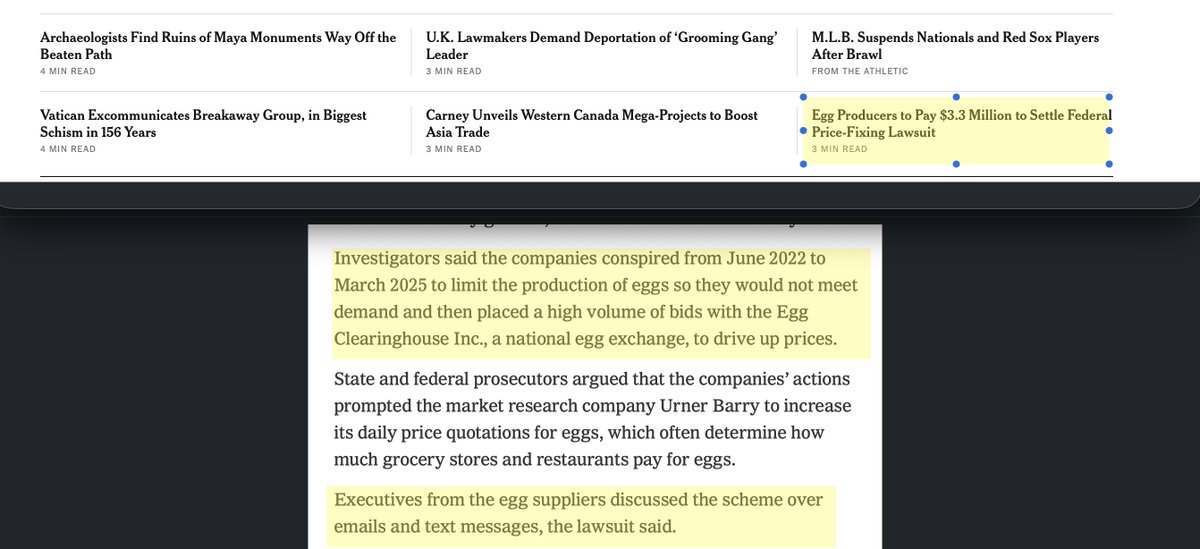
It turns out the great egg price increase that helped topple Joe Biden's presidency was <checks notes> due to an alleged conspiracy among egg producers to artificially increase prices and the coverage of that fact is a blink-and-you-miss-it story on the NYT website 🙃
Whats strange about soccer: It employs absurd mathematical precision to police offsides, a rule that mostly matters in spirit rather than in strict application. (You just don't want cherrypicking) But its extremely casual about timekeeping, whose literal application matters a ton
The screen dilemma is all downstream of some pretty critical parenting missteps including some combo (or all) of the following:
1. A TV constantly or frequently on in their presence.
2. Parents themselves turning to screens to cope with boredom or stress.
3. Kids who can’t independently play because their parents have been hovering and facilitating their play from day one.
4. An overwhelming number of toys in the house, with more showing up all the time (dopamine spike then drop).
5. Closed-end toys that don’t force imagination.
6. Introduction to modern media that is way too overstimulating (see point 1).
🍁 🍁🍁🍁🍁
Monsanto wanted its growth hormone in every glass of Canadian milk. One government scientist stood in the way and his own bosses spent 14 years trying to destroy him for it.
His name was Dr. Shiv Chopra.
Born in India, 1934. Came to Canada in the 1960s. PhD in microbiology. Senior scientist at Health Canada's Bureau of Veterinary Drugs. 35 years reviewing drug applications. Approve the safe ones. Reject the unsafe ones. Protect the public.
For 20 years he did it quietly.
Then Monsanto came knocking.
A new drug. Bovine growth hormone. Brand name Posilac. Inject it into dairy cows, get 10-15% more milk. Bigger profits for the industry. Far bigger profits for Monsanto. The FDA had rubber-stamped it in 1993. Monsanto expected Canada to follow.
The file landed on Chopra's desk.
He started reading the science. He started finding holes.
The data was thin. Long-term safety studies were missing. The cow studies that did exist showed lameness, mastitis, reproductive failure, shortened lifespans.
If it was doing that to the cow, what was it doing to the milk?
His recommendation: reject it. Demand real safety data.
His managers had a different idea.
Approve it. The Americans approved it. Why are you holding it up? Just sign off.
He refused.
So the pressure started. Closed-door meetings. Attempts to pull the file and hand it to someone friendlier. Gag orders don't talk to the media, don't talk to anyone. Suspensions. Reprimands. Demotions. Dead-end reassignments.
He kept refusing.
Two other scientists refused with him. Dr. Margaret Haydon. Dr. Gérard Lambert. Same data. Same alarm. Same answer.
In 1998 the Canadian Senate launched an investigation into what was happening inside Health Canada.
Chopra and his colleagues did something almost nobody does. They walked into the Senate and testified under oath. Said managers were pressuring them to approve unsafe drugs. Said industry was running the regulator. Said the system was broken.
It made headlines around the world.
In 1999, Health Canada rejected Monsanto's application. rBGH would not be approved. Europe banned it next. Then most of the developed world.
Sit with that. One immigrant scientist in Ottawa beat one of the largest chemical corporations on Earth — and won.
Then his own government fired him for winning.
July 14, 2004. After 35 years of service, Health Canada fired Chopra, Haydon, and Lambert on the same day. Official reason: insubordination. Real reason: he embarrassed them in front of the country.
The same year, the Prime Minister mailed him a gold watch for "illustrious service." While they were firing him. He called it comedy.
He sued to clear his name. The fight took 13 years. He lost appeal after appeal. The final ruling came down in 2017. Three months later, in January 2018, he died. 83 years old. Never reinstated. Never given his pension back. Never owed an apology by anyone.
But here is what they could never take back.
rBGH is still banned in Canada today. Every glass of Canadian milk is still hormone-free — because one man refused to sign.
And the United States? Never banned it. It's still legal there. Right now.
He kept it out of Canada and they fired him. The system he fought is still pouring it into glasses across the border.
So tell me below was Shiv Chopra a hero, or just a troublemaker who got what was coming to him? Pick a side. Because someone in those meetings is still telling scientists to "just sign off."
Elon Musk held up a chainsaw, fed USAID into the wood chipper, and at least 600,00 people have already died as a result - two-thirds of them children.
History's first trillionaire.
@steven_huyck@JoyceCarolOates Ah, my mistake, I got him and Truman mixed up
Though I’m not sure Eisenhower would disapprove of a US government trying to overthrow other countries (specifically Iran) and weep as you suggest
@steven_huyck@JoyceCarolOates The guy who dropped two atomic weapons on people? His heart and every other part of his being deserved to be crushed into paste
Two math olympiad champions wrote a training manual in 1993 on two old Macintosh computers, and every American kid who has won a major math competition in the last decade learned to think from it.
Their names are Sandor Lehoczky and Richard Rusczyk. The book is called The Art of Problem Solving. Most people in math know it as AoPS.
Since 2015, every single member of the US International Math Olympiad team has been an AoPS student. Not most of them. Every one.
That statistic sounds impossible until you understand what the book actually does.
Lehoczky and Rusczyk were not professors. They were competitors. Lehoczky earned the sole perfect AIME score in 1990 and led the national first place team. Rusczyk was a USA Mathematical Olympiad winner and a perfect AIME scorer in 1989. They had both survived the same brutal selection process the book was designed to train students for.
And the first thing they decided was that almost every existing math textbook was teaching the wrong thing.
School math gives you formulas. You memorize them. You apply them. You pass the test. Then you sit down in front of a real competition problem and the formula does not apply, and you have nothing underneath it.
That is the gap. The gap is not knowledge. It is thinking.
The entire premise of AoPS is that problem-solving is a transferable skill, not a bag of memorized tricks. A student who genuinely understands why a technique works can adapt it, combine it with something else, and deploy it in a context they have never seen before. A student who only memorized the technique freezes the moment the problem looks different.
The book teaches the difference between a formula and a method.
A formula tells you what to compute. A method tells you how to see. The students who win olympiads are not the ones who know more formulas. They are the ones who have trained themselves to look at an unfamiliar problem and recognize its structure. To see that this problem is secretly asking the same question as a problem they solved three weeks ago, just dressed differently.
Rusczyk calls this "learning to read the problem." Not reading the words. Reading what the problem is actually asking underneath the words.
The second thing they built into the book is tolerance for being stuck.
Most students treat confusion as a signal to stop. The book treats confusion as the starting point. Every chapter pushes students past the point where the obvious approach runs out. That moment of running out is not failure. That is where the actual thinking begins.
Lehoczky once described it this way. If you can solve a problem quickly, you are not learning. You are performing. Learning only happens when you are past the edge of what you already know.
The book was written on old Macintosh computers in 1993. Rusczyk launched the AoPS website in 2003. Today the community has over one million users. Thousands of students enroll in AoPS online courses every year. Most winners of every major American math competition are AoPS alumni.
A platform built by two kids who were good at math competitions has become the infrastructure that produces the next generation of mathematicians, engineers, and scientists who are good at thinking.
The formulas you memorized in school will eventually be obsolete.
The thinking you trained will not.
What is one problem in your life right now that you have been avoiding because you do not yet know the right formula to solve it?
There is a documented phenomenon in
CPTSD research called "betrayal trauma theory," developed by psychologist Jennifer Freyd. It proposes that trauma caused by people on whom the victim depends for survival produces a specific kind of cognitive adaptation. The child cannot afford to know what is being done to them because knowing would threaten the attachment they require to survive. So the knowing gets blocked. Not as a choice. As a survival mechanism.
If we are going to call the cost of public services a “loss,” then Canadian police forces lost $20 billion last year while delivering no birthday presents and also killing a lot of people.
This is absurd
You mean to tell me i can create a corporation that owns one square foot of land and it gets a vote?
How many times would I get to do that?
100? 1000? 20000?