Daily geopolitics decoded with history & spiritual insight (incl. timeless & channeled wisdom).
-- Think of life’s spiritual dimension first each morning --
If you let the map of clubs and photographs open a little wider, this fight is older than this week’s table.
In 1998 the rich industrial countries invited Russia in and called themselves the Group of Eight — a prize meant to say the Cold War was over.
In March 2014, after Russia seized Crimea, those same governments met at The Hague and threw Russia out. They cancelled the Sochi summit Putin had been planning to host and posed again as seven.
The “family photo” has been the ritual ever since: who stands in the line, who is cropped. Monday in the North Carolina mountains was that ritual in miniature.
Washington wanted the guest back in the frame. Europe would talk, even scold him in the room, and still would not stand next to him for the camera.
The war in Ukraine did not pause for the group picture.
Now let's keep a little more sky over the protocol, and the law underneath the photo is simple:
The law of affinity says you can only remain, for long, in company that matches your inner state.
A photograph is a claim that the company matches. Europe would not make that claim.
The law of free will says no one may coerce another soul or another people and then treat the act as a booking error.
“Can two walk together, except they be agreed?” is the old line from Amos.
They can sit at the same table. Agreement is a different thing.
The law of harmony adds the cost: what breaks the whole eventually presses back on the breaker.
A chair left empty is not kindness. It is the group saying the frequency has not changed.
The empty chair is the whole meeting.
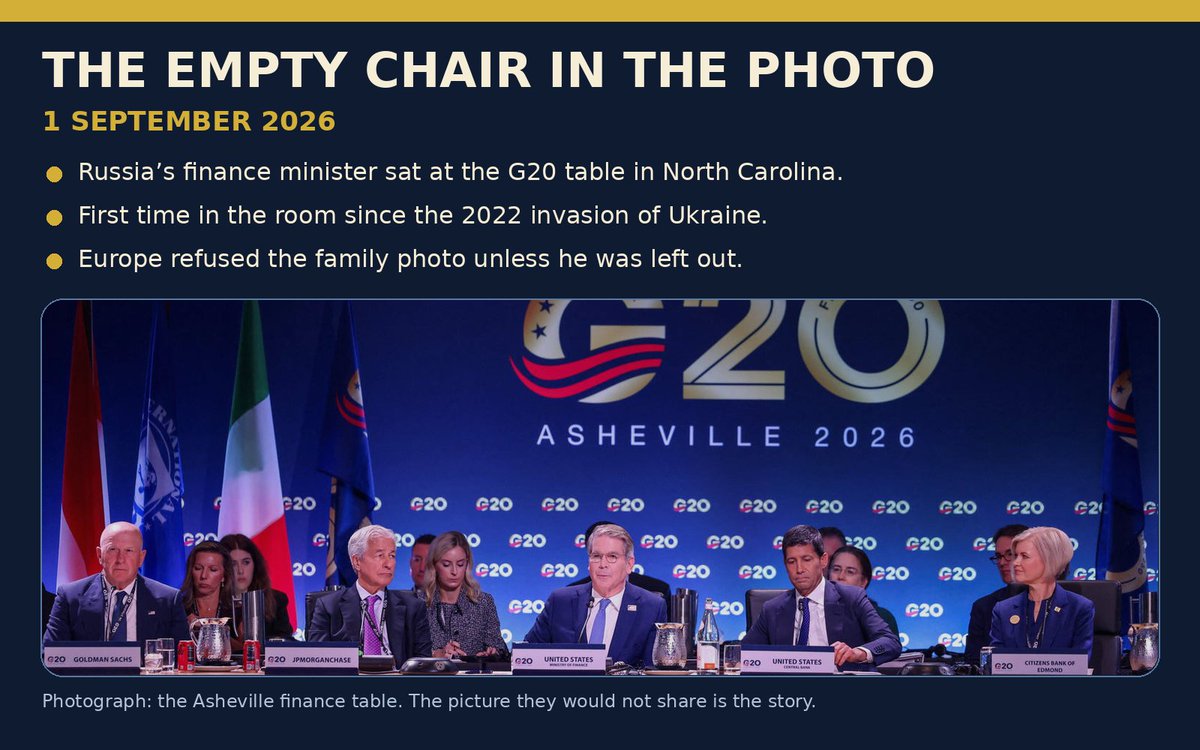
Russia’s finance minister sat at the G20 table in Asheville, North Carolina — first time in the room since the 2022 invasion of Ukraine.
Europe refused the family photograph unless he was left out. The picture was taken without him.
Germany’s finance minister, Lars Klingbeil, said: “You cannot simply return to normality.”
If you widen the frame from Istanbul to the same belt of map in 1955, you meet the last club that tried this sentence.
That year Turkey, Iraq, Iran, Pakistan and Britain signed the Baghdad Pact, later called the Central Treaty Organisation.
Washington blessed it.
The promise was collective defence against the Soviet Union. Iraq walked out after its 1958 coup. Iran walked out after 1979.
The paper outlived the trust.
What remains of that story is not “never ally.” It is: a mutual-defence sentence is only as strong as the quarrel you have not yet had with one another.
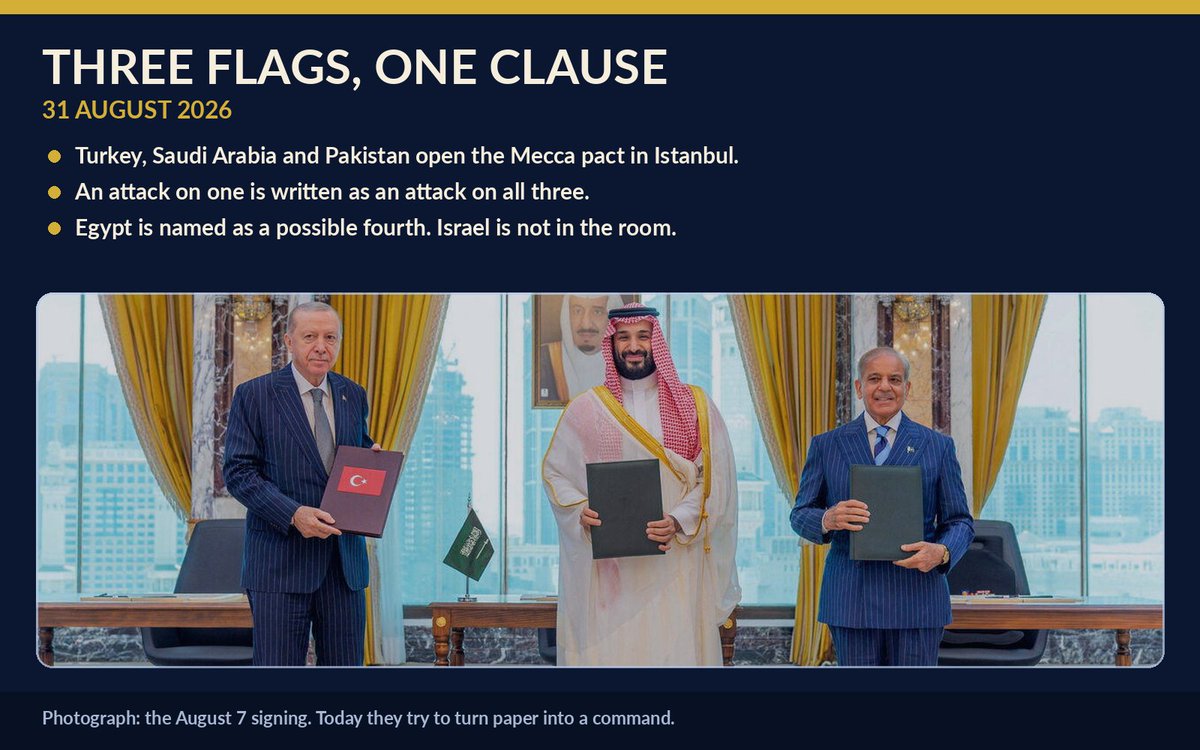
Today they gave the new paper a name — the Mecca Defence Alliance —, put a secretariat in Riyadh, and handed Pakistan the first three-year secretary-general.
They still did not say when an attack on one becomes an attack on all.
Turkey already has a live quarrel with Israel over the Abu al-Duhur airfield in Syria. Saudi Arabia still buys its heavy security from Washington. Pakistan brings a nuclear arsenal and a long habit of playing several tables at once.
The clause is clean. The office is new. The friendships are not.
If you let the spiritual layer sit beside the clause for a second, two old lines pull in opposite directions — and both are honest.
The Quran says, “Prepare against them whatever you are able of power,” and in another place, “Hold firmly to the rope of God all together and do not become divided.”
The Psalms answer from the other side of the same fear: “A king is not saved by his great army; a warrior is not delivered by his great strength.”
The law of free will still sits over every pact: no capital can sign away another people’s choice, and no paper can make three wills into one.
The law of compensation sits under it: harm packed into a “defence” still comes back in kind.
You can respect a country for wanting not to stand alone. You do not have to confuse a new letterhead with safety.
Three U.S. allies just wrote “an attack on one is an attack on all” — and left Israel outside the door.
Foreign ministers, defence ministers and army chiefs from Turkey, Saudi Arabia and Pakistan met in Istanbul today. It was the first working session of the Mecca Joint Defence Agreement they signed on 7 August.
The clause copies the North Atlantic promise: hit one, you have hit three. Egypt is being named as a possible fourth.
The Iran war is why they signed. Turkey’s quarrel with Israel over a Syrian airfield is why the room is not simple.
If you let the calendar run backward from this Berlin ward, you land in a Mayo Clinic corridor in 1948.
Philip Hench gave a handful of patients with the same joint disease a new laboratory adrenal steroid later named cortisone — a near-twin of the body’s own cortisol.
People who had been carried in walked out. Newspapers called it a miracle.
Within two years Hench had a Nobel Prize — and the same patients were swelling, breaking bones, and sliding into new kinds of illness from the drug that had freed them.
The lesson was not “never try.” It was: a reset that looks clean in month one still has to live in year five.
Today’s cell drip is a different tool. It tries to wipe the immune memory that keeps making the wrong antibodies, then let a younger set of cells grow back.
That is why three quiet patients matter — and why six is not yet a law of nature.
If you also sit with the inner question the trial is asking, it is about memory that will not let go.
The law of compensation says harm has to be balanced; the law of cause and effect says the consequence is already inside the act.
An immune system that attacks its own joints is a body keeping a grudge it no longer needs.
The Gospel of Thomas puts it without a clinic: “If you bring forth what is within you, what you bring forth will save you. If you do not bring forth what is within you, what you do not bring forth will destroy you.”
A Course in Miracles says the same turn more quietly: “Healing is the effect of minds that join, as sickness comes from minds that separate.”
The drip does not cancel free will. It offers the body a chance to stop repeating a story.
Whether that story stays gone is still the patient’s - and time’s.
A cancer drip just switched off a joint disease that drugs could not touch.
Six people in Berlin with severe rheumatoid arthritis — the kind that keeps attacking the joints after every usual medicine has failed — each received one infusion of their own white blood cells, reprogrammed the way cancer doctors do.
All six got better. Three are still off every arthritis drug a year later.
The study is tiny.
The claim is large: What if the body has simply forgotten the war?
@TheEconomist How about stopping the bullying?
How about growing up?
How about honoring laws as fundamental as the law of free will?
People as well as countries should choose their own actions without interference.
Tax-free status is a public gift meant for real charity, not for running politics from the shadows.
Congress already faced this in 1969, when the Ford Foundation used tax-exempt money to fund a voter drive in Cleveland and travel grants for political staff — and lawmakers of both parties tightened the rules because a charity shield had become a way to govern without standing for election.
The consequence is built into the act itself; it is not revenge.
Anyone inside these groups: would you consider a U-turn?
Recover integrity.
Put the privilege back into service instead of extraction.
Tax-free status is a public gift meant for real charity, not for running politics from the shadows.
Congress already faced this in 1969, when the Ford Foundation used tax-exempt money to fund a voter drive in Cleveland and travel grants for political staff — and lawmakers of both parties tightened the rules because a charity shield had become a way to govern without standing for election.
The consequence is built into the act itself; it is not revenge.
Anyone inside these groups: would you consider a U-turn?
Recover integrity.
Put the privilege back into service instead of extraction.
If you let the map sit still for a moment and look a century back, this hall has an older cousin.
In September 1815, after Napoleon was gone, Tsar Alexander of Russia pulled Austria and Prussia into what he called the Holy Alliance. The paper spoke of Christian brotherhood and a new peace among sovereigns.
What it became, within a few years, was a club for freezing other people’s maps and sitting on other people’s revolts. The language was high. The work was ordinary power.
The Shanghai club is not a copy of that treaty. It is the same human move: when you are boxed in on one side of the world, you gather friends on the other and call the gathering a new order.
India sitting at the same table as China and Pakistan is the reminder that a hall can be full and still not be a side.
Now if you also open the inner map for a minute, the law that is working here is affinity:
You end up in the company that matches the state you are actually in, not the speech you brought.
Marcus Aurelius wrote, “That which is not good for the hive cannot be good for the bee.”
A Course in Miracles puts the same cut more sharply: “You see the world you have made, but you do not see yourself as the image maker.”
The seven spiritual laws say the same thing without the Latin: like draws like, and anything that breaks the harmony of the whole eventually presses back on the one who broke it.
A summit can still be useful. It just cannot cancel the bill that each capital brought in its own suitcase.
The table in Bishkek is full, and nobody wants to name the wars sitting on it.
Xi, Putin, Modi and Iran’s president Masoud Pezeshkian meet today in Kyrgyzstan for the twenty-fifth birthday of the Shanghai Cooperation Organisation. Erdogan is in the hall though Turkey is not a member.
Putin has packed at least nine side meetings. The two he needs most are Xi and Pezeshkian. Russia is looking east because the west has closed.
Targeting can be neat on a slide...
Fallout is not.
On 1 March 1954 the United States set off a hydrogen bomb at Bikini Atoll; the cloud ignored the map and dusted a Japanese fishing boat called the Lucky Dragon, miles outside the “safe” zone, while children on Rongelap played in the white powder thinking it was snow.
That is why, nine years later, Washington, London and Moscow banned explosions in the air: strontium-90 from those clouds was already in the baby teeth of children in St. Louis.
The common air is one body.
What is put into it comes back through everyone.
Those who treat the sky as a private firing range: choose restraint!