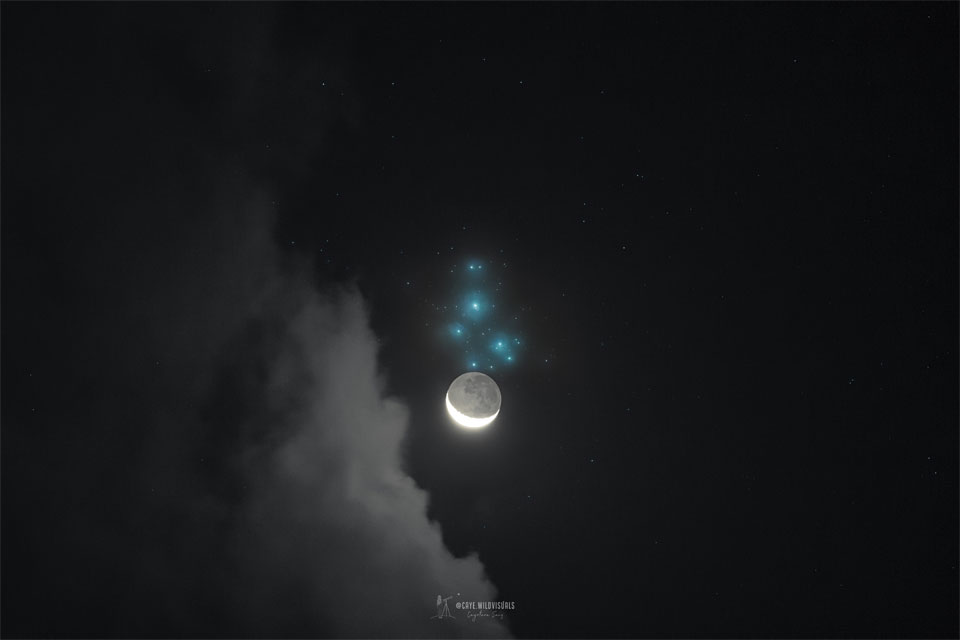
Sometimes, the Moon visits the Pleiades. Technically, this means that the orbit of our Moon takes it directly in front of the famous Pleiades star cluster, which is far in the distance. The technical term for the event is an occultation, and the Moon is famous for its rare occultations of all planets and several well-known bright stars. The Moon's tilted and precessing orbit makes its occultations of the Seven Sisters star cluster bunchy, with the current epoch starting in 2023 continuing monthly until 2029. After that, though, the next occultation won't occur until 2042. Taken from Cantabria, Spain on April 1, the featured image is a composite where previous exposures of the Pleiades from the same camera and location were digitally added to the last image to bring up the star cluster's iconic blue glow.
Image Credit: Cayetana Saiz
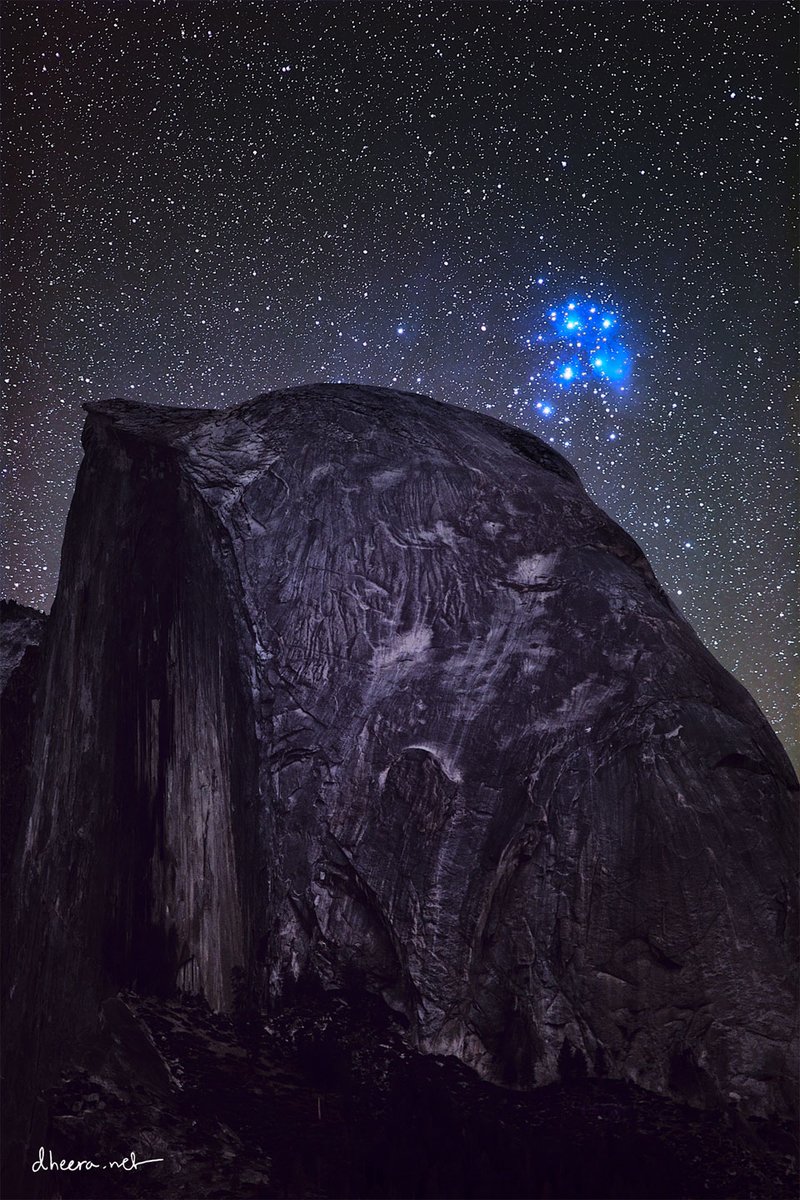
Stars come in bunches. The most famous bunch of stars on the sky is the Pleiades, a bright cluster that can be easily seen with the unaided eye. The Pleiades lies only about 450 light years away, formed about 100 million years ago, and will likely last about another 250 million years. Our Sun was likely born in a star cluster, but now, being about 4.5 billion years old, its stellar birth companions have long since dispersed. The Pleiades star cluster is pictured over Half Dome, a famous rock structure in Yosemite National Park in California, USA. The featured image is a composite of 28 foreground exposures and 174 images of the stellar background, all taken from the same location and by the same camera on the same night in October 2019. After calculating the timing of a future juxtaposition of the Pleiades and Half Dome, the astrophotographer was unexpectedly rewarded by an electrical blackout, making the background sky unusually dark.
Image Credit & Copyright: Dheera Venkatraman
It was December and the sky lit up like a Christmas tree. Shimmering, the vivid green, blue, and purple auroral colors that formed the tree-like apparition were caused by high atmospheric oxygen and nitrogen reacting to a burst of incoming electrons. Collisions caused the orbital electrons of atoms and molecules to jump into excited energy states and emit visible light when returning to their normal state. The featured image was captured in Djúpivogur, Iceland during the last month of 2023. Our Sun is currently in its most energetic phase of its 11-year cycle, with its high number of active regions and sunspots likely to last into next year. Of course, the Sun has been near solar maximum during this entire year, with its outbursts sometimes resulting in spectacular Earthly auroras.
Image Credit & Copyright: Jingyi Zhang