Survive first. Profit is what happens while you're still in the game.
Lesson 1 of our "Survive First" series — risk, manipulation, and market mechanics, every week.
Follow so the next one finds you.
— The https://t.co/FgO1OvCL6A team
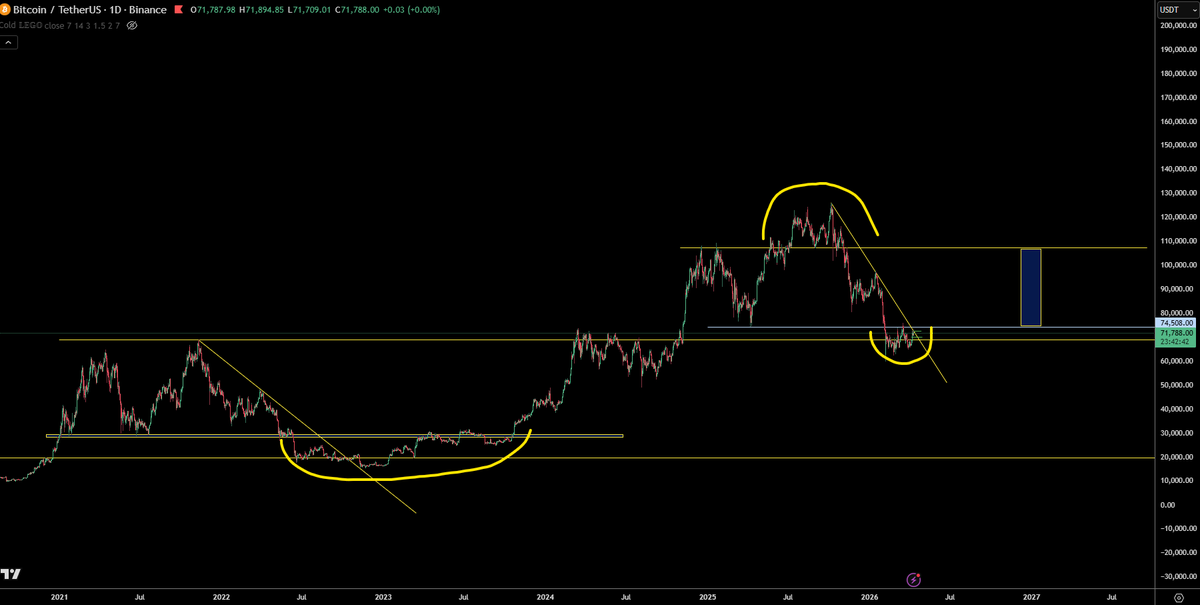
$BTC - if we deviate back within this range then i think low confirmed for a move towards 105-108k
till then this is resistance. for swing longs i will wait for a reclaim. till then short term trading within the range
covered the plans in the stream below
@trader1sz My scanner just flagged this BTC setup — 4H RSI 73 vs Daily RSI 29 Extreme Fear at 13 while taker buys hit 1.4× Two timeframes screaming opposite things at the same time. Here's every scenario with the live data 🧵
@trader1sz My scanner just flagged this BTC setup — 4H RSI 73 vs Daily RSI 29 Extreme Fear at 13 while taker buys hit 1.4× Two timeframes screaming opposite things at the same time. Here's every scenario with the live data 🧵
🔍 BTC holding $67k — correlation dropping on these coins:
Scanner fired on:
- $ONDO — decorrelated + volatility expanding
- $XXX — same pattern
When BTC is stable and alts decouple = pump window open
Live scanner → https://t.co/MS0NVaD8d5
#BTC#Binance#AltSeason
Survive first. Profit is what happens while you're still in the game.
Lesson 1 of our "Survive First" series — risk, manipulation, and market mechanics, every week.
Follow so the next one finds you.
— The https://t.co/FgO1OvCL6A team
How to size a position properly:
Position = (Account × Risk%) ÷ Stop distance
Example: $1,000 account, 1% risk, stop 5% below entry → $10 ÷ 0.05 = $200 position
Leverage only changes the margin you post, not this math. The stop decides the size. Always.
This is why professionals risk 1–2% per trade. Not position size — maximum loss if the stop hits.
At 1% risk you can be wrong 20 times in a row and still keep 82% of your account. At 10% risk, 20 straight losses leaves you 12%.
Same strategy. Different survival.
The recovery trap:
Lose 10% → need +11% to get back Lose 20% → need +25% Lose 30% → need +43% Lose 50% → need +100% Lose 70% → need +233% Lose 90% → need +900%
Losses are not symmetric. A drawdown is a hole with curved walls — the deeper you go, the steeper the climb out.
Nobody blows up a trading account because of one bad call.
They blow up because of position size.
Here's the math that should be taped to every trader's screen. Takes 2 minutes to read. Saves accounts. 🧵