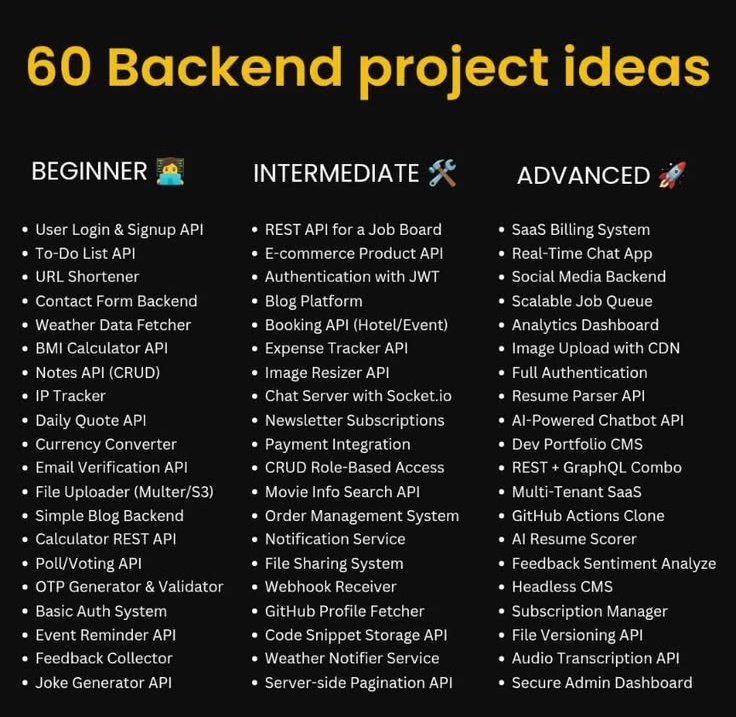
🧵 How data actually flows in the backend (most devs only know half of this)
You hit “send” on a request.
Feels instant, but between your client and the response, there’s an entire pipeline running.
Let me break it down layer by layer 🧵
All Paid Courses (Free for First 4500 People)
𝗣𝗮𝗶𝗱 𝗖𝗼𝘂𝗿𝘀𝗲 𝗙𝗥𝗘𝗘 (PART - 1)
1. Artificial Intelligence
2. Machine Learning
3. Prompt Engineering
4. Claude,Chatgpt,Grok
5. Data Analytics
6. AWS Certified
7. Data Science
8. BIG DATA
9. Python
10. Ethical Hacking
(72 Hours only )
To get-
1. Follow me to get DM
2. Like + RT
3. Reply " All "
Software engineers don't get paid to write code; they get paid to solve problems.
The faster you realize this, the sooner you'll stop being afraid that AI will replace you and the better your career will be.
Graduating from ALX Backend Engineering tomorrow 🎓
A big thanks to the ALX community for making this journey engaging.
Learned Python, Django, API development & databases, building real applications while growing consistency & problem-solving
@facesofalxse#ALX_BE#ALX_SE
I think it would help a lot of people to have a "theory" limit.
Learn, apply, learn, apply, etc.
Reading and note-taking are useful tools, but countless people stay paralyzed in a pile of books and notes.
The most memorable lessons are taught in application.
🌟📅 End of Month 2 in #ALX_BE, and I’ve started working with Django! 🧑🏽💻✨ Excited to create dynamic web applications and powerful backends using Python’s top framework. 🚀💻
What’s your favorite Django feature? Let’s chat about it! 💬👇🏽 #ALX#Django@facesofalxse
Cons of being a software engineer no one really talks about 👇
Everyone sees the salaries, WFH perks, and fancy titles.
Here’s the other side:
• Your learning never ends
If you stop learning for even 6–12 months, you start falling behind. Tech doesn’t wait.
• Mental fatigue is real
Staring at screens, debugging for hours, context switching—your brain gets tired before your body.
• You’re judged by output, not effort
10 hours of hard thinking can look like “nothing” if the feature didn’t ship.
• Imposter syndrome never fully goes away
New stack, new company, smarter peers → constant self-doubt.
• Deadlines don’t care about bugs
Management promises dates. Engineers deal with reality.
• Work-life balance depends on the team, not the role
One bad manager can ruin a “dream job”.
• Rejections hit differently
You can be good and still fail interviews because of luck, timing, or niche questions.
• Side projects feel mandatory
To grow or switch jobs, your free time often becomes “resume time”.
• AI pressure is increasing
You’re expected to be faster, smarter, and more productive—constantly.
• Your worth can feel tied to your skills
When code breaks, confidence breaks with it.
Still a great career.
Just not the “easy money” path social media sells.
If you’re choosing this field—choose it with eyes open.
127.0.0.1 is the IP address known as localhost. It always points back to your own machine. No matter where you are in the world or what network you’re on, 127.0.0.1 means “this computer, right here.”
When developers test websites, APIs, or servers, they usually run them on 127.0.0.1 first. It’s a safe, isolated environment where nothing is exposed to the internet and nothing external can interfere. If it works on localhost, then you can think about letting others see it.
So the phrase “There is no place like 127.0.0.1” is a nerdy spin on “There’s no place like home.” For developers and engineers, localhost is home. It’s where things are predictable, controlled, and forgiving. You can break things, restart them, and try again without consequences.