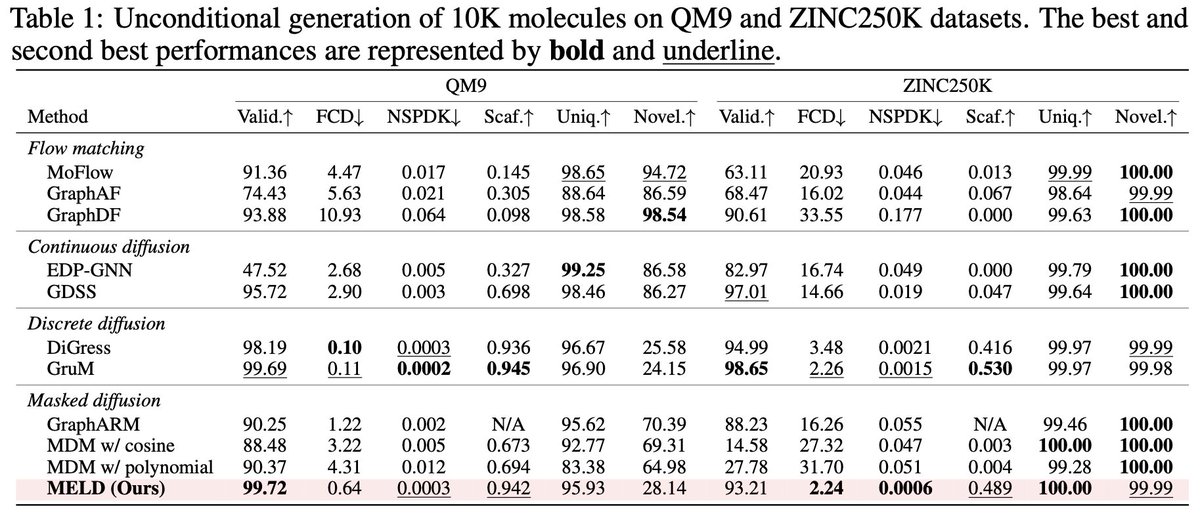
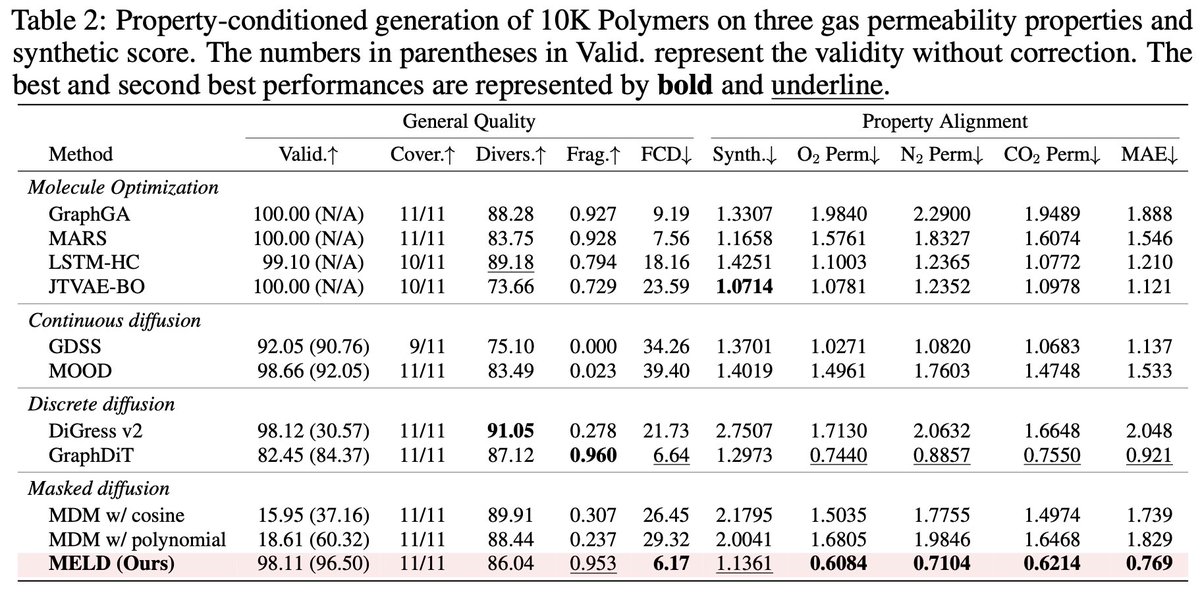
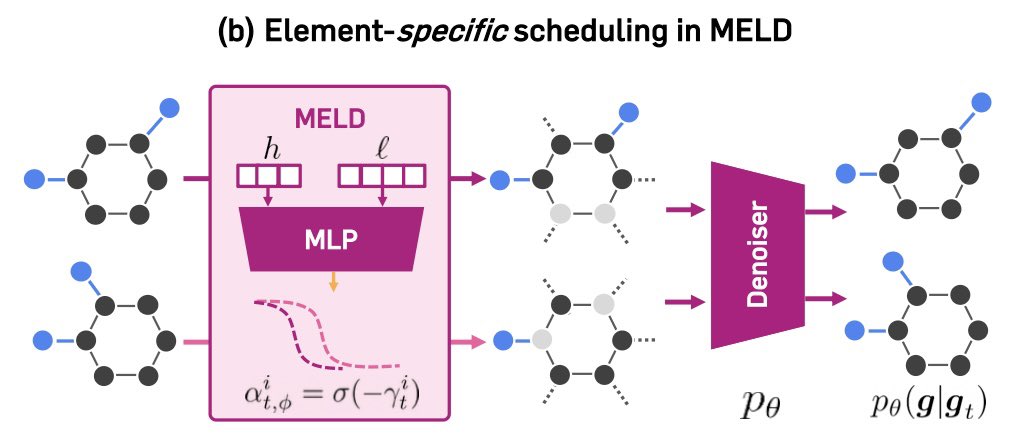
Meet MELD: a masked diffusion model (MDMs) designed for de novo molecule generation. MELD assigns per-element learnable noise schedule that tailors noise at the atom & bond level to avoid state-clashing problem. With MELD we achieve state-of-the-art property alignment in multi-conditioned generation and a >70% boost in chemical validity.
Dive in 👉 https://t.co/Ucm7z69xJU [1/7]
The BioCollection: Unified Pre-Training Scale LLM Corpus for Biology
1. Trillion Labs introduces THEBIOCOLLECTION, a 52.6B-token pre-training corpus that unifies scattered biological resources into a single, training-ready format spanning small molecules, proteins, genomic sequences, cells, and pathways.
2. The corpus converts heterogeneous biological databases into structured natural-language records, enriches them with tool-computed properties, and constructs novel instruction tasks for underrepresented capabilities like protein binding and genomic feature localization.
3. Paired with THEBIOCOLLECTION-EVAL, a matched evaluation suite covering recognition, generation, and prediction across all five biological domains plus cross-domain reasoning, the work provides a rigorous benchmark for biological language models.
4. Using the fixed Gravity-16B-A3B architecture, training on THEBIOCOLLECTION more than doubles overall biological performance with gains in every domain, while preserving general linguistic ability with minimal degradation.
5. Key innovations include tool-based enrichment with RDKit descriptors, DSSP structural features, and genomic span annotations, as well as source-derived instruction datasets for protein-ligand interface recovery and DNA/RNA exact localization.
6. Cross-domain reasoning tasks demonstrate that the model learns to chain evidence across biological levels, improving two-hop accuracy from 0.313 to 0.507 on knowledge-graph-based questions linking proteins to pathways, transcription factors to genes, and small molecules to targets.
📜Paper: https://t.co/wEris7BSWZ
#Bioinformatics #ComputationalBiology #LargeLanguageModels #BioLM #PretrainingCorpus #ProteinDesign #Genomics #DrugDiscovery #SingleCell #MachineLearning
OpenAI just launched a 3-hour course on building agentic systems from scratch:
00:00 - Building workspace agents
37:42 - Deep dive into OpenAI AgentKit
1:24:01 - Agent memory (loops, context, evals)
2:21:44 - Agentic training (OpenAI playbook)
This 3-hour watch will replace you 10 paid agentic courses.
Watch it today, then learn how to build a team of AI agents from scratch in the article below.
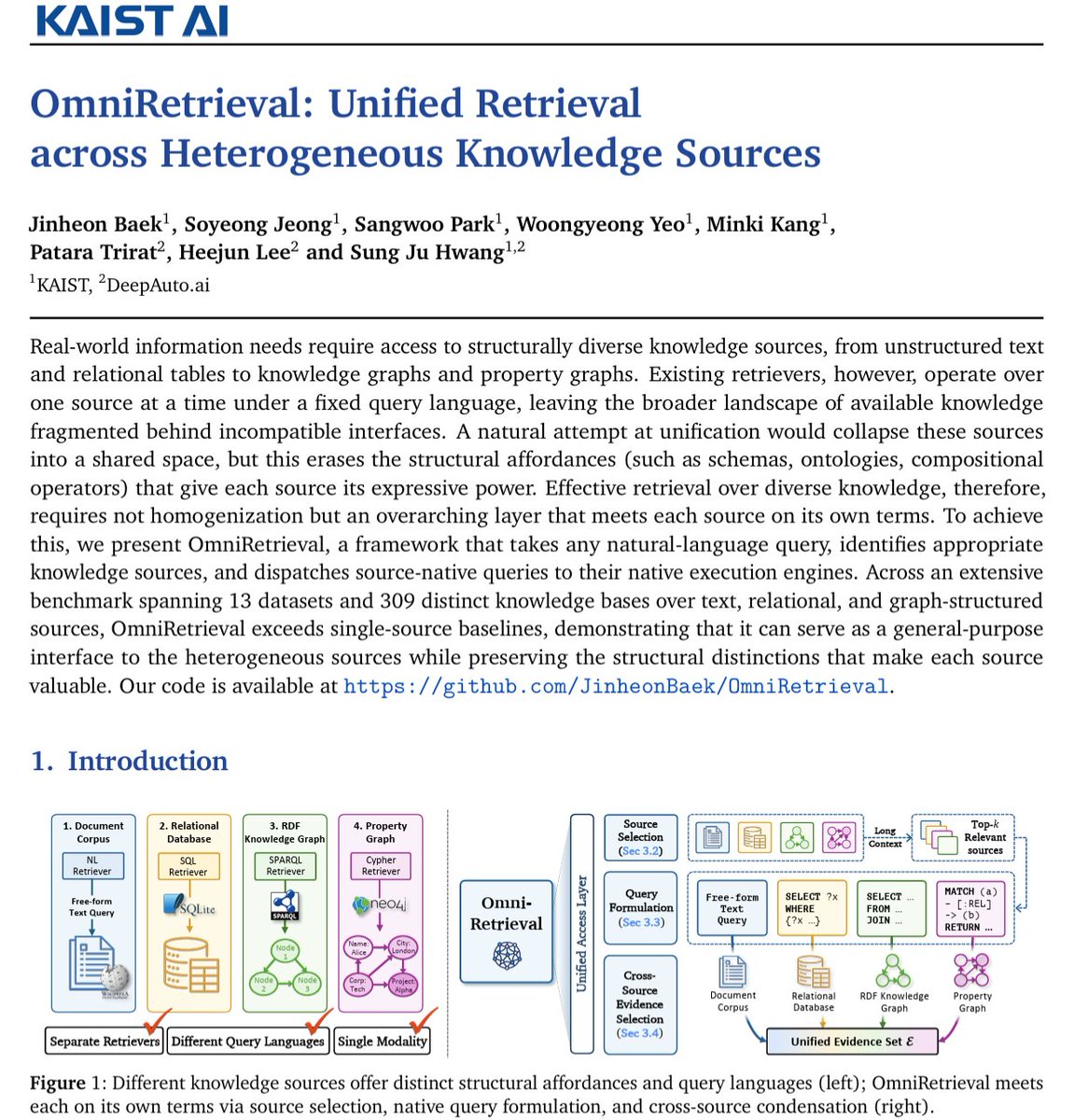
What if your retriever could speak every language your data speaks? 🌐
Your answer might live in a document 📄, a SQL table 🗃️, an RDF knowledge graph 🔗, or a property graph 🕸️, and OmniRetrieval reaches into all of them, meeting each source in its own native query language instead of flattening everything into one lossy space.
Paper: https://t.co/dI6IvBwfWW
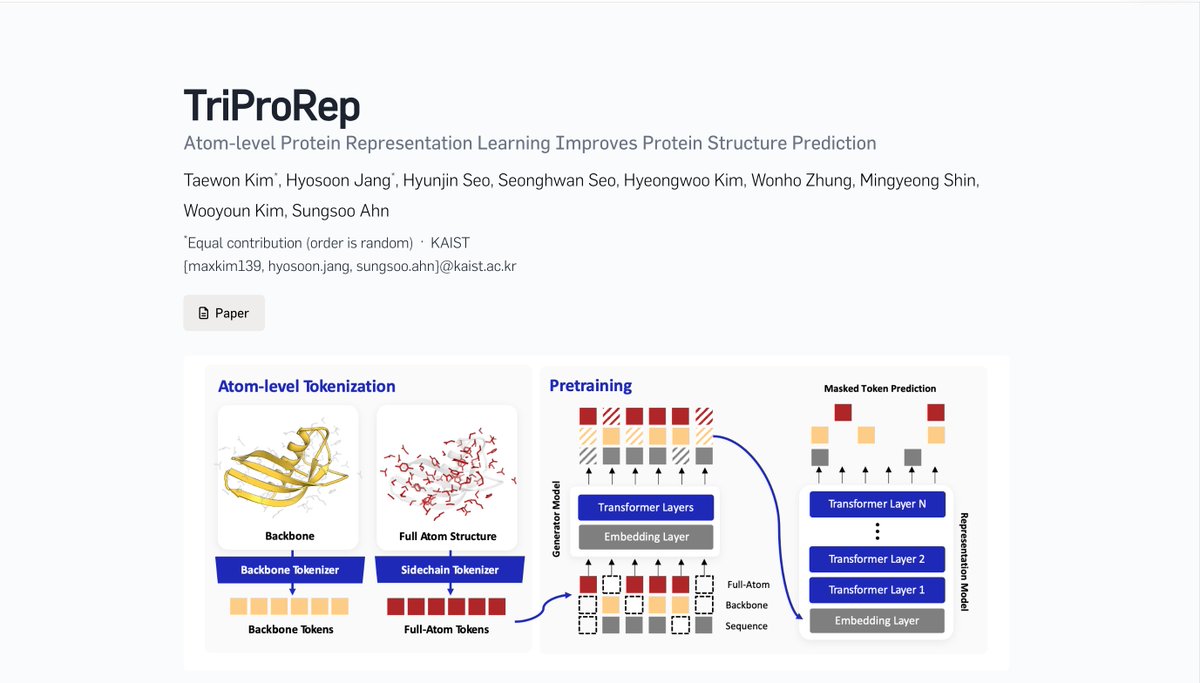
What should a structure-aware protein representation be good at?
It should provide geometric signals that structure models can use.
We introduce:
1️⃣ TriProRep: atom-level protein representations
2️⃣ REPSP: a structure-predictive benchmark
https://t.co/pFv2AdLkuM 👇 (1/9)
Vibeproteinbench: An Evaluation Benchmark for Language-interfaced Vibe Protein Design
1. VIBEPROTEINBENCH introduces a unified, language-interfaced evaluation for “vibe protein design,” where a single model must interpret open-ended natural-language intents and operate across a realistic end-to-end workflow, rather than solving isolated, schema-constrained subtasks.
2. The benchmark is organized into three connected stages that mirror computational protein design practice: Recognition (inferring properties from sequence), Rationale-guided Engineering (editing a wild-type sequence using mechanistic guidance), and Generation (creating novel sequences from functional or target-grounded specifications).
3. A key methodological contribution is “rationale-guided engineering”: each task provides expert-curated mechanistic rationales that partition residues into defective positions (allowed/required to change) and protected positions (must not change), forcing models to apply design logic instead of unconstrained rewriting.
4. Recognition tasks probe sequence–structure–function understanding via natural-language questions over: sequence-level physicochemical properties and motifs (e.g., GRAVY-based hydropathy bins, charge state, PROSITE motif spans), structure-level attributes derived from experimental structures (e.g., DSSP secondary structure and burial), and function/domain labels (e.g., ECOD, InterPro, GO).
5. Engineering tasks cover common optimization axes in practice: solubility, stability (fold stability and thermostability), and activity (including binding affinity and pocket expansion). Evaluation is multi-part: hard constraints (length preserved; protected residues unchanged; only defective positions mutated), rationale alignment (mutations follow the prescribed repair direction), and in silico validation (fold-quality gating with Protenix-v1 plus property-specific validators such as ∆∆G and docking-related checks).
6. Generation tasks cover two major “language intent” modes: (i) semantic function conditioning using GO term definitions (single MF, or MF paired with BP/CC), and (ii) binder design conditioned on explicit molecular targets (protein sequences or small-molecule SMILES), including practical lab-style constraints like miniprotein length (40–80 aa) and binding-site contact requirements.
7. The dataset construction emphasizes contamination control: a strict temporal cutoff (post 2025-09-01) for recognition and generation sources, plus literature-based filtering for engineering targets to remove proteins likely discussed in prior engineering/design papers.
8. Results across 12 LLMs show a steep capability drop along the workflow: recognition can be relatively high (best pass rate 75.3), but engineering and generation remain difficult (best pass rates 50.0 and 16.9). This suggests current models handle analysis-style prompts better than mechanistically grounded editing and functionally consistent de novo design.
9. Failure modes are diagnostic: engineering often fails at rationale alignment even when hard constraints are satisfied (some specialized models reach 100% on hard constraints yet near-0% rationale alignment). In generation, sequence validity and novelty are generally high, but functional consistency (GO match or interface validity) is the bottleneck, especially under multi-constraint prompts.
10. Cross-stage correlations support that the benchmark measures coherent underlying competence rather than unrelated quizzes (e.g., function/domain recognition correlates strongly with GO-conditioned generation, Spearman ρ up to 0.81), reinforcing the idea that robust vibe protein design requires integrated SSF understanding, mechanistic reasoning, and grounded generation.
📜Paper: https://t.co/sQcyokM7gr
#ProteinDesign #ComputationalBiology #Bioinformatics #LLM #Benchmark #ProteinEngineering #DeNovoDesign #AIforScience #GenerativeAI
This work wouldn't have been possible without my collaborators @taewonKKK@sihyun_yu@sungsoo_ahn_
Discover our paper for more details: https://t.co/pNNLcrL1KN [7/7]
Meet MELD: a masked diffusion model (MDMs) designed for de novo molecule generation. MELD assigns per-element learnable noise schedule that tailors noise at the atom & bond level to avoid state-clashing problem. With MELD we achieve state-of-the-art property alignment in multi-conditioned generation and a >70% boost in chemical validity.
Dive in 👉 https://t.co/Ucm7z69xJU [1/7]
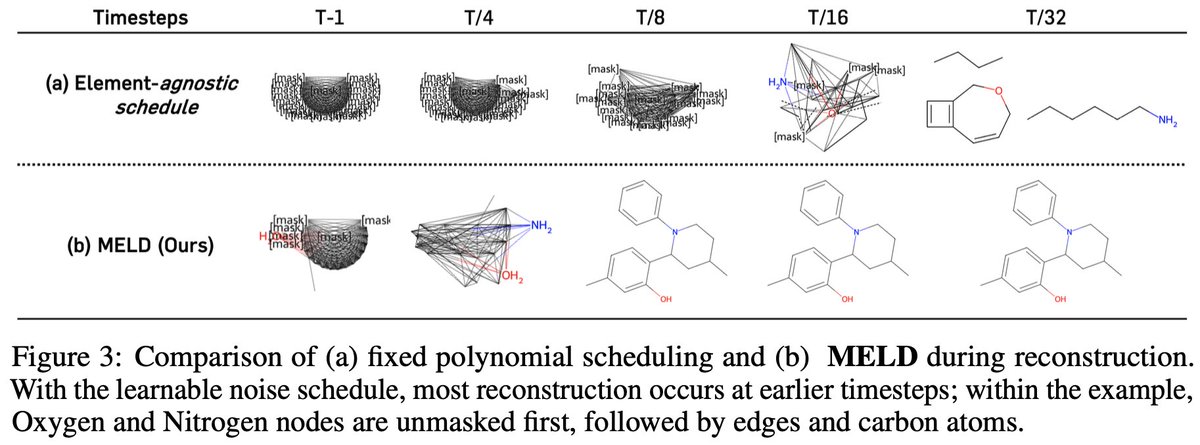
An interesting phenomenon we observed is that the learned scedule exhibits a certain hierarchy during molecule generation - where nodes precede edges. Nodes are reconstructed first, often those associated with functional groups, followed by their edge assignments. [6/7]
This simple strategy significantly enhances performance on both conditional and unconditional generation. Achieving state-of-the-art property alignment in multi-conditioned generation and nearly 70% validity improvements over naive MDMs on unconditional generation! [5/7]
With MELD, we “learn” to avoid such scenarios. By assigning different noise schedules per-element, the model learns in an end-to-end manner on how to avoid intermediate states with numerous possible parents. [4/7]
MDMs have shown impressive performance in general domains. We question, can this be extended to molecules? Interestingly, “naive” application of MDMs for molecular graphs fail miserably - due to a problem we dub: “state-clashing”. State-clashing is the phenomenon where multiple distinct graphs collapse into a single immediate state during the forward diffusion process. This makes the reverse process highly multi-modal, colliding with the unimodal nature of denoiser. [2/7]