A child of GOD 'Yes Im in the world-But Im NOT OF IT'☺ ♥MJ,MC,BRAN,STEVIE W,KCS,KIKI,JIGGA etc! MUCH♥4 Fam/Friends☺May God kp blessing us ALL!☺(Singer&Actress2)
Coco Gauff and Naomi Osaka are both off to their first career Wimbledon Quarterfinals 👏
At 22, Gauff would be the youngest American woman to complete the QF set since Serena Williams at the 2001 French Open (19).
Osaka got there by knocking off No. 1 Aryna Sabalenka, her earliest exit at a Major since the 2022 French Open.
Zohran Mamdani is leading where most politicians have failed - bold and fearless in tackling racial inequalities.
Not like the bullshit UK Tom Sewell report that denied Britain is institutionally racist. That's why it's the Sewage Report. Bravo Zohran! Carry on 👏🏾
Speak it loud.
WOW🔥: Supreme Court Justice Sonia Sotomayor publicly HUMILIATED Brett Kavanaugh in front of an entire university audience — and she didn't hold back for a single second.
Sotomayor, who grew up in a Bronx housing project, raised by a single mother after losing her father at age 9, called out Kavanaugh by name at the University of Kansas for having absolutely no clue what it means to live paycheck to paycheck.
The issue? Kavanaugh signed off on emergency orders allowing immigration agents to detain workers at bus stops, car washes, and street corners — then had the nerve to write that these detentions are "typically brief" and that most people "promptly go free."
Sotomayor wasn't having it.
"This is from a man whose parents were professionals. And probably doesn't really know any person who works by the hour," she said. "Those hours that they took you away, nobody's paying that person. And that makes a difference between a meal for him and his kids that night and maybe just cold supper."
Read that again. A missing hour of work means a child goes hungry that night. And Brett Kavanaugh — son of a lawyer, son of a judge, product of elite private schools, buddy of the man who appointed him — doesn't understand that. Can't understand that. Because he never had to.
This is what happens when you stack the nation's highest court with people who have never stood in a line at a food bank. Who have never skipped a meal so their kid didn't have to. Who have never been snatched off a street corner on the way to a job that feeds their family.
Sotomayor earned her seat the hard way. Kavanaugh was handed his amid credible allegations of sexual misconduct that his patron in the White House bulldozed through anyway.
One justice knows what poverty looks like. The other can't even imagine it. And yet they have equal votes on the future of millions of working Americans.
That's not justice. That's a rigged system wearing robes.
LIKE AND SHARE if you stand with Sonia Sotomayor — a woman who never forgot where she came from.
Rihanna grew up in poverty in Barbados, often going to school with worn-out shoes and sometimes walking barefoot when they broke. One of her teachers, Miss Roberts, quietly bought her a new pair with her own money and never told anyone. Rihanna later said she cried wearing them. Years later, after becoming a global superstar and billionaire, she reportedly learned Miss Roberts was retired and struggling. She bought her a house and continues supporting her with monthly financial help. A simple act of kindness became a lifelong circle of gratitude and love.
A big night at Old Trafford awaits ✨
Our #MUAcademy U21s take on Real Madrid Castilla in the #PL International Cup quarter-finals!
Coverage starts from 18:55 BST, live on #MUTV ⤵️
Shuffle just went from my beloved 'stranger in Moscow' to playing 'sI can't help it' from my also beloved Stevie Wonder written, #MJ 's #offthewall🥰 #histalent..😍
Eternally MYSTIFIED how some people do not realise that musically he is theeee GOAT❣
Michael Jackson is one of the most extraordinary star of recent history. His live performances without any lip-syncing are unbelievable, and his voice without any instruments is simply extraordinary!
43 years ago he created a groundbreaking Billie Jean choreo empire.
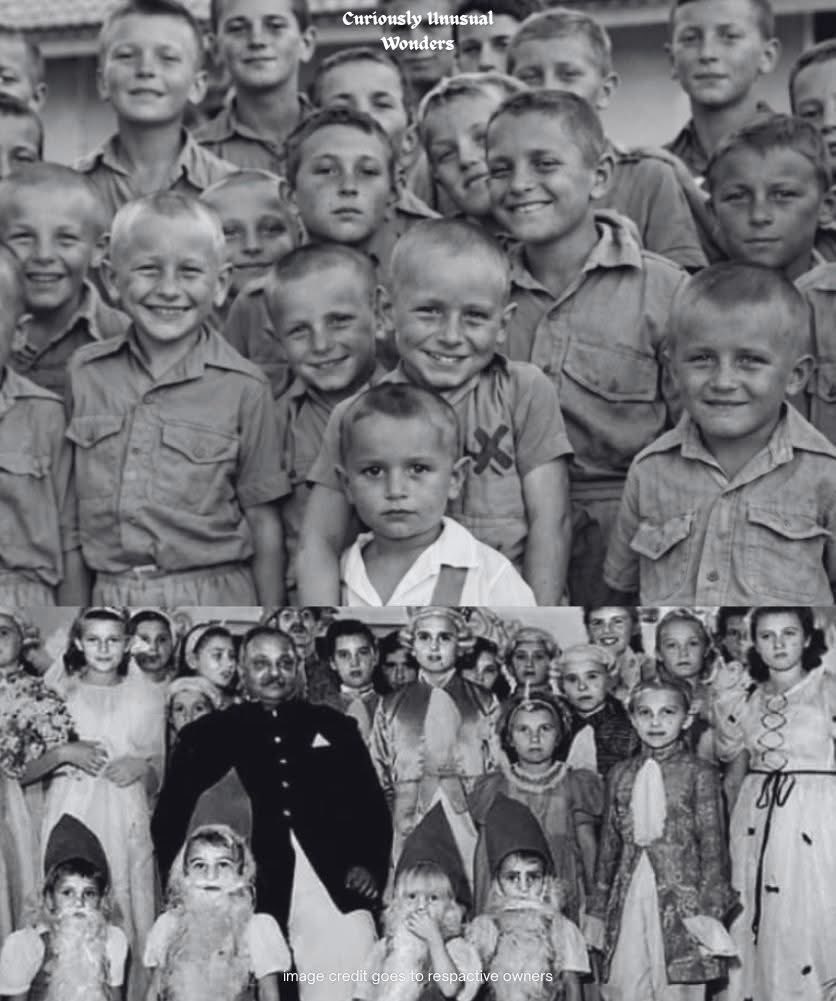
When 740 children were condemned to the sea and the world said no, one man said yes.
The world was on fire in 1942, and 740 exhausted children were trapped on a ship in the middle of the Arabian Sea with nowhere to go. These Polish orphans had already survived the horrors of Soviet labor camps, where they watched their parents perish from hunger and disease.
They had traveled through Iran to reach the coast of India, praying for safety, but every British-controlled port turned them away. One by one, the doors of the world slammed shut, leaving hundreds of hungry, terrified children drifting toward a certain death.
Among them was twelve-year-old Maria. She held her six-year-old brother’s hand tightly, remembering the last promise she made to their dying mother:
“Keep him safe.”
But as the ship’s food ran low and the medicine disappeared, Maria looked at the horizon and saw only rejection. The British authorities, who ruled India at the time, insisted the children were not their responsibility.
It seemed as though these 740 souls were invisible to a world consumed by war.
However, news of the wandering ship reached the ears of Jam Sahib Digvijay Singhji, the Maharaja of Nawanagar. He ruled a small princely state in Gujarat. He wasn’t a world leader with a massive army, and he certainly wasn’t required to help. In fact, by welcoming the children, he would be directly defying the British Empire, which had already said “no.”
When his advisors told him the tragic story, the Maharaja didn’t ask about the cost or the political risks. He simply asked how many children there were. When they told him “seven hundred and forty,” he made a decision that would echo through history.
He declared that while the British might control the ports, they did not control his conscience.
In August 1942, the ship finally docked at Nawanagar. The children who walked off that gangplank were skeletal, weak, and too traumatized to even cry. They expected to see soldiers or barbed wire. Instead, they saw a man dressed in white waiting for them on the pier.
The Maharaja knelt down so he could look the smallest children in the eye. Through an interpreter, he spoke words that changed their lives forever: “Do not consider yourselves orphans. From this moment on, I am your father, and you are my children.”
He didn’t just give them a place to sleep; he gave them a home. In the village of Balachadi, he built a sanctuary. He didn’t try to force Indian culture on them. Instead, he hired Polish teachers so they wouldn’t forget their language. He made sure they had Polish food and allowed them to practice their religion and sing their traditional songs.
Under the hot Indian sun, these children celebrated Polish Christmas and felt the warmth of a family they thought they had lost forever. For four years, while the rest of the planet was tearing itself apart, the Maharaja funded every doctor’s visit, every meal, and every schoolbook from his own personal fortune.
When the war finally ended and it was time for the “children of the Maharaja” to leave, many wept. They were leaving the only place that had treated them with dignity when the rest of the world looked away.
Those survivors have become doctors, engineers, and grandparents. In Poland, there are squares and schools named after Jam Sahib Digvijay Singhji, and he is remembered as a national hero.
Power is not measured by the lands you conquer, but by the lives you protect. When the world closes its heart, your greatest act of rebellion is to open yours. True immortality is found in the kindness that outlasts the king.
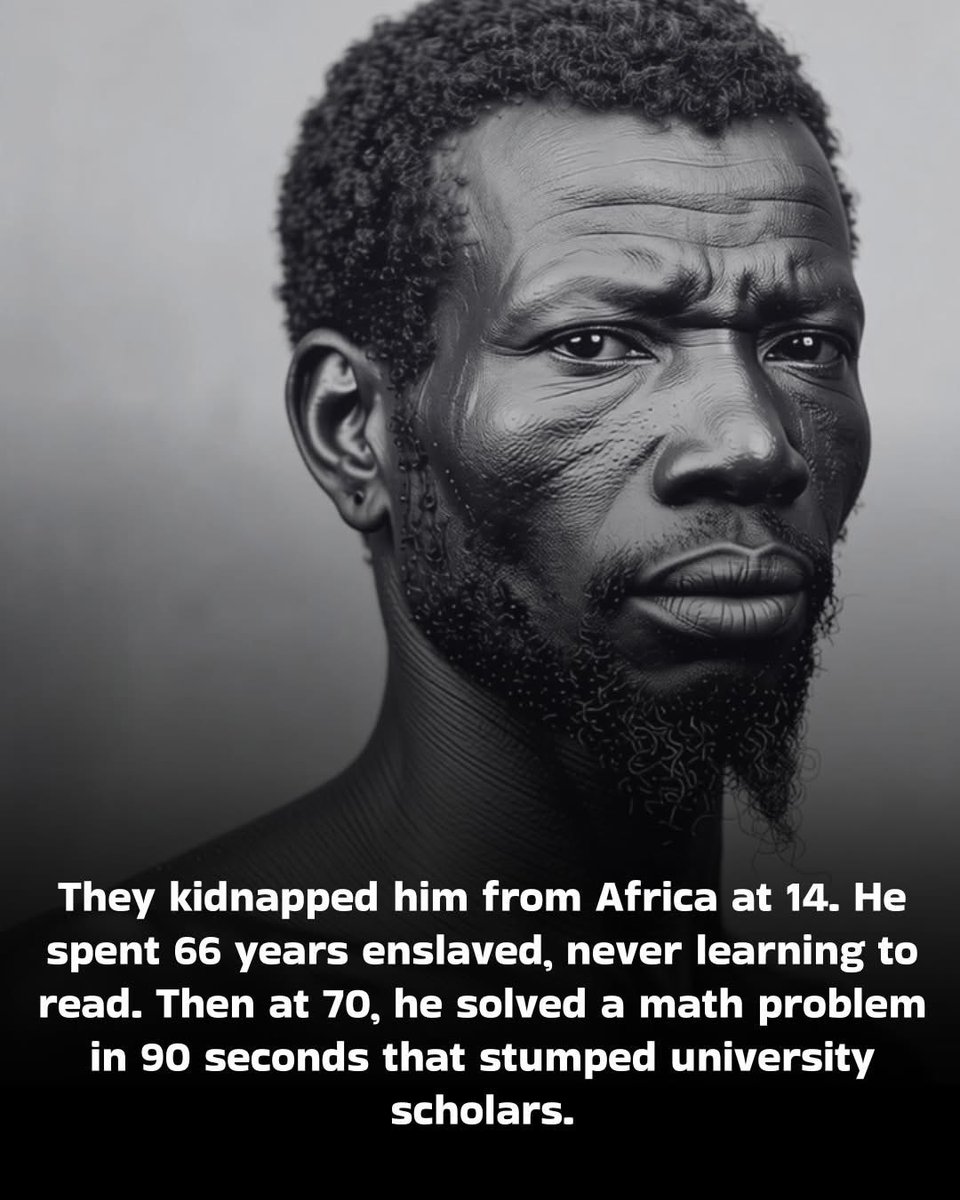
Around 1710, somewhere in West Africa, a boy was born who would become one of the most brilliant mathematicians of his era.
The world would never know his birth name. History would never record his family, his village, or the language he spoke as a child. At fourteen years old, slave traders kidnapped him, chained him in the hull of a ship, and transported him across the Atlantic Ocean to Virginia.
His name became Thomas Fuller. For the next 66 years, he lived enslaved on a Virginia plantation, forced into backbreaking agricultural labor from sunrise to sunset, six days a week.
He never learned to read or write. He never set foot inside a classroom. He was denied every form of formal education in colonial America.
But Thomas Fuller had a gift that couldn’t be stolen by chains, beaten out of him by overseers, or destroyed by slavery.
His mind was extraordinary.
By age 70, rumors of his abilities had spread beyond the plantation to Pennsylvania: an enslaved man who could solve in his head, in under two minutes, calculations that took educated men with paper and quill fifteen minutes or more.
In 1780, two educated men from Pennsylvania—William Hartshorne and Samuel Coates—traveled to Virginia to test him. Skeptical that any enslaved person who couldn’t read or write could possess such abilities, they asked Thomas three questions, as witnessed and documented by Dr. Benjamin Rush.
Question one: “How many seconds are in a year and a half?”
Thomas answered in two minutes: “47,304,000.” They checked and confirmed he was exactly right.
Question two: “How many seconds has a man lived who is 70 years, 17 days, and 12 hours old?”
Thomas answered in 90 seconds: “2,210,500,800.” One gentleman said he was wrong. Thomas replied calmly, “Stop, massa. You forget the leap year.” They recalculated and confirmed he was perfect.
Question three: “If a farmer has 6 sows, and each has 6 female pigs in the first year, and all of them increase at the same rate for 8 years—how many sows will there be in total?”
Thomas answered after about ten minutes: “34,588,806.” They confirmed it was perfect.
The men were astounded. One remarked it was tragic Thomas had never received formal education and imagined what he could have accomplished if taught properly. Thomas replied: “No, massa. It is best I had no learning, for many learned men be great fools.”
Thomas Fuller died in 1790 at age eighty, still enslaved. His story lived on. Dr. Benjamin Rush and other abolitionists used it as evidence against claims of African intellectual inferiority. Here was living proof that brilliance cannot be enslaved.
Thomas Fuller—born approximately 1710 in West Africa, died 1790 in Virginia, known as “The Virginia Calculator”—stands as testament to the countless brilliant minds slavery tried to erase.
Robert Mueller died last night.
He was 81 years old. He had a wife who loved him for sixty years. He had two daughters, one of whom he met for the first time in Hawaii, in 1969, on a few hours of military leave, before he got back on the plane and returned to Vietnam. He had grandchildren. He had a faith he practiced quietly, without performance. He had, in the way of men who have seen real things and survived them, a quality that is increasingly rare and increasingly mocked in the country he spent his life serving.
He had integrity.
And tonight the President of the United States said good!
I have been sitting with that word for hours now. Good. One syllable. The thing you say when the coffee is hot or the traffic is moving. The thing a man who has never had to bury anyone, never had to sit in the specific silence of a room where someone is newly absent, reaches for when he wants the world to know he is satisfied. Good. The daughters are crying and the wife is alone in the house and good.
I want to speak directly to the Americans reading this. Not the political Americans. Just the human ones. The ones who have lost a father. The ones who know what it is to be in that first hour, when you keep forgetting and then remembering again, when ordinary objects become unbearable, when the world outside the window seems obscene in its indifference. I want to ask you, simply, to hold that feeling for a moment, and then to understand that the man you elected looked at it and typed a single word.
Good.
This is not a country having a bad day. I need you to understand that. Countries have bad days. Elections go wrong. Leaders disappoint. Institutions bend. But there is a different thing, a rarer and more terrible thing, that happens when the moral center of a place simply gives way. Not dramatically. Not with a single catastrophic event. But quietly, in increments, until one evening a president celebrates the death of an old man whose family is still warm with grief, and enough people find it acceptable that it becomes the weather. Just the weather.
That is what is happening. That is what has happened.
The world knows. From Tokyo to Oslo, from London to Buenos Aires, people are not angry at America tonight. Anger would mean there was still something to fight for, some remaining faith to be betrayed. What I see, in the reactions from everywhere that is not here, is something older and sadder than anger. It is the look people get when they have waited a long time for someone they love to find their way back, and have finally understood that they are not coming.
America is being grieved. Past tense, almost. The idea of it. The thing it represented to people who had nothing else to believe in, who came here with everything they owned in a single bag because they had heard, somehow, across an ocean, that this was the place where decency was written into the walls. That idea is not resting. It is not suspended. It is being buried, in real time, with 7,450 likes before dinner.
And the church said nothing.
Seventy million people have decided that this man, this specific man who has cheated everyone he has ever made a promise to, who has mocked the disabled and the dead and the grieving, who celebrated tonight while a family wept, is an instrument of God. The pastors who made that bargain did not just trade away their credibility. They traded away the thing that made them worth listening to in the first place. The cross they carry now is a costume. The faith they preach is a loyalty oath with scripture attached. When the history of American Christianity is written, this will be the chapter they skip at seminary.
Now I want to talk about the men who stand next to him.
Because this is the part that actually breaks my heart.
JD Vance is not a bad man. I have to say that, because it is true, and because the truth matters even now, especially now. Marco Rubio is not a bad man. Lindsey Graham is not a bad man. They are idiots, but not bad, as in BAD! These are men with mothers who raised them and children who love them and friends who remember who they were before all of this. They are not monsters. Monsters are simple. Monsters do not cost you anything emotionally because there is nothing in them to mourn.
These men are something more painful than monsters.
They are men who knew better, and know better still, and will get up tomorrow and do it again.
Every small compromise they made had a reason. Every moment they looked the other way had a justification that sounded, at the time, almost reasonable. And now they have arrived here, at a place where a president celebrates the death of an old man and they will find a way, on television, to say nothing that means anything, and they will go home to houses where children who carry their name are waiting, and they will say goodnight, and they will say nothing.
Their oldest friends are watching. The ones who knew Rubio when he still believed in something. Who knew Graham when he said, out loud, on the record, that this exact man would destroy the Republican Party and deserve it. Who sat next to Vance and thought here is someone worth knowing. Those friends are not angry tonight. They moved through anger a long time ago. What they feel now is the quiet, irrecoverable sadness of watching someone disappear while still being present. Of watching a person they loved choose, again and again, to become less.
That is what cowardice costs. Not the coward. The people who loved him.
And in the comments tonight, the followers celebrate. People who ten years ago brought casseroles to grieving neighbours. Who stood in the rain at gravesides and meant the words they said. Who told their children that we do not speak ill of the dead because the dead were someone's beloved. Those people are tonight typing gleeful things about a man whose daughters are not yet done crying. And they feel clean doing it. Righteous. Because somewhere along the way the thing they were given in exchange for their decency was the feeling of belonging to something, and that feeling is very hard to give up even when you can no longer remember what you gave for it.
When Trump is gone, they will still be here.
Standing in the silence where the noise used to be. Without the permission the crowd gave them. Without the pastor who told them their cruelty was holy. They will be alone with what they said and what they cheered and what they chose to become, and there will be no one left to tell them it was righteous.
That morning is coming.
Robert Mueller flew across the Pacific on military leave to hold his newborn daughter for a few hours before returning to the war. He came home. He buried his dead with honour. He served presidents of both parties because he understood that the institution was larger than any one man. He told his grandchildren that a lie is the worst thing a person can do, that a reputation once lost cannot be recovered, and he lived that, every day, in the quiet and unglamorous way of people who actually believe what they say.
He was the kind of American the world used to point to when it needed to believe the story was true.
He died last night. His wife is alone in their house in Georgetown. His daughters are learning what the world is without him in it. And somewhere in the particular hush that falls over a family in the first hours of loss, the most powerful man and the biggest loser on earth sent a message to say he was glad.
The world that loved what America was supposed to be is grieving tonight. Not for Robert Mueller only. For the country that produced him and then became this. For the distance between what was promised and what was delivered. For the suspicion, growing quieter and more certain with each passing month, that the America people believed in was always partly a story, and the story is over now, and there is nothing yet to replace it.
That is all it needed to be.
A man died. His family is broken open with grief.
That is all it needed to be.
Instead the President said good.
And the country that once stood for something looked away 🇺🇸
Gandalv / @Microinteracti1
Japanese actor Hiroyuki Sanada spoke about the contradictions of human nature:
“Some people dream of having a swimming pool at home, while those who have one hardly ever use it. Those who have lost a loved one feel a profound sense of loss, while others often complain about their living relatives. Those without a partner long for one, while those who have one often don't appreciate it. The hungry would give anything for a meal, while the satiated complain about the taste of their food. Those without a car dream of owning one, while those who have a car are always looking for a better one.”
The key to happiness is gratitude: truly seeing and appreciating what we already have, and understanding that somewhere, someone would give anything for what we take for granted.