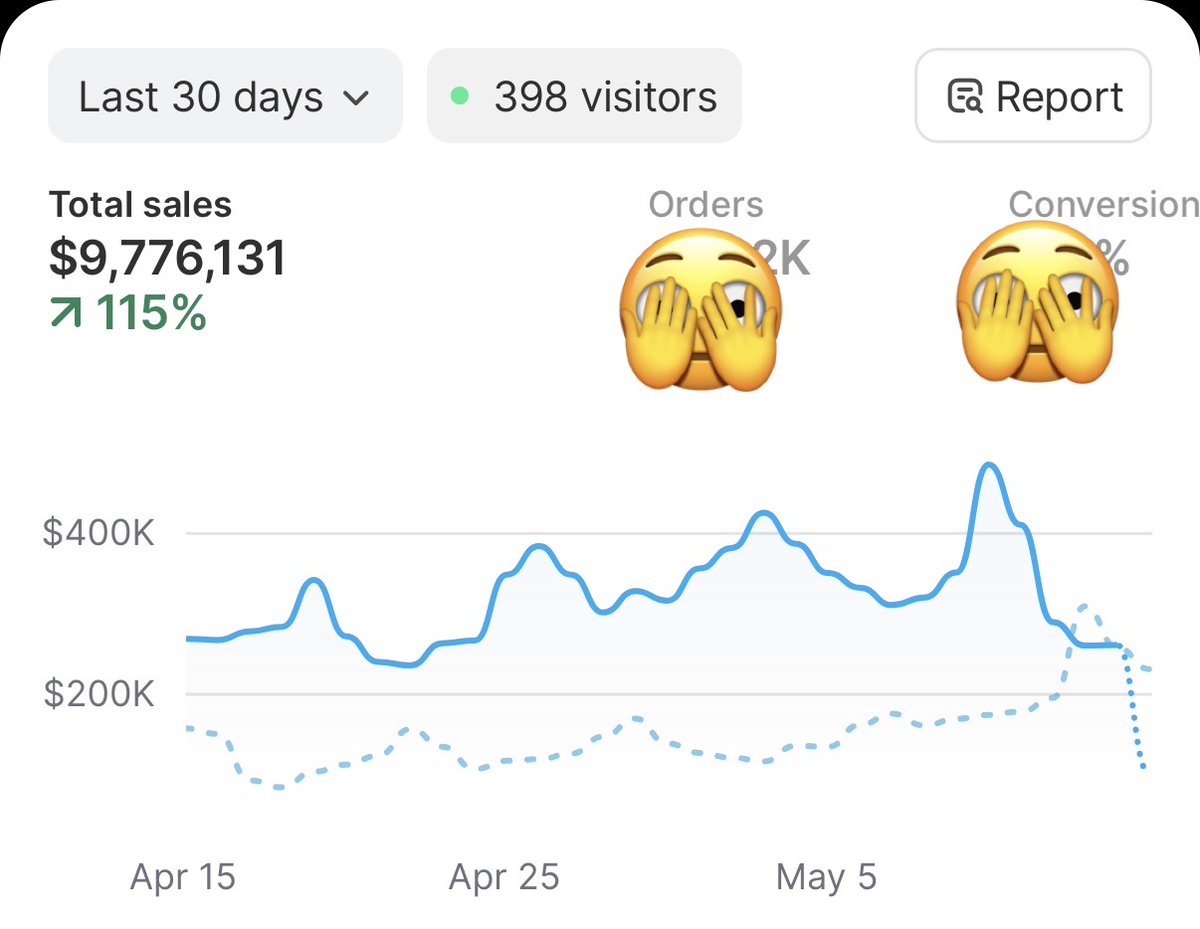
Don't know why I slept on connecting claude code to our shopify theme via github for so long. It feels magical.
You can just talk to it while you scroll through your site for however many minutes about fixing, changing or updating things. Scroll through everything on mobile and talk through what you'd want to improve as if you were a user.
Then it does them and it's very easy to deploy.
I'm wishing we didn't use Replo for landers b/c you can't edit things through claude on it. Really annoying
It's also been really great at auditing and optimizing the code base, removing old scripts, dead css, old sections, speed optimizations...
Helps go through your apps and see what you can build yourself. We had a clunky automatic add to cart app that was basically just a bunch of discount rules for auto-adding products to cart and claude is building it for us natively.
Haven't even gotten to the net-new building of landers, offers, etc yet where i think the real $$ for us is gonna be.
If you can find a really good ecom designer then you can do some serious damage and pretty much overnight too since you won't need to wait 7-14 business days for a shopify dev shop to work on things.
Also worth saying im an idiot on anything technical and i was able to figure out how it all works in less than an hour, so you can too.
One of the easiest ways to make your copy more believable is simply to stop writing in vague superlatives/generalities and instead use specific numbers/points.
Pretty much every brand makes the same general claims in their ads and landing page copy..."Thousands of happy customers," "Results fast," "Save big," "Trusted by the best," etc..
These claims basically do nothing when it comes to persuading your target customer to buy (honestly it actually can hurt your brand by seeming like a lie).
Now compare that to "215 people bought this last Tuesday" or "most people notice a difference by day 9" or "it knocked $340 off my electric bill the first month." The specific version isn't just more interesting, it's more believable and the reason is kind of counterintuitive.
This phenomena is a cognitive bias called Precision Bias, where the human brain confuses precision with accuracy.
The solution for your copy is pretty simple. Just go through everything you wrote and look for every vague claim and ask what's the real number behind this:
❌ Vague: helps you sleep better.
✅ Specific: most people are out within 20 minutes instead of lying there for an hour.
❌ Vague: loved by thousands.
✅ Specific: 4,300 five star reviews and we left the bad ones up.
❌ Vague: saves you time.
✅ Specific: turns a 2 hour job into about 15 minutes.
If you can't confidently make any specific claims then that is a bigger problem you need to address and no amount of marketing can save you.
This is how I structure my whitelisting campaign
→ 1 CBO
→ 1 ad set per whitelisted creator
Each ad set has around 5-10 ads, all set as partnership ads (both the creator name and brand showing at the top) - dynamic
Min spend limit of $100 on each ad set.
The min spend limits make sure every creator gets some spend. But because it's a CBO, Meta can still pick a favorite and push budget toward whoever's performing.
This lets me both trust the algo and keep control at the same time
→ Min spend forces distribution so no creator gets ignored
→ The CBO lets Meta lean into the winners
Best of both worlds. Control where it matters, but still enough room for the algo to do its thing
If you care more about your marketing team creating on brand assets over making you money you’re an idiot.
I can’t tell you how many SMBs we speak with who are perfectionists when it comes to their creative, landers, etc.
Then they wonder why their ads aren’t performing.
Maybe it’s because you only tested 3 new ads this month and all 3 looked perfectly on brand, but are missing everything a great DR ad needs.
Take your top best performing ads.
Launch a sales campaign, but instead of optimizing for purchases, optimize for daily unique reach.
Launch that campaign at like 5% of total spend.
To me this has been the biggest contributor overall to pushing net new reach on Meta.
The key here is the audience and placements seeing the content. Advantage+ needs to be off. Customize the placements. Exclude all engagers and buyers.
I've found launching with interests actually seems to push things higher. Use your cohorts to understand the demo and just send that signal.
I usually am a broad maxi, but for these I want a bit more control. I've found if you do give the reigns to Meta it generally does the opposite of what I wanted.
native-style ads are a CHEATCODE for scaling google ads
we're scaling these to $20k–$50k/week in spend on demand gen.
all cold traffic.
i made a guide breaking down how we pull it off.
like + reply "native" and i'll send it to you
(follow so i can DM)
Stop scaling Meta ads on hook rate and hold rate.
They barely correlate with anything that matters
Hook rate vs ROAS came back near zero.
Hold rate vs ROAS, near zero.
Both leaned slightly negative against CPA.
The metric every creative review obsesses over has almost no relationship to whether the account makes money.
The one creative signal that tracked efficiency at all was outbound CTR.
Getting someone to click out of the ad lined up with cheaper acquisition, around -0.17 against CPA.
But even that's a light correl.
The honest way to measure if a metric drives results is incrementality. A Pearson coefficient is a proxy, and a rough one.
But if a metric can't even show a correlation with your goal, be careful before you treat it as truth.
Proxy metrics sit several steps removed from the result. Most barely move with the outcome you care about.
Even when incrementality surfaces a real lift, the effect is usually small.
So here is where I always land:
Watch spend and revenue.
Analyze through the lens of audience cost and frequency.
Everything else is a proxy for those.
The further a metric sits from spend and revenue, the more noise you're quietly optimizing against.
Most of what fills a creative dashboard is a story you tell yourself on the way to the only numbers that pay you.
Less metrics is more
Today is my 45th birthday.
Here's 45 lessons & principles I've collected along the way:
01 - Pessimists sound smart, optimists get rich.
02 - Today is the youngest you'll ever be.
03 - Your happiness depends on the quality of your thoughts.
04 - Don't eat with people you wouldn't starve with.
05 - Trustworthiness beats attractiveness.
06 - Trust is earned in drops and lost in buckets.
07 - If you keep score with your partner, you've already lost.
08 - Spend your time becoming a great person and the right people show up.
09 - Everything we say at funerals should be spoken at birthday parties instead.
10 - Look down for gratitude, around for support, and up for inspiration.
11 - Make a fool of yourself more often. Embarrassment is the cheapest tuition there is.
12 - You are the only person on earth who can use your gifts, so stop waiting for permission.
13 - Everyone is jealous of what you've got, but nobody is jealous of how you got it.
14 - Never compare yourself to someone else's highlight reel.
15 - Live your life like everything is working out.
16 - The price of inaction is almost always higher than the price of being wrong.
17 - Accountability is the currency of autonomy.
18 - Good luck competing against someone who cares and is having fun.
19 - If you stand for everything, you stand for nothing.
20 - Strong position, loosely held.
21 - I'm either winning or I'm learning.
22 - Volatility is good for velocity.
23 - Movements don't start with stopping.
24 - Do the unscalable; that's where real leverage hides.
25 - Most people need to hear something seven times before it sinks in, so repeat yourself shamelessly.
26 - Incentives drive behavior, not the other way around.
27 - Perception is reality, whether you like it or not.
28 - Stories move people; spreadsheets don't.
29 - Marketing takes a day to learn and a lifetime to master.
30 - Don't rush to get big.
31 - Starting something to exit it is weird.
32 - People don't quit companies, they quit leaders.
33 - You're building a team, not a family.
34 - If you wouldn't work with them for a lifetime, don't work with them for five minutes.
35 - Great communicators take ownership of the other person's comprehension.
36 - Scale your thinking through writing.
37 - Every hour of your life is not worth the same. A few are probably worth 100x more than all the others combined.
38 - Givers have to set limits because takers never will.
39 - Be the biggest fan of the people you love, out loud, while they can hear it.
40 - Lift heavy. Walk daily. Cook your own food. Your body is the only one you get.
41 - Money buys options, not character.
42 - Your kids are watching how you handle the hard days, not the easy ones.
43 - Family is the only compounding asset that matters.
44 - Success is daily impatience combined with decades of patience.
45 - Your ducks are probably not in a row. You likely don’t even know where they all are. And one of them is probably a pigeon. Welcome to life.
@orenmeetsworld i scrapped approvals about six months ago.
best thing ever.
main person who did that makes 170k a year now she does real work.
every ad is approved.
we run them, if an ad is problematic with “brand” or anything else i turn it off.
The top 1.4% of ad accounts are responsible for 36% of all ad creative on Meta.
We used Clay to scrape 150,000 ecommerce sites to answer one question:
🤔 How many businesses are running ads right now?
47,152 of those 150k stores had one active ad. Now this is where it gets crazy:
→ 9,090 accounts are running 100+ active ads (19.3% of advertisers)
→ 1,641 accounts are running 500+ active ads (3.5%)
→ 679 accounts are running 1,000+ active ads (1.4%)
The median advertiser is running 23 different ads at any time.
The median @northbeam customer is running 150. 🛰️
Meta said it: creative diversification is key. Not just hooks, but completely new ad creative.
Hormozi is on to something.
Your marketing team should look like a content creation house!
The role of a creative strategist has changed massively in the last few years.
Before:
A CS could mostly survive by being “the ideas person.”
Now:
The best CS people operate more like performance directors.
Because modern ads are no longer just:
“Write script → shoot → launch.”
Now the strategist needs to understand:
1. Psychology
Not just “pain points.”
But:
What belief is stopping the purchase?
What emotion stops the scroll?
What insecurity creates urgency?
What identity does the customer want?
What awareness level are they at?
Good strategists understand:
People buy explanations before products.
2. Editing
You don’t need to be an editor.
But you need editing literacy.
Because pacing changes performance.
The strategist should understand:
>Pattern interrupts
>Retention dips
>Shot sequencing
>Text pacing
>Visual reinforcement
>Cognitive overload
>Audio energy shifts
A script can be “good on paper” and still die because of pacing.
3. Media buying
Not to launch campaigns.
But to interpret feedback loops.
A CS should know:
What low CTR usually means
Why high hook + low CVR happens
Why broad audiences react differently
Why frequency changes fatigue
How awareness fit impacts metrics
How placements affect performance
Without this…
The strategist becomes disconnected from reality.
4. Copywriting
>Still foundational.
>Hooks.
>Onramps.
>Information prioritization.
>Belief shifting.
>Desire building.
>Objection handling.
AI can generate words.
But it still struggles with:
“What should be said first?”
That’s strategy.
5. Creators
This became massively underrated.
Some creators:
>naturally build trust
>know how to sound believable
>understand pacing intuitively
>know how to create emotional familiarity
Others kill performance even with great scripts.
Modern CS work is partly:
>matching the right message with the right human delivery.
The best strategists today are:
>part psychologist
>part performance marketer
>part director
>part researcher
>part storyteller
>part systems thinker.
That’s why the role is becoming MORE valuable with AI, not less.
We spend millions of dollars every month on Facebook ads, and a lot of people ask about our testing strategy.
Here’s exactly how we do it.
We test all new creatives in ABO using Highest Volume.
Why? Because every creative gets a fair chance to spend and prove itself.
Our rule: 1 ad set = 1 concept (3 to 5 ads)
Once we identify winners, we scale them in two CBOs:
- Highest Volume CBO
- CPA Target CBO
Both campaigns are given the same budget, a solid five figures per day in spend.
Some days, the CPA Target campaign spends the full budget. Some days, it doesn’t.
Of course, the Highest Volume CBO always spends its full budget.
This setup gives us the best of both worlds:
- Consistent spend and scale
- Controlled efficiency
- Maximum delivery when the algorithm sees the opportunity (mostly on weekends for us)
Simple structure. Easy to manage. Extremely effective at scale 🚀